Women in construction statistics tell two stories at once. The industry has more women than at any point since 2004, and the crews that install and service buildings still have very few. Women are 47.1% of all employed people in the United States (U.S. Bureau of Labor Statistics, Jan 2026), so the gap is not about who is available to work.
This page collects the numbers that matter for a shop owner, a recruiter or a reporter. It covers how many women work in construction, which jobs they hold, how few work in HVAC and the other trades, how many are apprentices, how pay compares, who owns firms, why women leave, and how the United States compares with Canada and the United Kingdom.
Every figure comes from the agency or research group that produced it, with the date of the data. Where two sources measure the same thing differently, the text says so. The page is checked and updated every month.
For technician pay and training see HVAC technician statistics. For the hiring gap see skilled trade shortage statistics and construction labor shortage statistics.
Key Takeaways
- Women were 11.3% of the 12.1 million people employed in construction in 2025 (U.S. Bureau of Labor Statistics, Jan 2026).
- The number of women employed in construction grew by about 31,000 in 2025, to around 1.37 million, the highest share in 20 years (NAHB, Sep 2026).
- Women were 78% of office and administrative support workers inside construction firms (NAHB, Sep 2026).
- Women were only 4.3% of workers in construction and extraction occupations in 2025 (U.S. Bureau of Labor Statistics, Jan 2026).
- Women were 2.7% of heating, air conditioning and refrigeration mechanics and installers in 2025 (U.S. Bureau of Labor Statistics, Jan 2026), up from 1.5% in 2020 (U.S. Bureau of Labor Statistics, Jan 2021).
- Women were 5.4% of construction apprentices in the 37 states with comparable data in 2024 (IWPR, Aug 2025).
- In Washington State, women were 7.7% of construction apprentices and 33.9% of apprentices in other fields (Washington State Women’s Commission, Sep 2026).
- Women full-time in construction and extraction occupations earned a median of $977 a week in 2025, against $1,105 for men (U.S. Bureau of Labor Statistics, Jan 2026).
- The pay gap is widest in the occupation group that includes construction, where women earn 74.1% of what men earn (U.S. Census Bureau, Mar 2026).
- Women were 8.8% of construction employer firm owners in 2023, while they owned 22.9% of employer firms in all industries (CPWR, Jun 2026; U.S. Census Bureau, Nov 2025).
- 44.4% of tradeswomen surveyed had seriously considered leaving the industry (IWPR, Nov 2021).
- 23.6% of tradeswomen surveyed said they always or frequently face sexual harassment (IWPR, Nov 2021).
- In Canada, women were 2.6% of refrigeration and air conditioning apprentices in 2024, up from 0.7% in 1996 (Statistics Canada, Dec 2025).
How many women work in construction?
The headcount is the highest in the data and the share is still about one in nine. The growth is real, and it began from a low base.
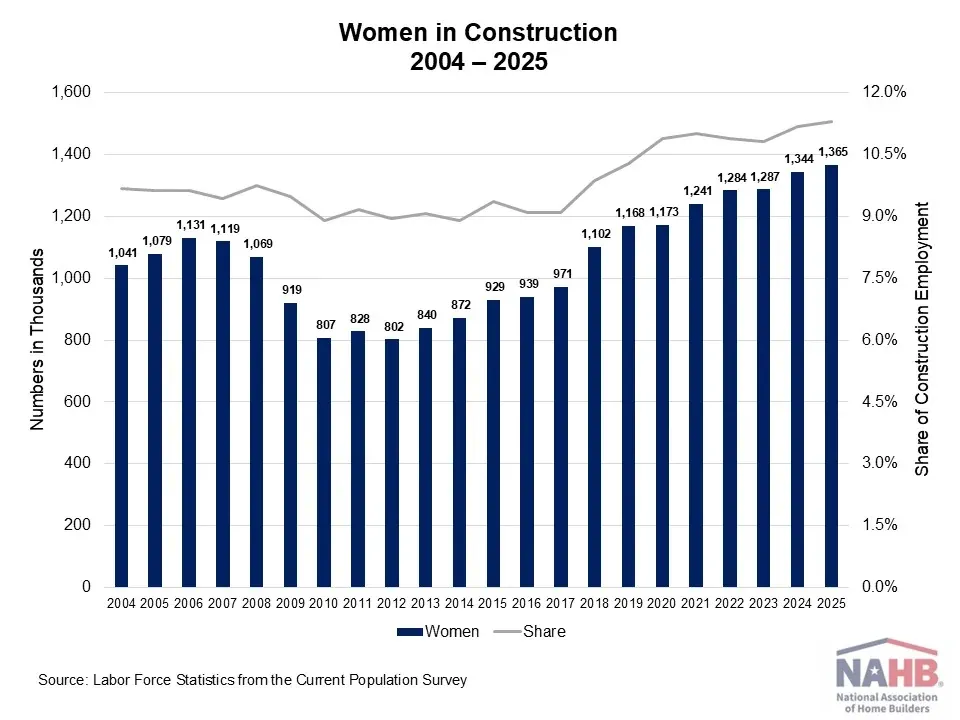 Figure 1: The number of women employed in construction fell during the housing bust, then climbed every year after 2012 and passed its 2006 peak by 2025. Source: NAHB, Women’s Share of Construction Workforce Reaches 20-Year High in 2025, Sep 2026, using Current Population Survey data. Chart published by the source, captured 20 Oct 2026.
How big is the female construction workforce?
- 1.365 million women were employed in construction in 2025, out of 12.121 million workers (U.S. Bureau of Labor Statistics, Jan 2026).
- The count of women in construction fell from more than 1.1 million in 2007 to roughly 807,000 in 2010 as the housing market collapsed (NAHB, Sep 2026).
- The count passed 1 million again in 2018 and reached 1.24 million in 2021 (NAHB, Sep 2026).
- CPWR’s analysis of the same survey counts 1,372,408 women in construction in 2025, up from 829,412 in 2011 (CPWR, Jul 2026).
- Women were 9.2% of construction workers in 2011 (CPWR, Jul 2026) and averaged 10.1% across 2011 to 2025 (CPWR, Jul 2026).
- Women were 10.9% of the 10.8 million construction workers in 2020 (U.S. Bureau of Labor Statistics, Jan 2021).
- Counting only jobs on employer payrolls, women held 14.4% of construction jobs in June 2025, up from 12.7% in June 2015 (IWPR, Aug 2025).
- The household survey counted 1,347,024 women in the industry in 2024, 45.8% more than the 923,955 in 2015 (IWPR, Aug 2025).
How does construction compare with other industries?
- Women were 29.1% of manufacturing workers in 2025 (U.S. Bureau of Labor Statistics, Jan 2026).
- Women were 21.3% of utilities workers in 2025 (U.S. Bureau of Labor Statistics, Jan 2026).
- Women were 13.7% of mining, quarrying and oil and gas extraction workers in 2025 (U.S. Bureau of Labor Statistics, Jan 2026).
- Women were 10.8% of landscaping services workers in 2025 (U.S. Bureau of Labor Statistics, Jan 2026).
- Women were 45.6% of retail trade workers in 2025 (U.S. Bureau of Labor Statistics, Jan 2026).
- Women were 77.9% of health care and social assistance workers in 2025 (U.S. Bureau of Labor Statistics, Jan 2026).
How old are female construction workers?
- 948,000 of the women in construction were aged 25 to 54 in 2025, and 327,000 were 55 or older (U.S. Bureau of Labor Statistics, Jan 2026).
- Only 74,000 were aged 20 to 24 and 16,000 were aged 16 to 19 (U.S. Bureau of Labor Statistics, Jan 2026).
- 24.1% of women in construction were 55 or older in 2025, against 17.2% of women craftworkers (CPWR, Jul 2026).
- 40.7% of women craftworkers were aged 16 to 34, a younger mix than the 29.4% for all women in construction (CPWR, Jul 2026).
- 65.5% of women in construction had some college, compared with 44.6% of women craftworkers (CPWR, Jul 2026).
- 24.6% of women in construction worked part time in 2025 (CPWR, Jul 2026).
What jobs do women hold in construction?
Most women in construction work in the office, not on the crew. That is useful work, but the field jobs have changed little.
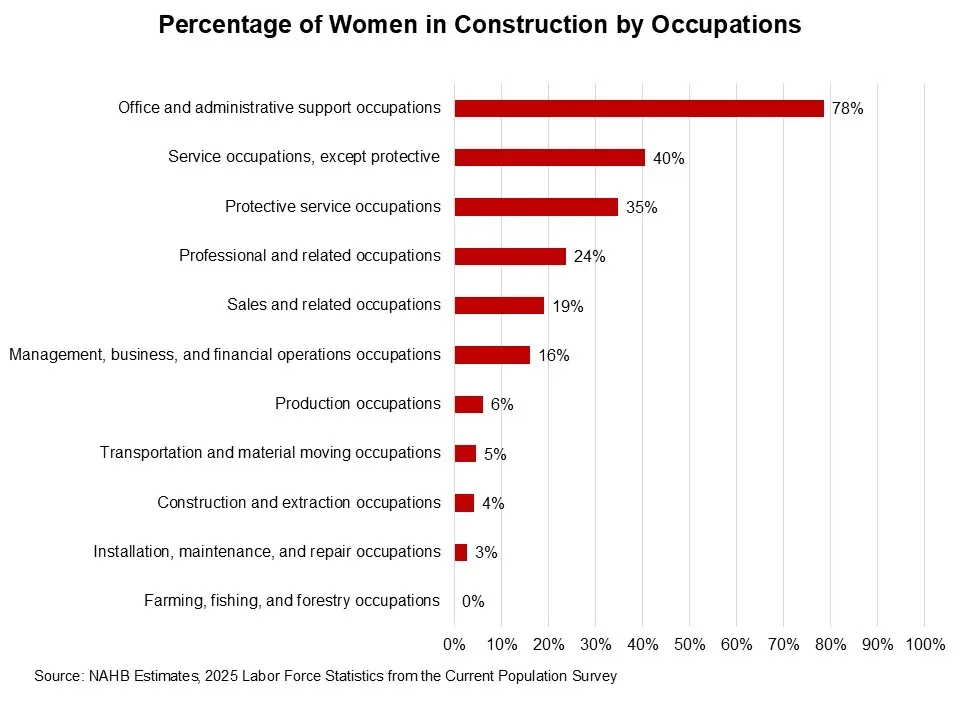 Figure 2: Women hold most office jobs inside construction firms and almost none of the field jobs that build and install. Source: NAHB, Women’s Share of Construction Workforce Reaches 20-Year High in 2025, Sep 2026, using 2025 Current Population Survey data. Chart published by the source, captured 20 Oct 2026.
Where do women work inside construction firms?
- Women were 40% of service occupations (excluding protective services) inside the construction industry in 2025 (NAHB, Sep 2026).
- Women were 35% of protective service occupations inside the industry (NAHB, Sep 2026).
- Women were 24% of professional occupations and 19% of sales occupations (NAHB, Sep 2026).
- Women were 16% of management, business and financial operations occupations (NAHB, Sep 2026).
- Women were 6% of production occupations and 3% of installation, maintenance and repair occupations inside the industry (NAHB, Sep 2026).
How many women manage, estimate and inspect?
- Women were 8.5% of the 1.199 million construction managers in 2025 (U.S. Bureau of Labor Statistics, Jan 2026).
- The share of women among construction managers was 8.4% in 2020 (U.S. Bureau of Labor Statistics, Jan 2021).
- Among full-time, year-round construction managers in 2024, 93,649 were women, or 9.5% (U.S. Census Bureau, Mar 2026).
- IWPR counts 131,355 women construction managers in 2024, a 10.5% share, up from 6.7% in 2015 (IWPR, Aug 2025).
- Women were 16.4% of full-time, year-round cost estimators in 2024 (U.S. Census Bureau, Mar 2026).
- Women were 17.3% of full-time, year-round civil engineers in 2024 (U.S. Census Bureau, Mar 2026).
- Women were 12.6% of the 120,000 construction and building inspectors in 2025 (U.S. Bureau of Labor Statistics, Jan 2026).
How many women lead crews?
- Women were 3.7% of the 788,000 first-line supervisors of construction trades and extraction workers in 2025 (U.S. Bureau of Labor Statistics, Jan 2026).
- IWPR puts women at 6.0% of construction first-line supervisors in 2024, or 47,520 people (IWPR, Aug 2025).
- Women were 6.1% of the 285,000 first-line supervisors of mechanics, installers and repairers in 2025, the group that includes service leads (U.S. Bureau of Labor Statistics, Jan 2026).
- Women were 4.2% of construction foremen in 2025, up from 2.0% in 2011 (CPWR, Jul 2026).
How many women work in HVAC and the other trades?
HVAC sits near the bottom of the large trades, but the share has nearly doubled since 2020. That is movement, though the starting point was very small.
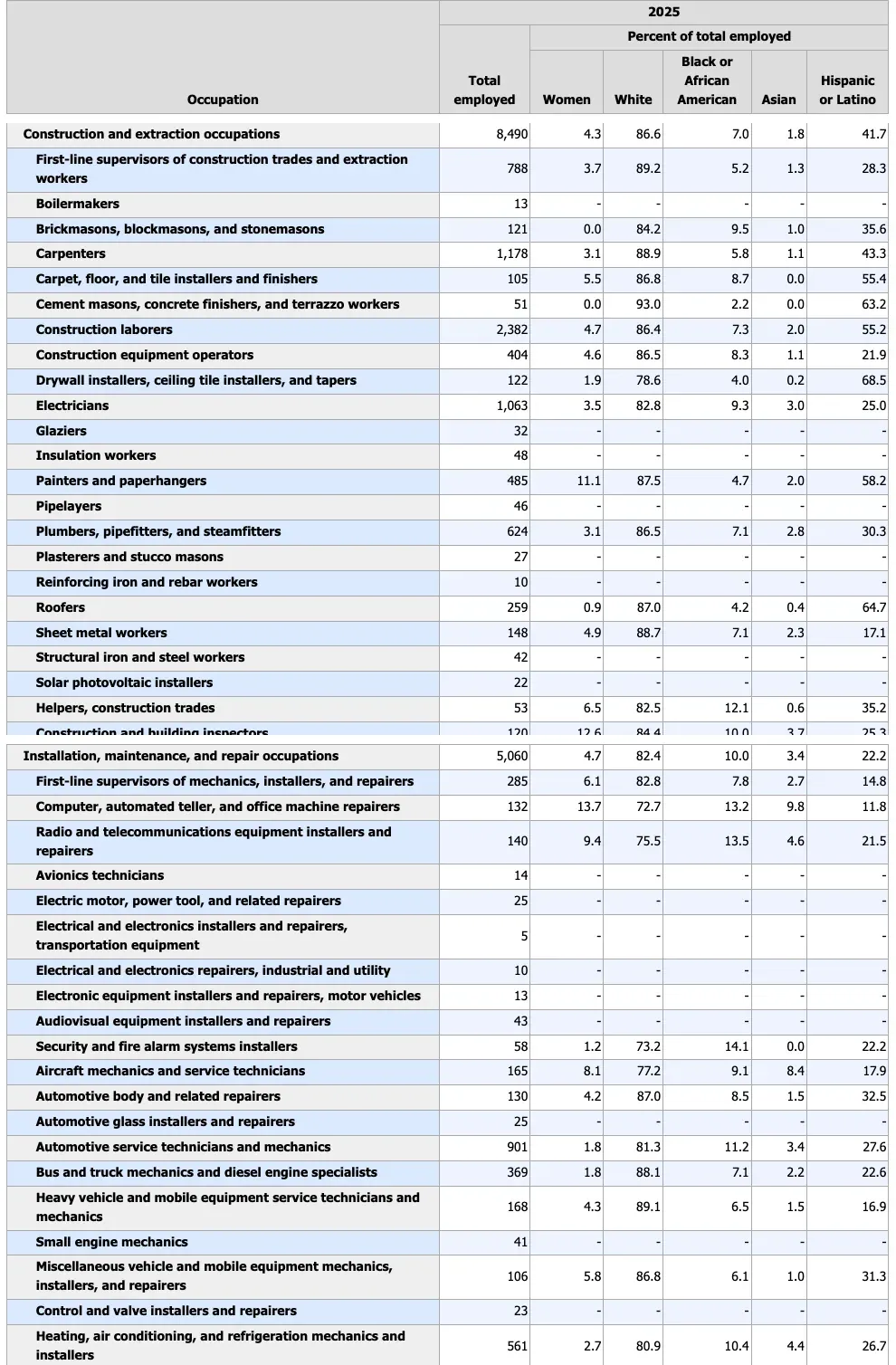 Figure 3: Heating, air conditioning and refrigeration mechanics sit at 2.7% women, close to electricians and carpenters and well above roofers. Source: U.S. Bureau of Labor Statistics, Employed people by detailed occupation, sex, race, and Hispanic or Latino ethnicity, Jan 2026. Screenshot of selected rows of the source table, captured 20 Oct 2026.
How many women work in HVAC?
- Women were 2.3% of the 472,000 HVACR mechanics and installers in 2022 (U.S. Bureau of Labor Statistics, Jan 2023).
- Of 469,000 full-time HVACR wage and salary workers in 2025, only 13,000 were women (U.S. Bureau of Labor Statistics, Jan 2026).
- The Census Bureau counts 7,405 women among 440,629 full-time, year-round HVACR mechanics and installers in 2024, a 1.7% share (U.S. Census Bureau, Mar 2026).
- In Canada, 408 of 15,663 refrigeration and air conditioning apprentices were women in 2024 (Statistics Canada, Dec 2025).
- Women were 1.1% of Canadian refrigeration and air conditioning apprentices in 2014, or 93 people (Statistics Canada, Dec 2025).
- Women were 0.6% of the same group in 2004, or 30 people (Statistics Canada, Dec 2025).
How do other trades compare?
- Women were 3.5% of the 1.063 million electricians in 2025 (U.S. Bureau of Labor Statistics, Jan 2026).
- Women were 3.1% of the 1.178 million carpenters in 2025 (U.S. Bureau of Labor Statistics, Jan 2026).
- Women were 4.7% of the 2.382 million construction laborers in 2025 (U.S. Bureau of Labor Statistics, Jan 2026).
- Women were 11.1% of painters and paperhangers in 2025, the highest share among the large field trades (U.S. Bureau of Labor Statistics, Jan 2026).
- Women were 0.9% of the 259,000 roofers in 2025 (U.S. Bureau of Labor Statistics, Jan 2026).
- Women were 4.9% of sheet metal workers and 1.9% of drywall installers in 2025 (U.S. Bureau of Labor Statistics, Jan 2026).
- Women were 5.2% of the 717,000 general maintenance and repair workers in 2025 (U.S. Bureau of Labor Statistics, Jan 2026).
- Women were 1.1% of plumbers, pipefitters and steamfitters in 2022 (U.S. Bureau of Labor Statistics, Jan 2023).
- Women were 1.8% of full-time, year-round plumbers in 2024, or 9,409 people (U.S. Census Bureau, Mar 2026).
- Women were 2.1% of full-time, year-round electricians in 2024, or 17,732 people (U.S. Census Bureau, Mar 2026).
- 366,360 women worked in construction and extraction occupations in 2024, almost 160,000 more than in 2015 (IWPR, Aug 2025).
- Women were 4.0% of construction and extraction workers in 2020 (U.S. Bureau of Labor Statistics, Jan 2021) and 4.2% in 2022 (U.S. Bureau of Labor Statistics, Jan 2023).
- Women were 4.7% of installation, maintenance and repair occupations in 2025 and 6.0% of the wider natural resources, construction and maintenance group (U.S. Bureau of Labor Statistics, Jan 2026).
- Women were 3.4% of full-time, year-round construction and extraction workers in 2024, or 206,053 people (U.S. Census Bureau, Mar 2026).
- Averaged over 2011 to 2025, women were 7.8% of painters, 3.7% of laborers, 2.4% of carpenters and 2.2% of electricians (CPWR, Jul 2026).
- Women were 4.0% of construction craftworkers in 2025, up from 2.1% in 2011 (CPWR, Jul 2026).
How many women are apprentices in the trades?
The pipeline is wider than the workforce, but it narrows at the construction door. Women are in apprenticeship. They are not in construction apprenticeship.
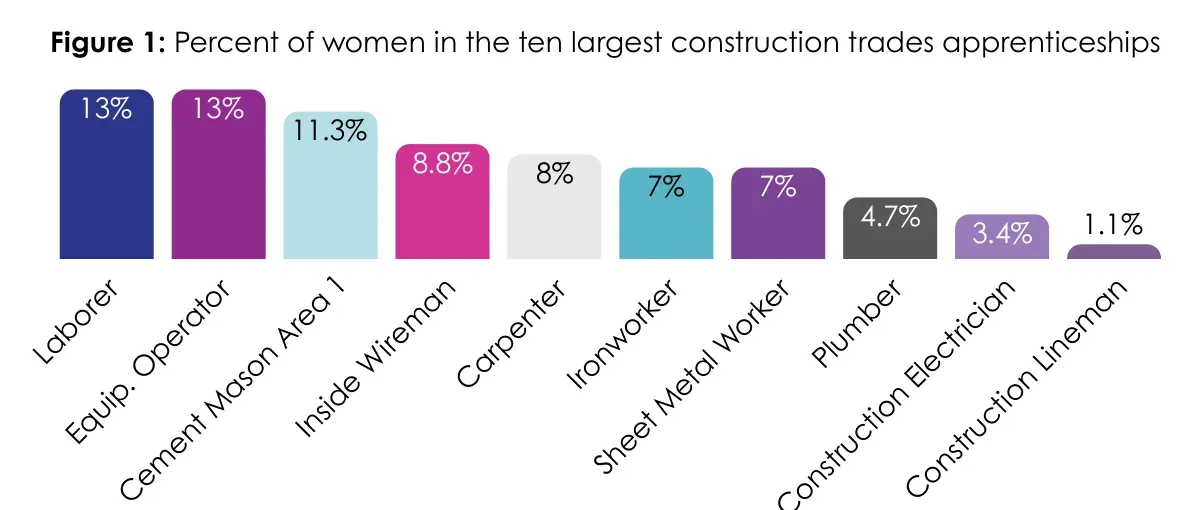 Figure 4: In Washington State, women are a larger share of laborer and equipment operator apprentices than of any other large construction trade, and almost absent from lineman programs. Source: Washington State Women’s Commission, Women in Washington’s Skilled Trades, Sep 2026. Chart published by the source, captured 20 Oct 2026.
What share of construction apprentices are women?
- The number of women in construction apprenticeships grew 185.9%, from 3,789 in 2015 to 10,834 in 2024, in states with data for both years (IWPR, Aug 2025).
- Arizona had the highest share of women among construction apprentices at 10.0%, followed by Alaska at 8.0% (IWPR, Aug 2025).
- Oregon had 823 women construction apprentices, 9.6% of the total, and Washington had 1,044, or 7.8% (IWPR, Aug 2025).
- California had 1,821 women construction apprentices, 3.1% of the total (IWPR, Aug 2025).
- Women were under 3% of construction apprentices in Arkansas, Maryland, Nebraska and South Dakota (IWPR, Aug 2025).
What does Washington State show?
- Women were 14.4% of the 39,998 apprentice records from 2022 to 2025 (Washington State Women’s Commission, Sep 2026).
- Construction trades made up 74.7% of the apprentice records, or 29,878 people (Washington State Women’s Commission, Sep 2026).
- Women were 13.0% of laborer apprentices and 13.0% of construction equipment operator apprentices (Washington State Women’s Commission, Sep 2026).
- Women were 8.8% of inside wireman apprentices and 8.0% of carpenter apprentices (Washington State Women’s Commission, Sep 2026).
- Women were 4.7% of plumber apprentices and 3.4% of construction electrician apprentices (Washington State Women’s Commission, Sep 2026).
- Women were 1.1% of the 888 construction lineman apprentices (Washington State Women’s Commission, Sep 2026).
- Women of color were 35.7% of all women apprentices in the ten largest construction trades (Washington State Women’s Commission, Sep 2026).
- The analysis counted heating, air conditioning and refrigeration mechanics as construction, so HVAC apprentices sit inside the 7.7% figure (Washington State Women’s Commission, Sep 2026).
How big is the pay gap in construction?
The gap is wider in the trades than in most of the economy, and it does not close where women are scarce. Pay data for the smallest trades is so thin that agencies often cannot publish it.
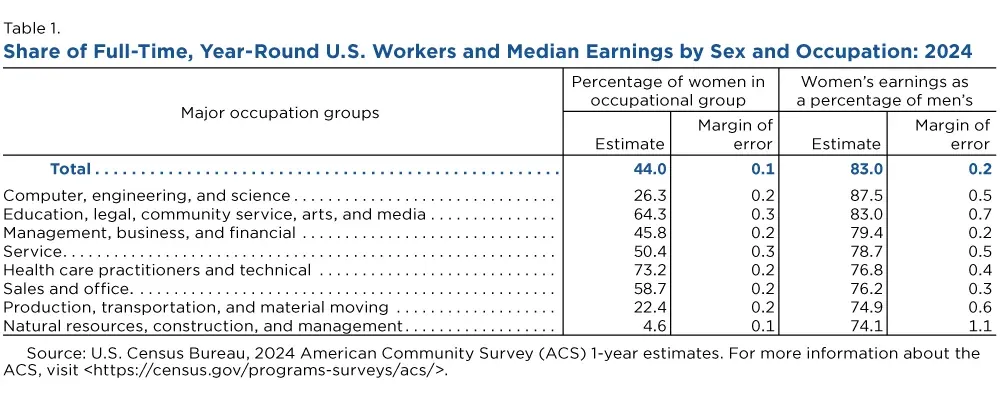 Figure 5: The natural resources, construction and maintenance group has the lowest share of women and the widest pay gap of any major group. Source: U.S. Census Bureau, Equal Pay Day: March 26, 2026, Mar 2026, using 2024 American Community Survey data. Table published by the source, captured 20 Oct 2026.
What do weekly earnings show?
- Across all occupations, women who worked full time earned a median of $1,089 a week in 2025 (U.S. Bureau of Labor Statistics, Jan 2026).
- In the second quarter of 2026, women’s median weekly earnings were $1,131, or 82.0% of the $1,380 median for men (U.S. Bureau of Labor Statistics, Jul 2026).
- Women who work in natural resources, construction and maintenance occupations earned $812 a week in the second quarter of 2026, against $1,120 for men (U.S. Bureau of Labor Statistics, Jul 2026).
- In construction and extraction occupations, women earned $770 a week and men earned $1,132 in the same quarter (U.S. Bureau of Labor Statistics, Jul 2026).
- In installation, maintenance and repair, women earned $1,050 and men earned $1,159 in the same quarter (U.S. Bureau of Labor Statistics, Jul 2026).
- Construction managers who were women earned $1,383 a week in 2025, against $1,893 for men, and 62,000 women held these jobs full time (U.S. Bureau of Labor Statistics, Jan 2026).
- Women construction laborers earned $887 a week in 2025, against $946 for men (U.S. Bureau of Labor Statistics, Jan 2026).
- Only 228,000 women worked full time in construction and extraction occupations in 2025, against 6.136 million men (U.S. Bureau of Labor Statistics, Jan 2026).
What do annual earnings show?
- Women made up 44% of full-time, year-round workers in 2024 and earned 83% of what men earned (U.S. Census Bureau, Mar 2026).
- Women in natural resources, construction and maintenance occupations had median earnings of $41,048, against $55,392 for men (U.S. Census Bureau, Mar 2026).
- In construction and extraction occupations, women earned 81.8% of men’s median, $42,986 against $52,531 (U.S. Census Bureau, Mar 2026).
- In installation, maintenance and repair occupations, women earned 82.7% of men’s median (U.S. Census Bureau, Mar 2026).
- Women carpenters earned 74.1% of what men earned (U.S. Census Bureau, Mar 2026).
- Women electricians earned a median of $51,490, against $62,291 for men, a ratio of 82.7% (U.S. Census Bureau, Mar 2026).
- Women first-line supervisors of construction trades earned 69.9% of what men earned, the lowest ratio published among construction and extraction occupations (U.S. Census Bureau, Mar 2026).
- Women cost estimators earned 76.4% of men’s median (U.S. Census Bureau, Mar 2026).
- Women construction managers earned 86.8% and women construction laborers earned 87.3% of what men earned (U.S. Census Bureau, Mar 2026).
- Women HVACR mechanics had a median of $45,181 against $57,340 for men, but the Census Bureau withheld the ratio because the sample was too small (U.S. Census Bureau, Mar 2026).
- Eight years after certification, Canadian women electricians earned $72,500 on average, against $85,100 for men (Diversity Institute, Jun 2026).
Who owns construction firms?
Women own few construction firms with employees and more firms with none. The rest work for others or for themselves.
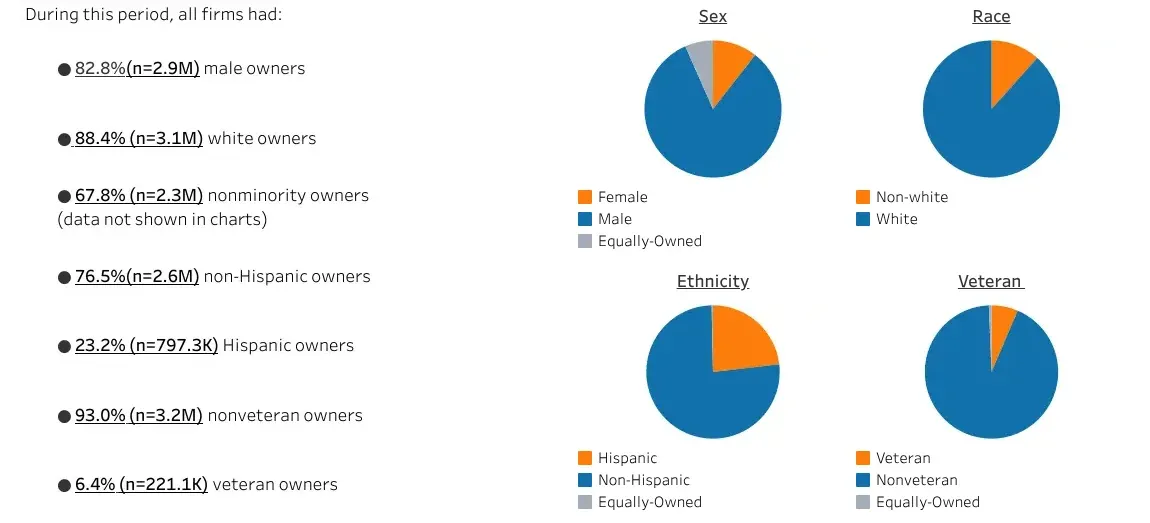 Figure 6: Most construction firm owners are men, and the orange slice of the sex chart shows how small the female share is. Source: CPWR, Demographics of Business Owners, Jun 2026, using Census Bureau data. Screenshot of the source dashboard, captured 20 Oct 2026.
How many construction firms do women own?
- Women were 430,800 of the owners of construction firms in 2023, or 11.9% of all owners (CPWR, Jun 2026).
- That was up from 314,400, or 10.0%, in 2017 (CPWR, Jun 2026).
- Of those firms in 2023, 67,500 had employees and 363,300 did not, so women made up 12.7% of nonemployer construction owners (CPWR, Jun 2026).
- Women were 71,400 of the owners of construction employer firms in 2021, a 9.6% share and the high point of the series (CPWR, Jun 2026).
- Another 10.9% of construction employer firm owners were in firms owned equally by women and men in 2023 (CPWR, Jun 2026).
- Men were 82.8% of all construction firm owners on average from 2017 to 2023 (CPWR, Jun 2026).
- Across all industries, women owned 12.9 million nonemployer businesses in 2023, or 42.3% (U.S. Census Bureau, Nov 2025).
How many female construction workers are self-employed?
A woman who runs her own trade business sets her own prices, writes her own quotes and sends her own invoices.
- 9.1% of women in construction were self-employed in an incorporated business in 2025, and 8.2% were self-employed without incorporating (CPWR, Jul 2026).
- Among women craftworkers, 13.1% were self-employed without incorporating in 2025, down from 23.7% in 2011 (CPWR, Jul 2026).
- Another 7.5% of women craftworkers were self-employed in an incorporated business in 2025 (CPWR, Jul 2026).
- In the United Kingdom, 31,619 women and 736,350 men were self-employed in construction in April to June 2026 (Office for National Statistics, Aug 2026).
Why do women leave the trades?
The most common reason women give for thinking about leaving is how they are treated. Treatment, child care and pregnancy support are all things a shop can change.
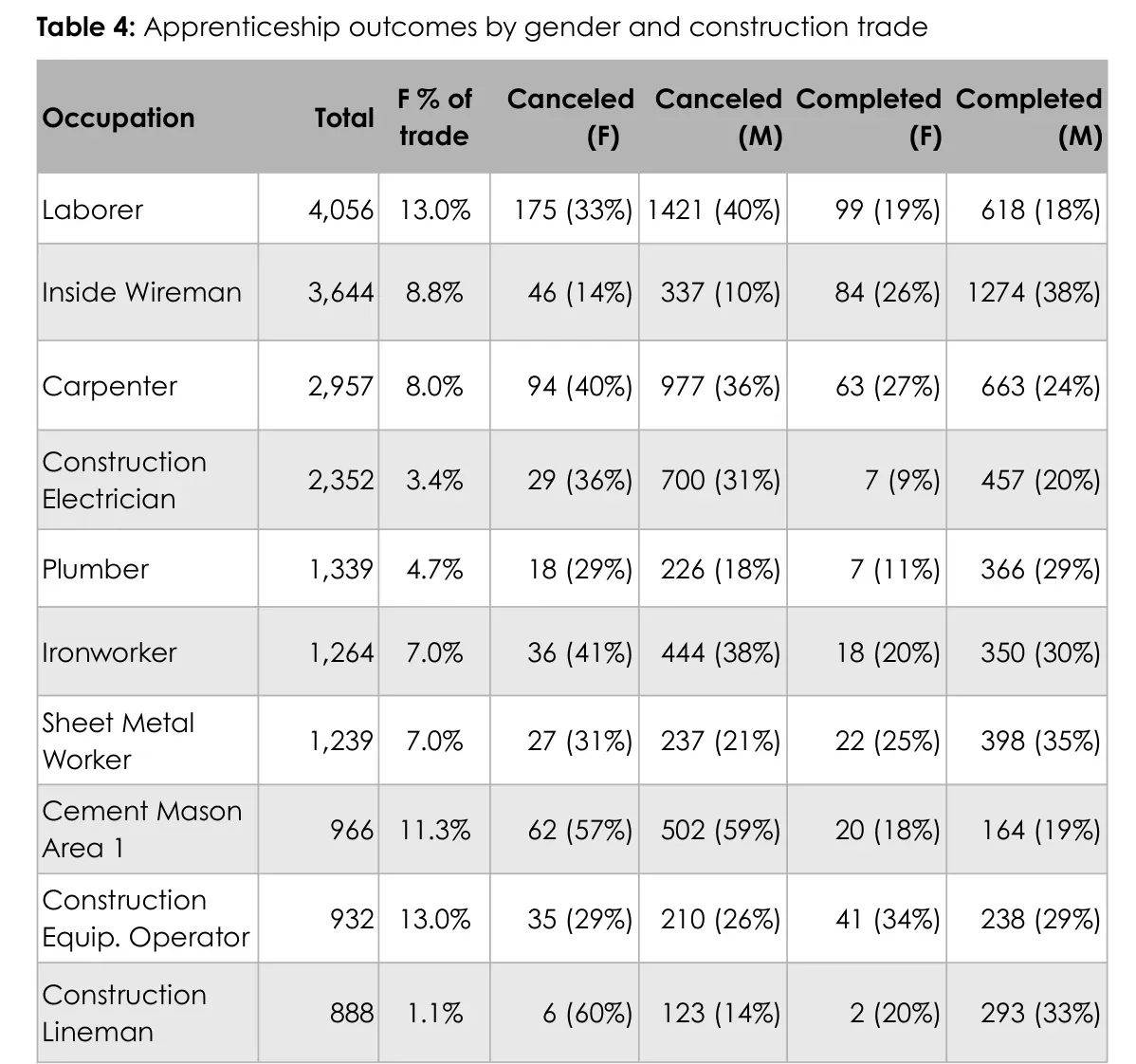 Figure 7: In the trades with the fewest women, women cancel more often and finish less often than men. Source: Washington State Women’s Commission, Women in Washington’s Skilled Trades, Sep 2026. Table published by the source, captured 20 Oct 2026.
What do tradeswomen say about leaving?
- IWPR’s survey drew 2,635 tradeswomen, including 598 apprentices, between December 2020 and March 2021 (IWPR, Nov 2021).
- 47.2% of those who had thought about leaving named harassment and lack of respect as the most common reason (IWPR, Nov 2021).
- 47.7% said they were held to a different standard than their male co-workers (IWPR, Nov 2021).
- 21.0% of women of color said they are always or frequently racially harassed (IWPR, Nov 2021).
- 19.0% of LGBTQ respondents said they always or frequently face harassment based on sexual orientation (IWPR, Nov 2021).
- 69.3% of parents who had considered leaving cited trouble finding child care (IWPR, Nov 2021).
- 63.4% of those parents rated the lack of pregnancy accommodations as an important reason (IWPR, Nov 2021).
- 21.6% of women apprentices said they are rarely or never treated equally with men on work assignments (IWPR, Nov 2021).
- 19.4% of women apprentices reported unequal treatment in on-the-job training (IWPR, Nov 2021).
Do outcomes differ where few women work?
- Washington lineman apprentices who were women canceled at 60%, against 14% for men (Washington State Women’s Commission, Sep 2026).
- Only 20% of women lineman apprentices completed, against 33% of men (Washington State Women’s Commission, Sep 2026).
- Women construction electrician apprentices completed at 9%, against 20% of men (Washington State Women’s Commission, Sep 2026).
- Women plumber apprentices canceled at 29% and completed at 11%, against 18% and 29% for men (Washington State Women’s Commission, Sep 2026).
- Women laborer apprentices canceled less often than men, 33% against 40% (Washington State Women’s Commission, Sep 2026).
- Women equipment operator apprentices completed at 34%, against 29% of men (Washington State Women’s Commission, Sep 2026).
- 56% of respondents to the state’s apprenticeship retention survey named workplace and industry culture as a factor in finishing (Washington State Women’s Commission, Sep 2026).
How common is harassment in male-dominated workplaces?
- 18% of working women said their workplace had more men than women in a 2017 survey (Pew Research Center, Mar 2018).
- 28% of women in mostly male workplaces said they had been sexually harassed at work, against 21% in balanced workplaces and 20% in mostly female ones (Pew Research Center, Mar 2018).
- 49% of women in mostly male workplaces said sexual harassment is a problem where they work, against 32% in mostly female workplaces (Pew Research Center, Mar 2018).
Is the gear and the jobsite built for women?
- OSHA finalized a rule in December 2024 that requires construction employers to provide personal protective equipment that fits each worker who needs it (OSHA, Dec 2024).
- NIOSH describes the construction workforce as about 11 million people with a growing share of women, and it has studied fall protection harness fit for male and female workers (NIOSH, Mar 2023).
- Women accounted for 413 of the 5,070 fatal work injuries in 2024, or 8.1% (U.S. Bureau of Labor Statistics, Feb 2026).
- Women accounted for 15.3% of workplace homicide victims in 2024, or 72 people (U.S. Bureau of Labor Statistics, Feb 2026).
How does the United States compare with Canada and the UK?
Other countries show the same pattern, and Canada shows how fast a share can move when the base is tiny. Even there, the trades stay far from parity.
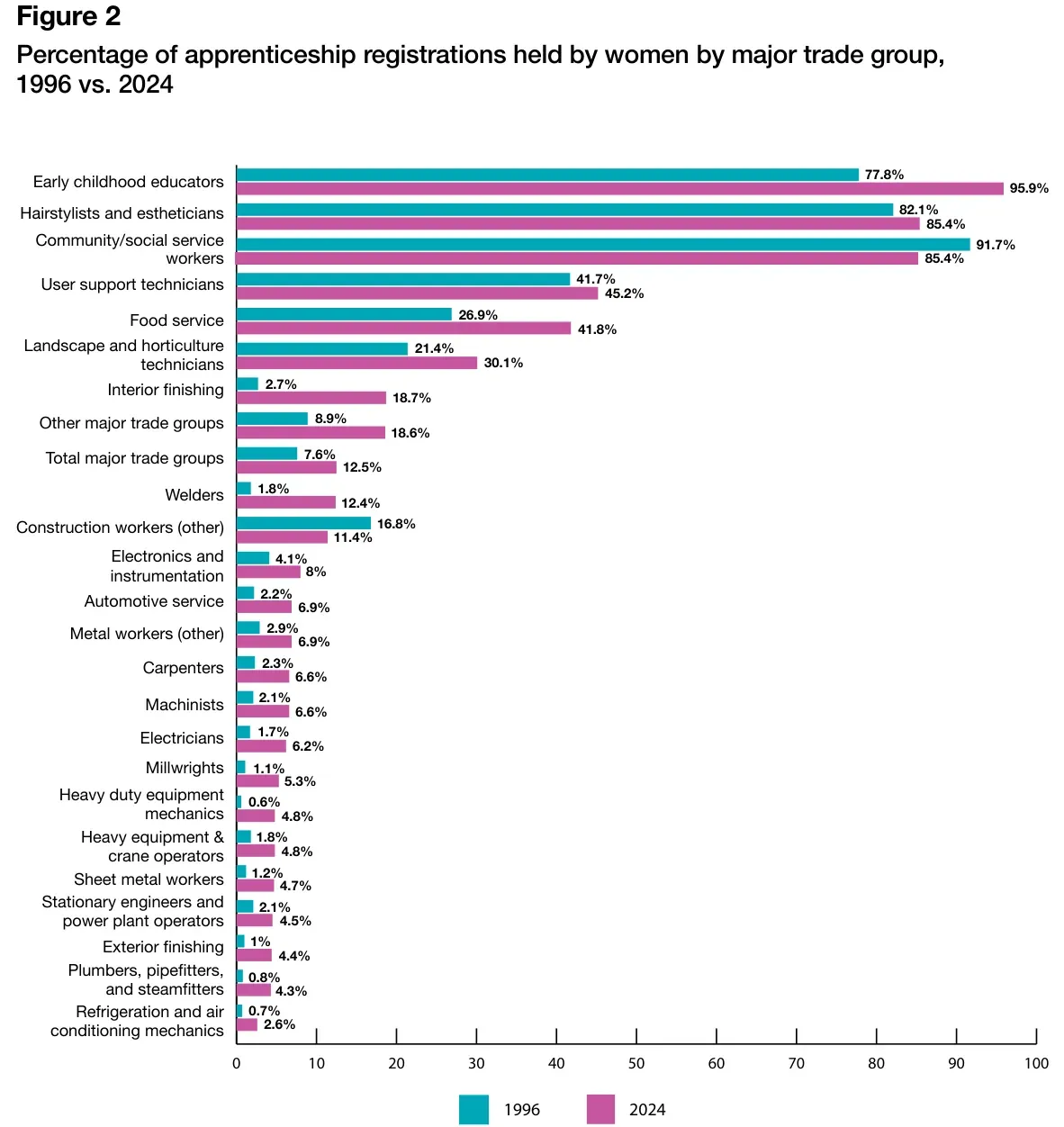 Figure 8: Canadian women’s share of apprentices rose in nearly every trade between 1996 and 2024, but trades such as plumbing and refrigeration and air conditioning stayed under 5%. Source: Future Skills Centre and Diversity Institute, Women in Trades: Progress Report, Jun 2026, charting Statistics Canada Table 37-10-0219-01. Chart published by the source, captured 20 Oct 2026.
How many Canadian apprentices are women?
- Women held 62,430 of 498,783 apprenticeship registrations in Canada in 2024, or 12.5% (Statistics Canada, Dec 2025).
- In 1996, women held 12,483 of 165,324 registrations, or 7.6% (Statistics Canada, Dec 2025).
- Women were 6.6% of carpenter apprentices in 2024, up from 2.3% in 1996 (Statistics Canada, Dec 2025).
- Women were 6.2% of electrician apprentices in 2024, up from 1.7% in 1996 (Statistics Canada, Dec 2025).
- Women were 4.3% of plumber, pipefitter and steamfitter apprentices in 2024, up from 0.8% in 1996 (Statistics Canada, Dec 2025).
- Women were 18.7% of interior finishing apprentices and 12.4% of welding apprentices in 2024 (Statistics Canada, Dec 2025).
- Women were 7.3% of workers in trades, transportation and equipment operation occupations in 2025 (Diversity Institute, Jun 2026).
- Women received 10.9% of all trade certificates in 2024, and 8.8% of Red Seal trade certificates (Diversity Institute, Jun 2026).
- Women made up under 2% of crane operators, heavy-duty equipment mechanics, industrial electricians and power-line workers, trades with average annual earnings of $161,400 to $200,200 (Diversity Institute, Jun 2026).
What does the UK workforce look like?
- In April to June 2026, 274,231 women and 1,018,084 men were employees in UK construction (Office for National Statistics, Aug 2026).
- The number of women employees in UK construction was 299,495 in April to June 2006 (Office for National Statistics, Aug 2026).
- It fell to 240,396 by April to June 2016 and was 277,190 a year before the latest reading (Office for National Statistics, Aug 2026).
Methodology and Sources
Each figure comes from the agency, regulator or research group that produced it. Where a research group reanalyzed a government survey, as NAHB, IWPR and CPWR do with the Current Population Survey, the text names the group and the measure. These groups use different definitions, so their counts differ slightly from the Bureau of Labor Statistics tables. The pay data comes from two surveys: the Current Population Survey, which reports weekly earnings, and the American Community Survey, which reports annual earnings for full-time, year-round workers. Small samples explain the gaps where a trade has no published pay figure for women. Roundup pages and blog posts were not used as sources. Every link was opened and the number was checked on the page, in the data file or in the PDF. The page is reviewed and updated every month.
Sources
The full list of sources cited on this page, in order of first use, is below.
- U.S. Bureau of Labor Statistics
- NAHB
- U.S. Bureau of Labor Statistics
- U.S. Bureau of Labor Statistics
- IWPR
- Washington State Women’s Commission
- U.S. Bureau of Labor Statistics
- U.S. Census Bureau
- IWPR
- Statistics Canada
- U.S. Bureau of Labor Statistics
- CPWR
- CPWR
- U.S. Bureau of Labor Statistics
- U.S. Census Bureau
- U.S. Bureau of Labor Statistics
- U.S. Bureau of Labor Statistics
- Diversity Institute
- CPWR
- CPWR
- U.S. Census Bureau
- Office for National Statistics
- Pew Research Center
- OSHA
- NIOSH
- U.S. Bureau of Labor Statistics