Skilled trade shortage statistics point two ways at once. Federal job openings have cooled from their peak, yet most contractors still cannot fill the seats they have. Both are true, and the gap between them is where small shops feel the pain.
This page collects the latest primary numbers on open jobs, the hardest trades to staff, the technician supply gap, age, training, pay and demand. Every figure comes from the group that ran the survey or built the dataset. We link the source and date each one. When the official forecast and the trade surveys disagree, we say so.
If you run an HVAC or home service shop with a few techs, read the sections on HVAC, pay and small business first. They cover what the shortage costs you and where the labor market is heading.
Key Takeaways
- Technician programs graduate 101,743 people a year against 241,842 annual openings in ten technician sectors (TechForce Foundation, May 2026).
- 88% of contractors with craft openings say those jobs are as hard or harder to fill than a year ago (AGC and NCCER, Sep 2026).
- 77% of firms hiring HVAC technicians report difficulty filling those jobs (AGC and NCCER, Sep 2026).
- 36% of HVAC technician demand goes unmet each year (TechForce Foundation, May 2026).
- 47% of home builders report a shortage across nine core trades, the highest reading since the survey began in 1996 (NAHB, Oct 2026).
- 32% of small business owners had a job opening they could not fill, 8 points above the historical average (NFIB, Sep 2026).
- The median electrician is 39.6 years old, younger than the 42.1 median for all employed workers (BLS Current Population Survey, Annual 2025).
- Electricians leave the labor force at 2.6% a year, against 4.2% across all occupations (BLS Occupational Separations and Openings, Aug 2026).
- The 16 to 24 labor force is projected to shrink by 2.0 million, or 9.2%, from 2025 to 2035 (BLS Civilian Labor Force Projections, Aug 2026).
- BLS does not project an overall labor shortage, because its model ties labor supply to labor demand (BLS Employment Projections, Aug 2026).
- 93% of apprentices keep a job after finishing a registered apprenticeship (U.S. Department of Labor, Aug 2026).
- Average hourly earnings in construction reached $41.69 in September 2026, up from $40.01 a year earlier (BLS Employment Situation, Sep 2026).
- U.S. electricity generation is set to hit a record 4,368 billion kilowatthours in 2026 (EIA, Sep 2026).
How many jobs are open right now?
Open jobs are not the whole story. National openings have eased, but the trades that build, wire and cool buildings still report seats they cannot fill.
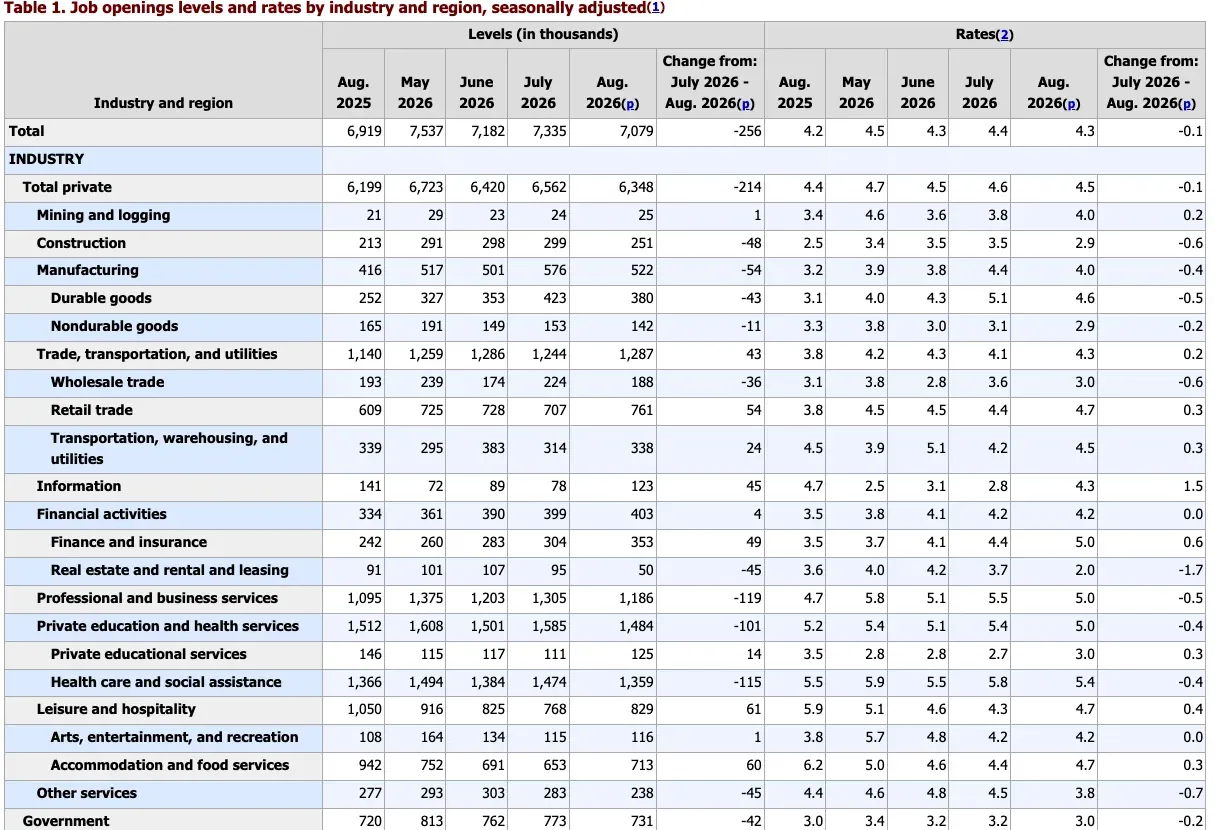 Figure 1: Job openings by industry, with construction and manufacturing rows showing how many seats stayed open in August 2026 compared with a year earlier. Source: BLS, Job Openings and Labor Turnover Summary, Table 1, Aug 2026. Screenshot of the source page, captured 20 Oct 2026.
What do federal job openings data show?
Employers across the economy had 7,079,000 job openings in August 2026, a rate of 4.3% (BLS JOLTS, Aug 2026). Trade-heavy industries add more detail.
- Construction had 251,000 openings, a rate of 2.9%, up from 213,000 a year earlier (BLS JOLTS, Aug 2026).
- Manufacturing had 522,000 openings, a rate of 4.0% (BLS JOLTS, Aug 2026).
- Durable goods manufacturers alone had 380,000 openings, a rate of 4.6% (BLS JOLTS, Aug 2026).
- Construction employers made 308,000 hires, a rate of 3.7% (BLS JOLTS hires, Aug 2026).
- Construction employers laid off 99,000 workers, a rate of 1.2% (BLS JOLTS layoffs, Aug 2026).
- Construction payrolls grew by 11,000 jobs in September 2026, after averaging 10,000 a month over the prior 12 months (BLS Employment Situation, Sep 2026).
What do contractors say about open positions?
Contractor surveys show the hiring pain more sharply than the federal totals do.
- 87% of firms have openings for hourly craft workers, and 82% have openings for salaried staff (AGC and NCCER, Sep 2026).
- One quarter of contractors report 11 or more unfilled craft positions (AGC and NCCER, Sep 2026).
- 73% of firms expect to add employees in the next 12 months, while 8% expect to cut (AGC and NCCER, Sep 2026).
- 92% of companies reported difficulty hiring for open positions in the 2025 edition of the same survey (NCCER, Sep 2025).
- ABC estimates the construction industry needs 349,000 net new workers in 2026 and 456,000 in 2027 (ABC, Jan 2026).
Is this a global problem?
It is, and U.S. employers sit near the middle of the pack.
- 72% of 39,000 employers in 41 countries reported hiring difficulty, down from 74% a year earlier (ManpowerGroup, Feb 2026).
- 69% of U.S. employers reported hiring difficulty in the same survey (ManpowerGroup, Feb 2026).
Which skilled trades are hardest to fill?
Electricians, mechanics and HVAC techs top the lists, and the pattern holds across two different surveys of two different groups of builders.
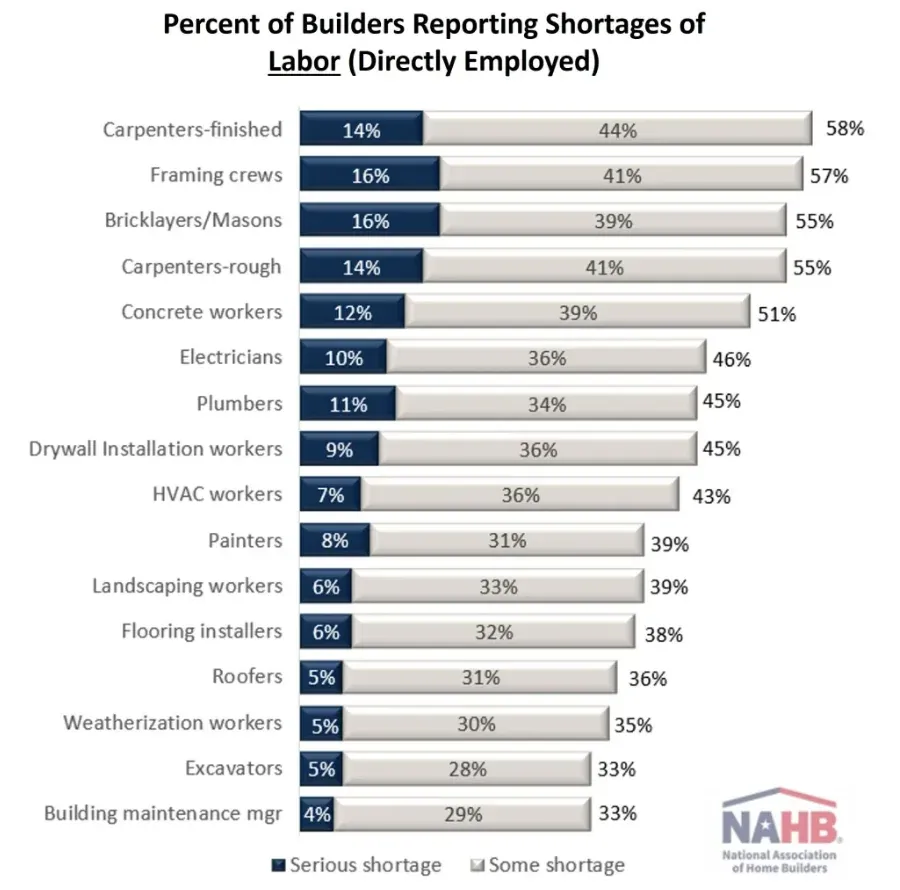 Figure 2: Share of builders reporting a serious or some shortage in 16 trades, from finished carpentry at the top to building maintenance managers at the bottom. Source: NAHB, Eye On Housing, Labor Shortages a Growing Problem, Sep 2026. Chart published by the source, captured 20 Oct 2026.
Which crafts do contractors struggle to hire?
Contractors with openings were asked how hard each role is to fill.
- 81% of firms with electrician openings report difficulty filling them (AGC and NCCER, Sep 2026).
- 79% report difficulty finding mechanics (AGC and NCCER, Sep 2026).
- 76% report difficulty finding concrete workers (AGC and NCCER, Sep 2026).
- Roughly three-quarters of firms hiring pipelayers, plumbers and cement masons report difficulty (AGC and NCCER, Sep 2026).
- 75% of firms hiring superintendents report difficulty, the hardest salaried role to fill (AGC and NCCER, Sep 2026).
- 72% report difficulty filling estimating positions (AGC and NCCER, Sep 2026).
Which trades do home builders report short?
NAHB asks builders about 16 trades twice a year.
- 58% of builders report a shortage of finished carpenters, the highest of the 16 trades (NAHB, Oct 2026).
- Shortages are lowest, at 33%, for excavators and building maintenance managers (NAHB, Oct 2026).
- Framing crew shortages rose 9 points to 57% since April 2025 (NAHB, Oct 2026).
- 46% of builders report an electrician shortage (NAHB, Oct 2026).
- 45% report a plumber shortage, unchanged since April 2025 (NAHB, Oct 2026).
- Landscaping worker shortages rose 7 points to 39% (NAHB, Oct 2026).
- Roofer shortages rose 6 points to 36% (NAHB, Oct 2026).
How far behind is the supply of new technicians?
Schools are producing more graduates, and it is still not close to enough. The shortfall is a pipeline problem, and it has a price.
 Figure 3: TechForce headline numbers, showing annual technician openings, annual graduates, the unmet share of demand, lost economic output and technicians needed by 2029. Source: TechForce Foundation, Supply, Demand and Opportunity, May 2026. Screenshot of the source page, captured 20 Oct 2026.
How big is the technician supply gap?
TechForce builds its gap from federal school completion data and BLS demand projections.
- The gap costs $7.42 billion in wage-based output every year (TechForce Foundation, May 2026).
- The five-year cumulative wage loss from 2025 to 2029 is $37.09 billion (TechForce Foundation, May 2026).
- 125,718 technician positions go unfilled each year across all ten sectors (TechForce Foundation, May 2026).
- The industry needs 1.2 million new technicians by 2029 (TechForce Foundation, May 2026).
- School graduations grew 7.6% in a year, with growth in eight of ten sectors (TechForce Foundation, May 2026).
How many welders does the country need?
Welding is the trade where an industry body publishes its own workforce count.
- The American Welding Society says the U.S. will need 320,500 new welding professionals by 2029 (AWS, May 2026).
- AWS estimates 771,000 welding professionals work in the U.S. in 2025 (AWS, Sep 2025).
How many openings does each trade produce a year?
BLS counts openings from growth, retirements and workers who switch occupations.
- Electricians: 72,700 openings a year from 2025 to 2035 (BLS Occupational Separations and Openings, Aug 2026).
- Automotive service technicians: 66,200 openings a year (BLS Occupational Separations and Openings, Aug 2026).
- Plumbers, pipefitters and steamfitters: 42,000 openings a year (BLS Occupational Separations and Openings, Aug 2026).
- All occupations together: 17.46 million openings a year (BLS Occupational Separations and Openings, Aug 2026).
Are skilled trade workers really getting older?
Less than the headlines suggest. Most trades are younger than the average U.S. worker. The leaders of crews are the older group, and that is where the knowledge sits.
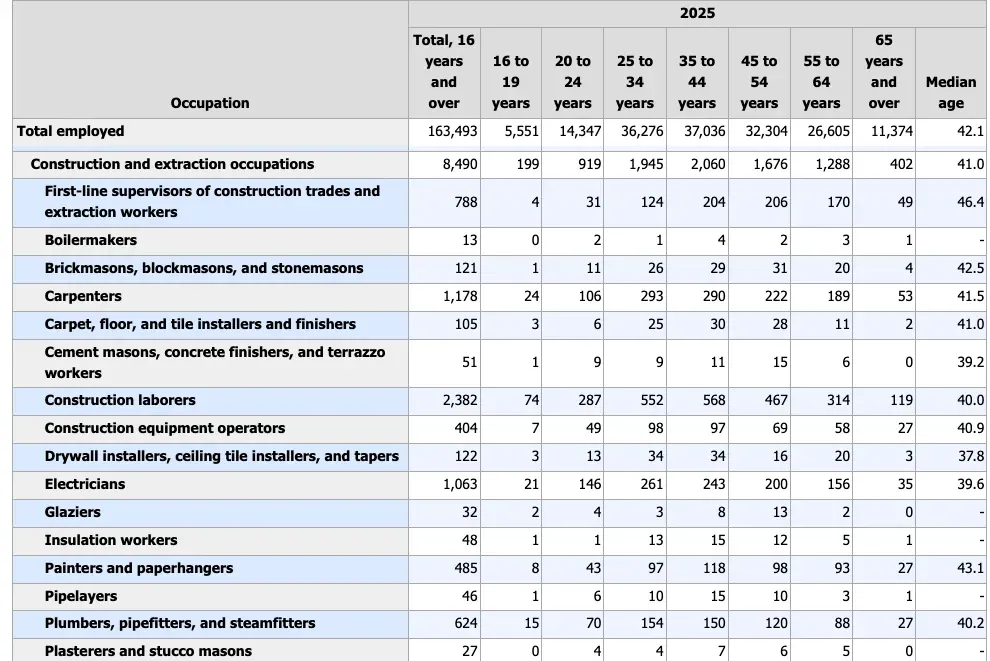 Figure 4: Employed workers by age group and median age for construction and extraction trades, from first-line supervisors to plumbers. The header row and the trades rows are joined from one source table. Source: BLS, Current Population Survey table 11b, Annual 2025. Screenshot of the source page, captured 20 Oct 2026.
How old is the typical tradesperson?
The Current Population Survey reports median age for each occupation.
- Construction and extraction occupations have a median age of 41.0 (BLS Current Population Survey, Annual 2025).
- First-line supervisors of construction trades are older, at 46.4 (BLS Current Population Survey, Annual 2025).
- Construction and building inspectors have a median age of 46.1 (BLS Current Population Survey, Annual 2025).
- Plumbers, pipefitters and steamfitters: 40.2 (BLS Current Population Survey, Annual 2025).
- Roofers: 36.6 (BLS Current Population Survey, Annual 2025).
- 35,000 employed electricians are 65 or older (BLS Current Population Survey, Annual 2025).
How many tradespeople leave each year?
Exits from the labor force are lower in the trades than in the economy as a whole. Most openings come from workers who move to other occupations.
- Plumbers leave the labor force at 2.7% a year (BLS Occupational Separations and Openings, Aug 2026).
- Automotive service technicians leave at 2.9% a year (BLS Occupational Separations and Openings, Aug 2026).
- About 22,100 electricians exit the labor force each year, while 43,100 move to other occupations (BLS Occupational Separations and Openings, Aug 2026).
- AWS says more than 157,000 welding professionals are approaching retirement (AWS, Sep 2025).
Are enough young people entering the trades?
The pipeline is the weak point. The young labor force is shrinking, and the training paths are long.
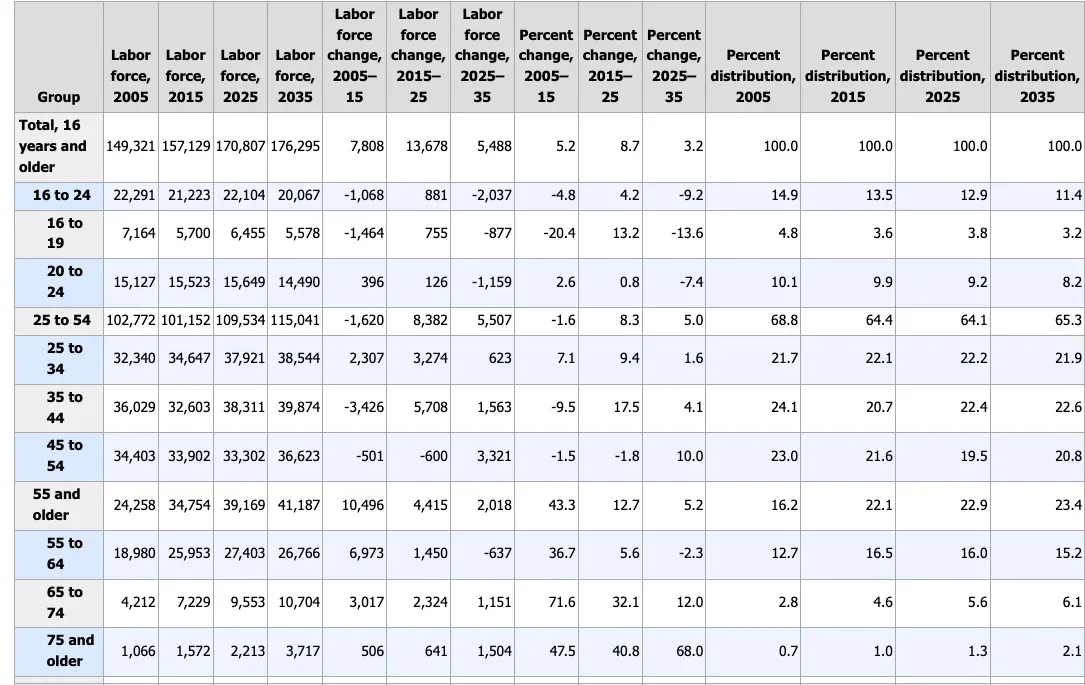 Figure 5: The civilian labor force by age band, with 2025 levels, the projected 2035 level and the percent change from 2025 to 2035. The 16 to 24 band is projected to shrink the most. Source: BLS, Civilian labor force by age, sex, race, and ethnicity, Aug 2026. Screenshot of the source page, captured 20 Oct 2026.
How fast is the labor force growing?
Slowly, and mostly at the older end.
- The total labor force is projected to grow 3.2% from 2025 to 2035, to 176.3 million people (BLS Civilian Labor Force Projections, Aug 2026).
- The 25 to 54 group is projected to grow 5.0% (BLS Civilian Labor Force Projections, Aug 2026).
- The 20 to 24 group is projected to shrink 7.4% (BLS Civilian Labor Force Projections, Aug 2026).
- The 55 to 64 group is projected to shrink 2.3% (BLS Civilian Labor Force Projections, Aug 2026).
- The 75 and older group is projected to grow 68.0% (BLS Civilian Labor Force Projections, Aug 2026).
How long does it take to train a tradesperson?
Training time limits how fast shops can add skilled staff.
- BLS lists apprenticeship as the typical training path for electricians and plumbers (BLS Occupational Projections and Characteristics, Aug 2026).
- BLS lists long-term on-the-job training for HVAC mechanics and installers (BLS Occupational Projections and Characteristics, Aug 2026).
- McKinsey found many skilled trade roles need about three years of apprenticeship (McKinsey, Apr 2024).
What is being done to widen the pipeline?
Federal policy is pushing toward more and shorter training.
- New apprentices rose 79% over the past 10 years (U.S. Department of Labor, Aug 2026).
- The Department of Labor awarded nearly $162 million to expand registered apprenticeship through pay-for-performance incentives (U.S. Department of Labor, Jul 2026).
- Workforce Pell grants cover programs as short as 8 weeks starting July 1, 2026 (U.S. Department of Education, May 2026).
- Most community college contacts in the Cleveland Fed district expected enrollments to grow in fall 2026 (Federal Reserve Beige Book, Jul 2026).
How short is HVAC?
HVAC is short, but it is not the worst-off technician trade. It sits in the middle of ten sectors, with a real gap between openings and graduates. See the full workforce profile on the HVAC technician statistics page.
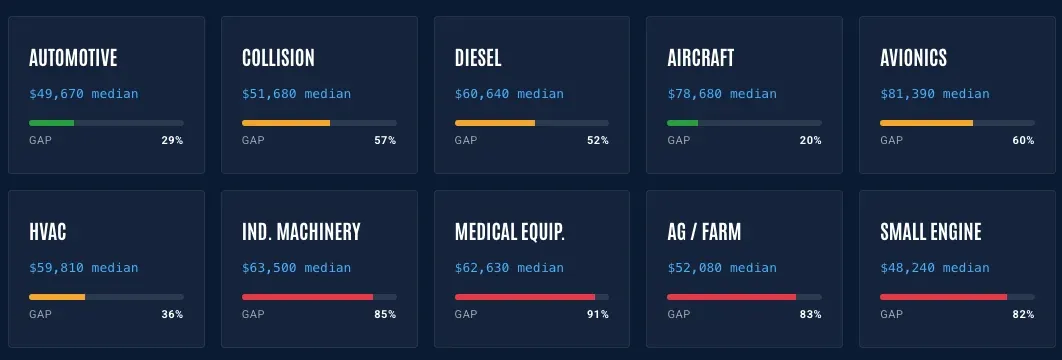 Figure 6: Share of annual demand that goes unmet in ten technician sectors, with median pay. HVAC sits at 36%, well below industrial machinery and medical equipment. Source: TechForce Foundation, Supply, Demand and Opportunity, May 2026. Screenshot of the source page, captured 20 Oct 2026.
How big is the HVAC technician gap?
TechForce measures HVAC demand against school completions.
- HVAC demand is 41,052 openings a year, leaving a gap of 14,853 (TechForce Foundation, May 2026).
- HVAC programs produced 23,251 completions in the 2023-24 school year, up 8.6% (TechForce Foundation, May 2026).
- 669 institutions offer HVAC programs (TechForce Foundation, May 2026).
- 99% of HVAC completions are certificates (TechForce Foundation, May 2026).
- HVAC fills 64 of every 100 positions it needs, against 15 for industrial machinery (TechForce Foundation, May 2026).
- Medical equipment has the widest gap of the ten sectors, at 91% unmet (TechForce Foundation, May 2026).
- Aircraft maintenance has the narrowest gap of the ten sectors, at 20% unmet (TechForce Foundation, May 2026).
What do HVAC employers and builders report?
- 43% of home builders report a shortage of HVAC workers, unchanged since April 2025 (NAHB, Oct 2026).
- 41% of HVAC contractors have adopted press fittings and another 21% plan to switch within a year, largely because new techs learn them faster than brazing (ACCA, Dec 2025).
What does the federal data say about HVAC employment?
BLS shows steady growth and a workforce that turns over by moving, not retiring.
- HVAC mechanic and installer employment is projected to grow from 440,900 in 2025 to 489,100 in 2035, up 10.9% (BLS Occupational Separations and Openings, Aug 2026).
- BLS projects 40,600 HVAC openings a year (BLS Occupational Projections and Characteristics, Aug 2026).
- About 12,300 HVAC workers leave the labor force each year, while 23,400 move to other occupations (BLS Occupational Separations and Openings, Aug 2026).
- 6.3% of HVAC mechanics and installers are self-employed (BLS Occupational Projections and Characteristics, Aug 2026).
- The median HVAC mechanic is 39.9 years old (BLS Current Population Survey, Annual 2025).
- 28,000 employed HVAC workers are 65 or older (BLS Current Population Survey, Annual 2025).
For the wider market picture, see the HVAC industry statistics page.
Are labor shortages pushing wages up?
Yes, though not at a panic pace. Pay is rising faster in the trades than across the private sector, and contractors say they are raising it to compete.
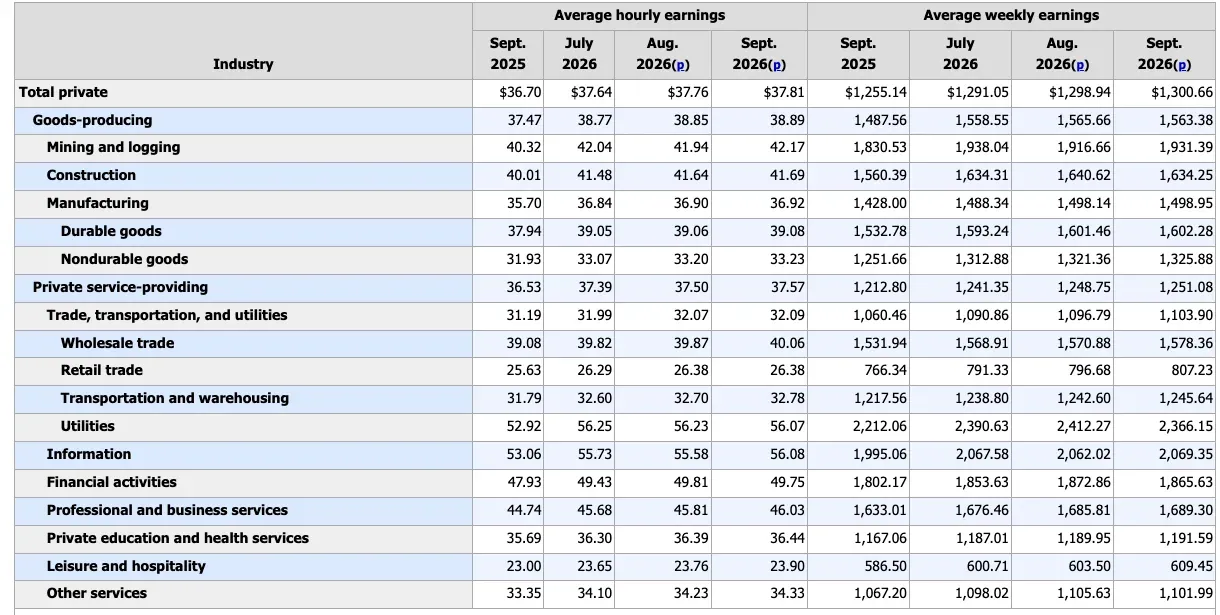 Figure 7: Average hourly and weekly earnings for private industries, with construction, manufacturing and utilities rows showing the change from September 2025 to September 2026. Source: BLS, Employment Situation Table B-3, Sep 2026. Screenshot of the source page, captured 20 Oct 2026.
How much have trade wages risen?
- Weekly earnings in construction were $1,634.25 in September 2026, up from $1,560.39 a year earlier (BLS Employment Situation, Sep 2026).
- Hourly earnings in manufacturing were $36.92, up from $35.70 (BLS Employment Situation, Sep 2026).
- Across all private payrolls, hourly earnings rose 3.0% over 12 months to $37.81 (BLS Employment Situation, Sep 2026).
- The Atlanta Fed Wage Growth Tracker stood at 3.9% in September 2026 (Atlanta Fed, Sep 2026).
- Workers who stayed in their jobs saw 3.4% growth, while job changers saw 4.7% (Atlanta Fed, Sep 2026).
- McKinsey found weekly earnings in construction were 23.5% above pre-pandemic levels in March 2024 (McKinsey, Apr 2024).
How are employers paying to compete?
Pay is the first lever most shops pull.
- 55% of contractors raised base pay for hourly craft workers by more than they did a year earlier (AGC and NCCER, Sep 2026).
- Home builders report a median 4.2% rise in the labor cost of building the same home over 12 months (NAHB, Oct 2026).
- A net 20% of small business owners plan to raise compensation over the next three months (NFIB, Sep 2026).
- 19% of employers worldwide name higher wages as part of their response to talent scarcity (ManpowerGroup, Feb 2026).
- Fed district contacts tied some wage increases to competition for skilled workers (Federal Reserve Beige Book, Jul 2026).
What do trade jobs pay compared with the average job?
- Electricians earn a median $63,190 a year (BLS Occupational Projections and Characteristics, Aug 2026).
- Plumbers, pipefitters and steamfitters earn a median $63,800 (BLS Occupational Projections and Characteristics, Aug 2026).
- Automotive service technicians earn a median $50,620, close to the $50,980 median for all occupations (BLS Occupational Projections and Characteristics, Aug 2026).
When labor costs rise, prices set last year may stop covering the work. Shops that check their rates against labor cost protect their margin.
What does the shortage cost a small shop?
For a shop with a handful of techs, one open seat is a large share of capacity. The surveys show a labor problem that is more about finding qualified people than about paying them.
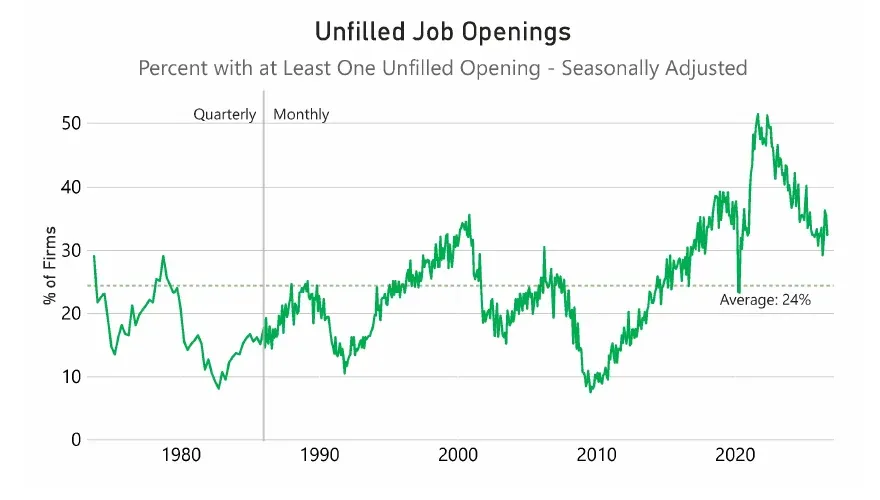 Figure 8: The share of NFIB member firms with at least one unfilled job opening, shown against its long-run average of 24%. Readings in 2021 and 2022 ran far above that line. Source: NFIB, September 2026 Jobs Report, Sep 2026. Chart published by the source, captured 20 Oct 2026.
What do small business owners report?
NFIB surveys its member firms every month.
- 27% of owners have openings for skilled workers (NFIB, Sep 2026).
- 16% have openings for unskilled labor (NFIB, Sep 2026).
- 45% of owners trying to hire found few or no qualified applicants, including 20% who found none (NFIB, Sep 2026).
- 26% named labor quality or availability as their single most important problem, 14 points above the historical average (NFIB, Sep 2026).
- Only 6% named labor costs as their top problem, the lowest since December 2020 (NFIB, Sep 2026).
- Smaller employers fare slightly better on hiring: 64% of firms under 10 employees report difficulty, against 75% at firms with 1,000 to 4,999 (ManpowerGroup, Feb 2026).
Why is it so hard to keep new hires?
The hiring problem is also a retention problem.
- 50% of contractors say available candidates lack the skills, certificates or licenses (AGC and NCCER, Sep 2026).
- 42% say new hires fail to show up or quit shortly after starting (AGC and NCCER, Sep 2026).
- 36% cite candidates who lack a driver’s license, work permit or clean background check (AGC and NCCER, Sep 2026).
- 30% report difficulty because candidates cannot pass a drug test (AGC and NCCER, Sep 2026).
- 83% of firms see at least some turnover among new field employees in their first 90 days (AGC and NCCER, Sep 2026).
- Construction employers had 152,000 quits in August 2026, a rate of 1.8% (BLS JOLTS quits, Aug 2026).
What happens to jobs and customers?
- 42% of contractors say worker shortages have delayed projects, the top cause of delay (AGC and NCCER, Sep 2026).
- 74% report at least one significant project delay in the past year (AGC and NCCER, Sep 2026).
- Only 30% of the smallest firms raised headcount by at least 5%, against 54% of mid-size firms and 79% of the largest (AGC and NCCER, Sep 2026).
- More than half of professional contractors report challenges hiring skilled labor, rising to 60% among those who worked on disaster recovery (Home Depot Foundation, Jan 2026).
When a tech quits or a seat stays empty, the owner often picks up the calls, the quotes and the invoices. Office time is the first thing to shrink.
Where will demand for trade workers grow next?
Demand is moving toward power, cooling and the people who maintain machines. Electricity use is climbing, and data centers are pulling on the same labor pool as everyone else.
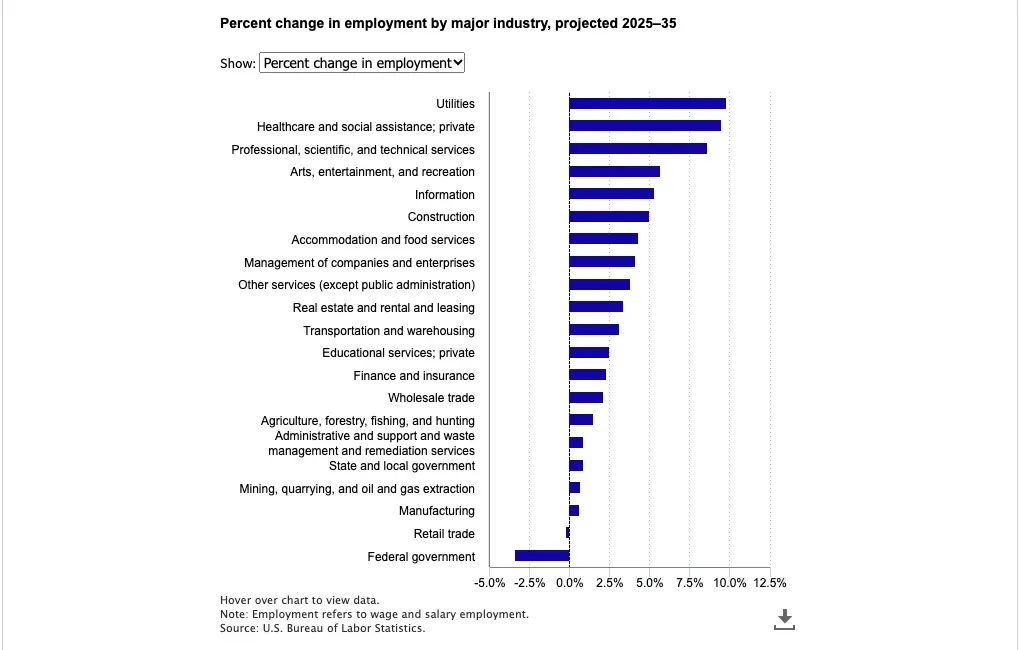 Figure 9: Projected percent change in wage and salary employment by major industry from 2025 to 2035, with utilities growing fastest. Source: BLS, The Economics Daily, Utilities fastest job growth, Sep 2026. Chart published by the source, captured 20 Oct 2026.
What does the federal 10-year outlook show?
- The U.S. is projected to add 5.9 million jobs from 2025 to 2035, growth of 3.5% against 10.9% over the prior decade (BLS Employment Projections, Aug 2026).
- Utilities have the fastest projected job growth at 9.8%, but that is only 58,800 new jobs (BLS Employment Projections, Aug 2026).
- Solar photovoltaic installers are projected to grow 36.5% (BLS Employment Projections, Aug 2026).
- Wind turbine service technicians are projected to grow 29.5% (BLS Employment Projections, Aug 2026).
- Electricians are projected to add 75,900 jobs, a 9.2% increase (BLS Occupational Separations and Openings, Aug 2026).
- Industrial machinery mechanics are projected to grow 17.8%, adding 79,700 jobs (BLS Occupational Separations and Openings, Aug 2026).
Why does power demand matter for trade labor?
- EIA expects electricity sales of 4,135 billion kilowatthours in 2026 and 4,211 in 2027 (EIA, Sep 2026).
- 28% of contractors worked on a data center project in the past 12 months (AGC and NCCER, Sep 2026).
- 58% of those firms say data centers increased competition for skilled workers (AGC and NCCER, Sep 2026).
- 49% report more wage pressure because of data centers (AGC and NCCER, Sep 2026).
- 30% report more turnover because of data centers (AGC and NCCER, Sep 2026).
How are employers responding to the shortage?
Raising pay is only the start. Employers are recruiting younger, training in-house and leaning on technology to stretch the people they have.
 Figure 10: Share of contractors that increased training spending, added online recruiting and expanded outreach to schools and career programs in 2026. Source: AGC, Construction Workforce Shortages Remain Acute news release, Sep 2026. Screenshot of the source page, captured 20 Oct 2026.
How are contractors recruiting and training?
- 36% of firms started or increased spending on training and professional development (AGC and NCCER, Sep 2026).
- 49% added or increased online recruiting, such as social media and digital ads (AGC and NCCER, Sep 2026).
- 48% increased engagement with high schools, colleges and career and technical programs (AGC and NCCER, Sep 2026).
- 25% implemented or increased in-person, onsite craft training (AGC and NCCER, Sep 2026).
- 20% use craft staffing firms (AGC and NCCER, Sep 2026).
What strategies do employers use worldwide?
- 91% of employers are using a mix of strategies to cope with scarcity (ManpowerGroup, Feb 2026).
- 27% lead with upskilling or reskilling (ManpowerGroup, Feb 2026).
- 20% offer more schedule flexibility (ManpowerGroup, Feb 2026).
- 18% target new talent pools (ManpowerGroup, Feb 2026).
Can technology close the gap?
- 51% of contractors expect AI and robotics to have a positive effect on construction over five years, against 8% who expect a negative effect (AGC and NCCER, Sep 2026).
- 67% expect AI to have the greatest impact on estimating and bidding in their own firms (AGC and NCCER, Sep 2026).
- 62% expect the greatest impact on scheduling and planning (AGC and NCCER, Sep 2026).
- In the Kansas City Fed district, firms reported ongoing competition for skilled labor, especially machine operators and welders (Federal Reserve Beige Book, Jul 2026).
Methodology and Sources
We selected statistics from the agency, association or research group that produced them. We did not use roundups or vendor blogs. Each figure links to the source page or report and carries the month of the data or release. Where sources disagree, we show both. For example, AGC lists 35% in its survey analysis and 36% in its news release for firms raising training spend, and we cite the news release.
Several widely repeated HVAC shortage counts, such as round-number unfilled-job totals, trace back to no primary source, so we left them out. BLS also says its projections do not forecast a labor shortage, so shortage claims here come from surveys and from supply and demand comparisons by named groups. BLS Current Population Survey figures are 2025 annual averages. We refresh this page monthly.
Sources
- AGC and NCCER, 2026 Workforce Survey Analysis
- AGC, Construction Workforce Shortages Remain Acute news release
- NCCER, AGC/NCCER 2025 Craft Workforce Survey
- ABC, 2026 workforce shortage model
- NFIB, September 2026 Jobs Report
- NAHB, Labor Shortages a Growing Problem
- TechForce Foundation, Supply, Demand and Opportunity 2026
- TechForce Foundation, full report PDF
- ManpowerGroup, 2026 Talent Shortage Survey
- American Welding Society, Welding Digest
- American Welding Society, welding workforce data
- BLS, Job Openings and Labor Turnover Survey, openings
- BLS, JOLTS hires
- BLS, JOLTS quits
- BLS, JOLTS layoffs
- BLS, Employment Situation summary
- BLS, Employment Situation Table B-3
- BLS, Employment Projections 2025-2035
- BLS, Occupational separations and openings
- BLS, Occupational projections and characteristics
- BLS, Civilian labor force projections
- BLS, Current Population Survey table 11b
- BLS, The Economics Daily, projected industry growth
- EIA, September 2026 Short-Term Energy Outlook release
- U.S. Department of Labor, ApprenticeshipUSA factsheet
- U.S. Department of Labor, apprenticeship awards
- U.S. Department of Education, Workforce Pell final rule
- Atlanta Fed, Wage Growth Tracker
- Federal Reserve, Beige Book, July 2026
- McKinsey, Tradespeople wanted
- Home Depot Foundation, skilled labor research
- ACCA, Contractor of the Future Study
Glossary
- ABC: Associated Builders and Contractors, a construction trade group.
- AGC: Associated General Contractors of America, a construction trade group.
- AWS: American Welding Society.
- BLS: U.S. Bureau of Labor Statistics.
- EIA: U.S. Energy Information Administration.
- JOLTS: the BLS Job Openings and Labor Turnover Survey.
- NAHB: National Association of Home Builders.
- NCCER: National Center for Construction Education and Research.
- NFIB: National Federation of Independent Business, which surveys its small business members.
- Labor force exit: a worker who leaves the labor force, for example to retire.
- Occupational transfer: a worker who moves to a different occupation.