Landscaping industry statistics show a trade that is huge in total and tiny at the shop level. Most firms have fewer than five paid workers, work swings hard by season, and the money comes from homes, property managers and public land.
This page takes each number from the agency, regulator or company that produced it. Sources include the Census Bureau, the Bureau of Labor Statistics, the USDA, the Department of Labor, the EPA, the Energy Information Administration and the annual reports of public landscape companies. Every figure links to its source and carries a date. Market research roundups are not used.
It is written for owners of small field service shops and for anyone who needs a number they can cite. If you run a lawn, tree or hardscape crew, the sections on seasonal demand and rising costs matter most. If you run another home service trade, the same pattern shows up in your own year. For the wider market, see home service demand. For the largest trade on this site, see HVAC market data.
Key Takeaways
- Employer landscaping firms took in $118.4 billion in receipts in 2022 (Census Bureau SUSB, Apr 2025).
- Landscaping services had 114,842 employer firms in 2022, and 82,695 of them had fewer than five employees (Census Bureau SUSB, Apr 2025).
- Another 537,970 landscaping businesses had no employees at all in 2024 (Census Bureau Nonemployer Statistics, Sep 2026).
- Grounds maintenance workers held 1,299,200 jobs in 2025 (BLS Occupational Outlook Handbook, Sep 2026).
- Median pay for grounds maintenance workers was $19.27 an hour, or $40,080 a year, in 2025 (BLS Occupational Outlook Handbook, Sep 2026).
- Landscaping services employment rose from 781,800 in January 2026 to 1,016,900 in July 2026, before seasonal adjustment (BLS Current Employment Statistics, Sep 2026).
- Scotts Miracle-Gro books more than 75% of its North American consumer lawn and garden sales in two fiscal quarters (Scotts Miracle-Gro 10-K, Nov 2025).
- The average US household spent $238.02 on gardening and lawn care services in 2024, and 19.28% of households reported paying for them (BLS Consumer Expenditure Survey, Aug 2026).
- Landscaping and groundskeeping made up 38.3% of all H-2B positions certified in fiscal 2025, more than any other occupation (Department of Labor H-2B Statistics, Sep 2025).
- Regular gasoline averaged $4.284 a gallon and diesel $6.276 on Oct 19, 2026, up $1.265 and $2.656 in a year (EIA Gasoline and Diesel Fuel Update, Oct 2026).
- BLS projects employment of grounds maintenance workers to grow 5% from 2025 to 2035, which it calls faster than average (BLS Occupational Outlook Handbook, Sep 2026).
- BrightView, the largest commercial landscaper, says it holds a 1.5% share of its combined landscape maintenance and snow removal market (BrightView 10-K, Nov 2025).
- Some 37% of new single-family homes finished in 2025 stood on lots under 7,000 square feet, up from 25% in 2009 (Census Bureau New Housing Characteristics, Jul 2026).
- Outdoor use is more than 30% of total household water use on average (EPA WaterSense, Mar 2026).
How big is the US landscaping market?
The market is large, but no one firm controls it. The money sits in a very large number of small crews, so the totals only make sense when you look at who is behind them.
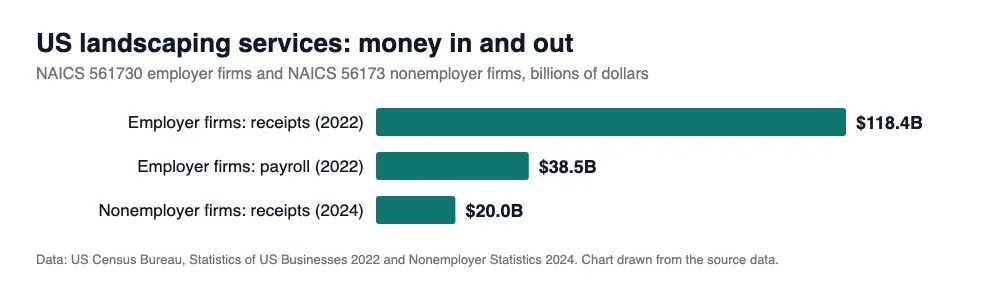 Figure 1: Employer landscaping firms moved far more money than the solo operators, but both groups are large. Source: Census Bureau, Statistics of U.S. Businesses, Apr 2025, with nonemployer receipts from the Census Bureau’s 2024 Nonemployer Statistics. Chart drawn by us from the source data, captured 20 Oct 2026.
How much do landscaping firms pay out in wages?
Wages are the biggest cost in the business, and two federal counts agree on the scale.
- Employer landscaping firms reported $38.5 billion in annual payroll in 2022 (Census Bureau SUSB, Apr 2025).
- The Quarterly Census of Employment and Wages put private-sector landscaping wages at $47.7 billion in 2025, a later year that covers every employer that pays unemployment insurance tax (BLS QCEW, Aug 2026).
- Businesses with no employees took in $20.0 billion in receipts in 2024 (Census Bureau Nonemployer Statistics, Sep 2026).
Is the industry still growing?
Slowly. Counts of businesses and jobs edged up in 2025, projected growth is modest, and the seasonally adjusted monthly job count has been flat to lower in 2026.
- Landscaping establishments rose 0.2% in 2025 to 123,326 (BLS QCEW, Aug 2026).
- Average landscaping employment rose 1.3% to 912,821 (BLS QCEW, Aug 2026).
- Average annual pay in the industry rose 3.8% to $52,284 (BLS QCEW, Aug 2026).
- Seasonally adjusted employment in landscaping services slipped from 933,100 in January 2026 to 918,800 in August 2026 (BLS Current Employment Statistics, Sep 2026).
- BLS projects jobs in services to buildings and dwellings, the group that holds landscaping and pest control, to rise from 2,293,700 in 2025 to 2,352,600 in 2035, a gain of 2.6% (BLS Employment Projections, Sep 2026).
How are the largest landscape companies doing?
The biggest names are small slices of a huge market, and their latest results show soft demand for big projects.
- BrightView reported $2,672.8 million in net service revenue for fiscal 2025, down 3.4% (BrightView 10-K, Nov 2025).
- Maintenance services brought in $1,891.3 million of that total (BrightView 10-K, Nov 2025).
- Development services, which design and install new landscapes, brought in $789.1 million (BrightView 10-K, Nov 2025).
- SiteOne Landscape Supply, which sells to landscape firms, reported net sales of $4,704.8 million for fiscal 2025, up 4% (SiteOne 10-K, Feb 2026).
How many landscaping companies are there, and how big are they?
The typical landscaping firm is a handful of people. Large firms exist, but they are a tiny share of the firm count.
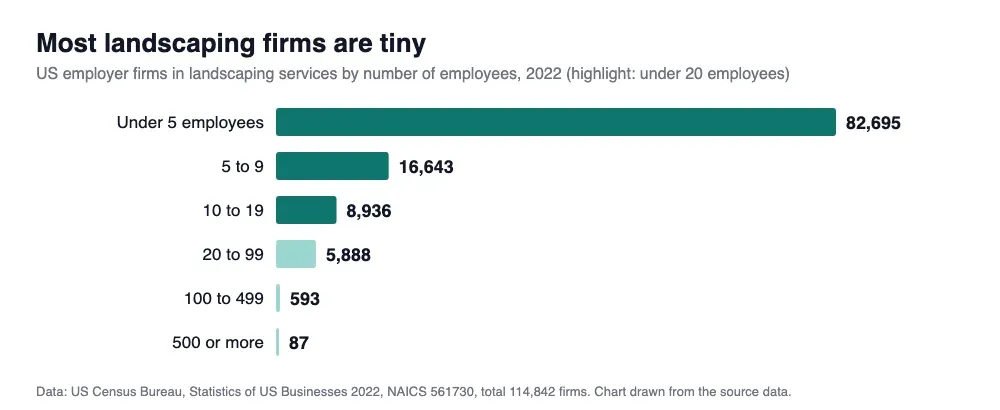 Figure 2: Nearly three in four employer firms have fewer than five employees, and fewer than 100 firms have 500 or more. Source: Census Bureau, Statistics of U.S. Businesses size classes, Apr 2025. Chart drawn by us from the source data, captured 20 Oct 2026.
What do landscaping statistics show about firm size?
Most employer firms are very small, and the count falls fast as firms get bigger.
- 16,643 firms had 5 to 9 employees (Census Bureau SUSB, Apr 2025).
- 8,936 firms had 10 to 19 employees (Census Bureau SUSB, Apr 2025).
- Firms with fewer than 20 employees numbered 108,274 and employed 340,782 workers (Census Bureau SUSB, Apr 2025).
- Those same small firms took in $57.1 billion in receipts (Census Bureau SUSB, Apr 2025).
- 5,888 firms had 20 to 99 employees (Census Bureau SUSB, Apr 2025).
- 593 firms had 100 to 499 employees (Census Bureau SUSB, Apr 2025).
- Only 87 firms had 500 or more employees, yet they employed 120,142 workers (Census Bureau SUSB, Apr 2025).
- Those 87 firms took in $18.0 billion in receipts (Census Bureau SUSB, Apr 2025).
- 24,676 firms had receipts under $100,000 (Census Bureau SUSB, Apr 2025).
- 82 firms had receipts of $100 million or more, and together they took in $17.9 billion (Census Bureau SUSB, Apr 2025).
Which states have the most landscaping businesses?
Warm and populous states lead, and the order changes depending on whether you count firms, jobs or receipts.
- Florida had the most employer firms, 10,302 (Census Bureau SUSB, Apr 2025).
- California had 9,078 employer firms (Census Bureau SUSB, Apr 2025).
- New York had 7,661 employer firms (Census Bureau SUSB, Apr 2025).
- California led in receipts at $14.0 billion (Census Bureau SUSB, Apr 2025).
- Florida firms took in $9.6 billion (Census Bureau SUSB, Apr 2025).
- Texas, with 5,362 firms, took in $8.6 billion (Census Bureau SUSB, Apr 2025).
- California averaged 106,225 private landscaping jobs in 2025 (BLS QCEW, Aug 2026).
- Florida averaged 89,426 private landscaping jobs in 2025 (BLS QCEW, Aug 2026).
- Texas averaged 67,017 private landscaping jobs in 2025 (BLS QCEW, Aug 2026).
Who sells to landscaping firms?
Suppliers see the small-firm structure from the other side of the counter.
- SiteOne says its customer base is more than 440,000 firms and individuals (SiteOne 10-K, Feb 2026).
- No single SiteOne customer made up more than 2% of net sales, and the top 10 together made up less than 4% (SiteOne 10-K, Feb 2026).
- BrightView had about 18,600 employees at the end of fiscal 2025, including seasonal workers (BrightView 10-K, Nov 2025).
How many people work in landscaping, and what do they earn?
Landscaping is a big employer with low entry barriers and modest pay. The job count also changes depending on whether self-employed owners are included.
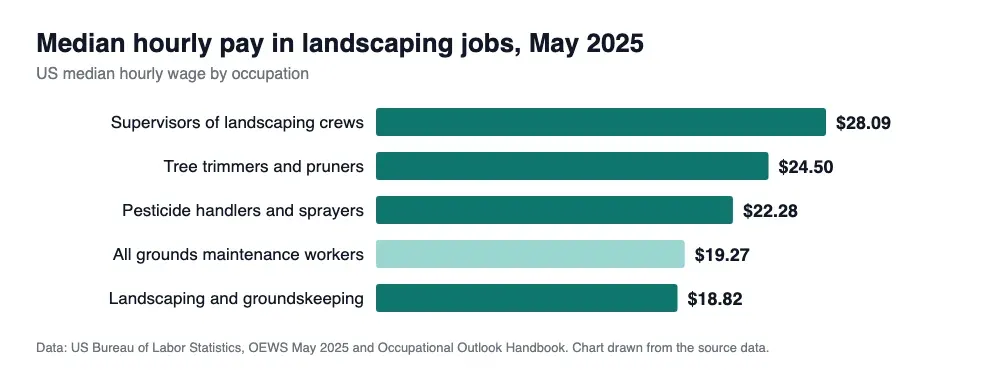 Figure 3: Supervisors earn about 50% more per hour than crew members, and tree work pays more than general landscaping. Source: Bureau of Labor Statistics, Occupational Employment and Wage Statistics, May 2026, with the all-workers figure from the Occupational Outlook Handbook. Chart drawn by us from the source data, captured 20 Oct 2026.
How many landscaping jobs are there?
The count depends on who is included. The Occupational Outlook Handbook counts self-employed owners, while the payroll survey does not.
- Landscaping and groundskeeping workers held 1,188,600 of the jobs in 2025 (BLS Occupational Outlook Handbook, Sep 2026).
- Tree trimmers and pruners held 70,600 (BLS Occupational Outlook Handbook, Sep 2026).
- Pesticide handlers, sprayers and applicators held 25,700 (BLS Occupational Outlook Handbook, Sep 2026).
- The payroll survey counted 952,640 landscaping and groundskeeping workers in May 2025 (BLS OEWS, May 2026).
- It counted 130,760 first-line supervisors of landscaping, lawn service and groundskeeping workers (BLS OEWS, May 2026).
- Services to buildings and dwellings employ 48% of grounds maintenance workers (BLS Occupational Outlook Handbook, Sep 2026).
- Self-employed workers make up 20% (BLS Occupational Outlook Handbook, Sep 2026).
- Government employs 8% (BLS Occupational Outlook Handbook, Sep 2026).
Who works in landscaping?
The workforce is mostly men, nearly half Hispanic or Latino, and spread across the age range.
- The Current Population Survey counted 1,114,000 employed landscaping and groundskeeping workers in 2025 (BLS Current Population Survey, Feb 2026).
- Women were 7.9% of them (BLS Current Population Survey, Feb 2026).
- Hispanic or Latino workers were 47.5% (BLS Current Population Survey, Feb 2026).
- The median age was 41.7 (BLS Current Population Survey, Feb 2026).
- 81,000 workers were 65 or older (BLS Current Population Survey, Feb 2026).
- 69,000 workers were 16 to 19 years old (BLS Current Population Survey, Feb 2026).
- Most grounds maintenance workers need one month or less of on-the-job training (BLS Occupational Outlook Handbook, Sep 2026).
What do landscaping workers earn?
Pay is low at the entry level and rises with tree work, chemical licenses and crew leadership.
- Landscaping and groundskeeping workers earned a median $18.82 an hour in May 2025 (BLS Occupational Outlook Handbook, Sep 2026).
- Tree trimmers and pruners earned $24.50 (BLS Occupational Outlook Handbook, Sep 2026).
- Pesticide handlers, sprayers and applicators earned $22.28 (BLS Occupational Outlook Handbook, Sep 2026).
- First-line supervisors earned a median $28.09 (BLS OEWS, May 2026).
- The lowest 10% of grounds maintenance workers earned less than $15.01 an hour, and the highest 10% earned more than $28.10 (BLS Occupational Outlook Handbook, Sep 2026).
- Full-time landscaping and groundskeeping workers had median weekly earnings of $783, against $1,204 for all full-time wage and salary workers (BLS Current Population Survey, Feb 2026).
- Grounds maintenance workers in services to buildings and dwellings earned a median $20.90 an hour (BLS Occupational Outlook Handbook, Sep 2026).
What is the job outlook?
Steady, with most openings coming from turnover rather than new jobs.
- BLS expects 60,100 more grounds maintenance jobs by 2035 (BLS Occupational Outlook Handbook, Sep 2026).
- Landscaping and groundskeeping jobs are projected to reach 1,244,200 (BLS Occupational Outlook Handbook, Sep 2026).
- About 162,500 openings a year are projected over the decade, many from workers who leave the occupation (BLS Occupational Outlook Handbook, Sep 2026).
When is landscaping demand highest, and how big is the swing?
Landscaping is a spring-to-fall trade, and the swing is larger than most owners plan for. Payroll and equipment costs run all year, while the work does not.
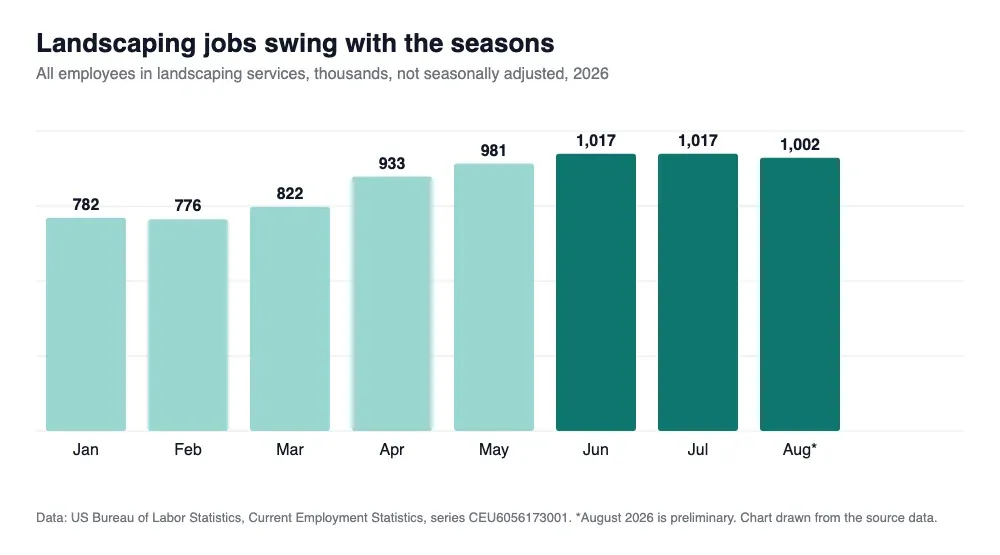 Figure 4: Landscaping payrolls were about 30% larger in summer 2026 than in winter, which shows how much staffing and billing change within one year. Source: Bureau of Labor Statistics, Current Employment Statistics, Sep 2026. Chart drawn by us from the source data, captured 20 Oct 2026.
How much do landscaping jobs rise and fall?
Hiring jumps in April and hours stretch in summer.
- Employment rose to 933,100 in April 2026 from 822,300 in March (BLS Current Employment Statistics, Sep 2026).
- Employment fell back to 848,200 by December 2025 (BLS Current Employment Statistics, Sep 2026).
- Production workers averaged 35.7 hours a week in February 2026 and 40.8 in August (BLS Current Employment Statistics, Sep 2026).
How concentrated is lawn and garden spending?
Product makers see the same curve, and it is steeper than the payroll data.
- Scotts shipped 41.6% of its fiscal 2025 net sales in the second quarter (Scotts Miracle-Gro 10-K, Nov 2025).
- It shipped 34.8% in the third quarter (Scotts Miracle-Gro 10-K, Nov 2025).
- The first quarter held 12.2% and the fourth quarter 11.4% (Scotts Miracle-Gro 10-K, Nov 2025).
- Toro ships its residential lawn and garden products mainly between February and June (Toro 10-K, Dec 2025).
How do landscape firms and suppliers smooth out the year?
By selling services that do not stop in winter, such as snow removal, and by working in places where grass grows all year.
- SiteOne booked 31.1% of its 2025 net sales in the second quarter and 20.0% in the first (SiteOne 10-K, Feb 2026).
- The second quarter produced 54.7% of SiteOne’s adjusted EBITDA, against 5.4% in the first (SiteOne 10-K, Feb 2026).
- BrightView earned $210.8 million from snow removal in fiscal 2025, a winter offset to slower landscape work (BrightView 10-K, Nov 2025).
- BrightView says its highest employment comes in its third and fourth fiscal quarters, April through September (BrightView 10-K, Nov 2025).
A shop that bills by the visit earns little in winter and carries the same truck payments. Clear prices, recurring service plans and fast invoices are how small crews keep cash steady between seasons. For payment timing across small businesses, see late payment data.
How much do households and businesses spend on lawn and landscape work?
People spend on lawns in two ways: on products they use themselves and on services they hire. Both are modest per home and large in total.
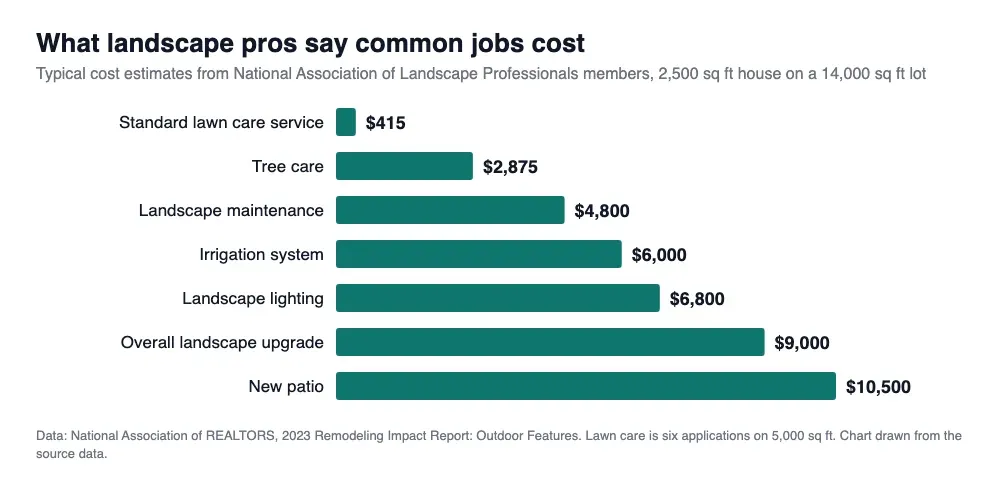 Figure 5: A lawn care plan costs hundreds of dollars while design and hardscape jobs cost thousands, so one price list has to cover very different job sizes. Source: National Association of REALTORS, 2023 Remodeling Impact Report: Outdoor Features, Mar 2023. Chart drawn by us from the source data, captured 20 Oct 2026.
What does the average household spend on lawn and garden products?
Less than it spends on hired lawn care, and a large share of owners still do the work themselves.
- Households spent $128.67 on lawn and garden supplies in 2024 (BLS Consumer Expenditure Survey, Aug 2026).
- They spent $53.25 on lawn and garden equipment (BLS Consumer Expenditure Survey, Aug 2026).
- On an average day in 2025, 10.0% of Americans did lawn and garden care, and those who did spent 1.90 hours on it (BLS American Time Use Survey, Jun 2026).
- Men were more likely to do it, at 11.2% against 8.9% for women (BLS American Time Use Survey, Jun 2026).
What do landscape professionals say common jobs cost?
NALP members estimated costs for a 2,500 square foot house on a 14,000 square foot lot. The figures are from 2023, so treat them as a baseline and not today’s price.
- A standard lawn care service of six seasonal applications on 5,000 square feet cost $415 (NAR Outdoor Features Report, Mar 2023).
- Annual landscape maintenance cost $4,800 (NAR Outdoor Features Report, Mar 2023).
- Tree care cost $2,875 (NAR Outdoor Features Report, Mar 2023).
- An irrigation system cost $6,000 (NAR Outdoor Features Report, Mar 2023).
- Landscape lighting cost $6,800 (NAR Outdoor Features Report, Mar 2023).
- An overall landscape upgrade cost $9,000 (NAR Outdoor Features Report, Mar 2023).
- A new patio cost $10,500 (NAR Outdoor Features Report, Mar 2023).
- REALTORS valued a standard lawn care service at 217% of its cost (NAR Outdoor Features Report, Mar 2023).
Do homeowners hire out the work?
Many still do it themselves, which caps what a crew can charge for simple jobs.
- 40% of consumers did their entire outdoor project themselves (NAR Outdoor Features Report, Mar 2023).
- 37% hired a professional for the whole job (NAR Outdoor Features Report, Mar 2023).
- 13% did some of the work, and 10% hired labor but bought the materials (NAR Outdoor Features Report, Mar 2023).
- 97% of NAR members said curb appeal is important in attracting buyers (NAR Outdoor Features Report, Mar 2023).
- 92% of REALTORS suggested that sellers improve curb appeal before listing (NAR Outdoor Features Report, Mar 2023).
- 92% of NALP members saw more demand for contracting work during the pandemic (NAR Outdoor Features Report, Mar 2023).
How big are retail lawn and garden sales?
The big box stores and the product makers show where consumer dollars land.
- Home Depot sold $10,467 million in its Outdoor Garden department in fiscal 2025, 6.4% of net sales (Home Depot 10-K, Mar 2026).
- Lowe’s sold $6,577 million in Lawn & Garden, 7.6% of sales (Lowe’s 10-K, Mar 2026).
- Scotts Miracle-Gro had net sales of $3,413.1 million in fiscal 2025, down 3.9% (Scotts Miracle-Gro 10-K, Nov 2025).
- Home Depot and Lowe’s together accounted for 52% of Scotts net sales (Scotts Miracle-Gro 10-K, Nov 2025).
For home improvement spending beyond the yard, see home improvement spending.
What do landscapers buy, and who sells it to them?
Landscape firms buy plants, stone, pipe, chemicals and machines, and the sellers publish more detail than most of the firms do.
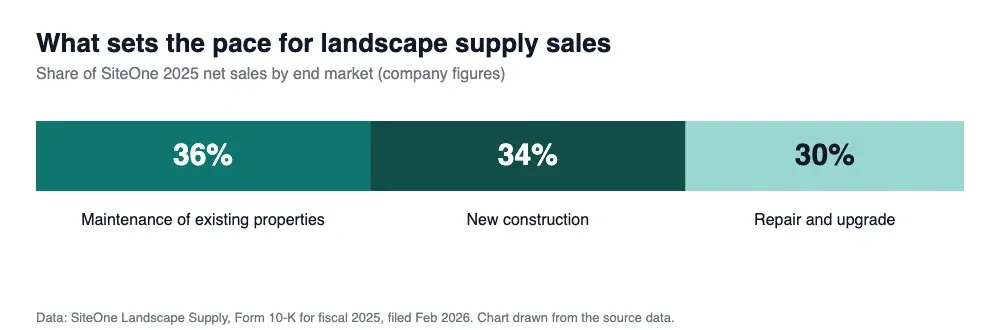 Figure 6: Maintenance of existing properties is the largest slice of landscape supply sales, which is why the trade holds up when new building slows. Source: SiteOne Landscape Supply, Form 10-K for fiscal 2025, Feb 2026. Chart drawn by us from the source data, captured 20 Oct 2026.
How big is wholesale landscape supply?
SiteOne is the one public distributor that reports this market in detail.
- SiteOne estimates its North American wholesale landscape supply market at about $25 billion (SiteOne 10-K, Feb 2026).
- Nursery products make up more than one third of industry sales, by SiteOne’s estimate (SiteOne 10-K, Feb 2026).
- Customers buying $25,000 or less a year made up 23% of SiteOne net sales, mid-size customers 29% and customers above $150,000 made up 48% (SiteOne 10-K, Feb 2026).
- Organic daily sales of fertilizer, control products and other agronomic goods grew 7% in 2025 (SiteOne 10-K, Feb 2026).
- Organic daily sales of hardscapes, irrigation, nursery goods and other landscaping products fell 1% (SiteOne 10-K, Feb 2026).
- SiteOne ran more than 670 branches in 45 states at the end of 2025 (SiteOne 10-K, Feb 2026).
How big are plants and sod?
Growers sold far more in 2024 than they did five years earlier.
- US horticultural specialty operations sold $18.3 billion of products in 2024, up from $13.8 billion in 2019 (USDA Census of Horticultural Specialties, Feb 2026).
- Nursery stock sales were $5.34 billion (USDA Census of Horticultural Specialties, Feb 2026).
- Bedding and garden plants sold for $4.03 billion (USDA Census of Horticultural Specialties, Feb 2026).
- Sod, sprigs and plugs sold for $1.70 billion, up from $1.27 billion in 2019 (USDA Census of Horticultural Specialties, Feb 2026).
- Potted herbaceous perennials sold for $1.36 billion (USDA Census of Horticultural Specialties, Feb 2026).
What is happening in equipment?
Professional buyers kept spending while homeowners pulled back.
- Toro’s Professional segment, which serves landscape contractors, golf courses and sports fields, had net sales of $3,624.0 million in fiscal 2025, up 1.9% (Toro 10-K, Dec 2025).
- Toro’s Residential segment fell 14.0% to $858.4 million (Toro 10-K, Dec 2025).
- Toro’s total net sales were $4,510.4 million, down 1.6% (Toro 10-K, Dec 2025).
What shapes demand: homes, lawns, water and golf?
Demand follows houses, weather and water rules more than it follows fashion.
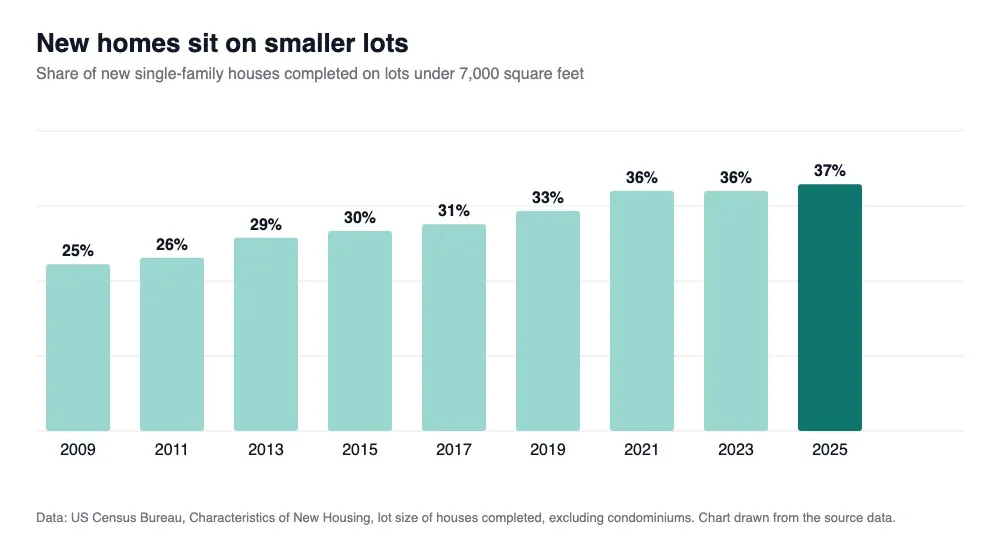 Figure 7: The share of new homes on small lots has climbed for more than a decade, which means less lawn per home and more tight, high-detail yard work. Source: Census Bureau, Characteristics of New Housing lot size table, Jul 2026. Chart drawn by us from the source data, captured 20 Oct 2026.
How much lawn is there in the US?
More than most people guess, and it is a managed crop.
- NASA researchers estimated that lawns cover about 128,000 square kilometers in the US (NASA Earth Observatory, Nov 2005).
- That is roughly three times the acreage of irrigated corn (NASA Earth Observatory, Nov 2005).
Are new lots getting smaller?
Yes. New homes sit on less land, which shifts work from mowing large lawns to maintaining small, dense yards.
- Builders completed 1,005,000 single-family homes in 2025 (Census Bureau New Housing Characteristics, Jul 2026).
- 41% of those built for sale had a lot under 7,000 square feet (Census Bureau New Housing Characteristics, Jul 2026).
- Lots of 22,000 square feet or more fell from 30% of completions in 2009 to 18% in 2025 (Census Bureau New Housing Characteristics, Jul 2026).
How much water goes to outdoor use?
Outdoor water is where irrigation work and water rules meet.
- Outdoor use can reach 60% of household water use in arid regions (EPA WaterSense, Mar 2026).
- As much as 50% of outdoor water is lost to wind, evaporation and runoff from inefficient irrigation (EPA WaterSense, Mar 2026).
- A WaterSense labeled irrigation controller can cut irrigation water use by up to 30% (EPA WaterSense, Mar 2026).
- A poorly maintained automatic irrigation system can waste up to 25,000 gallons a year (EPA WaterSense, Mar 2026).
Does golf still need grounds crews?
Golf is a large, steady customer for turf equipment and grounds labor.
- About 16,000 golf courses sat at 14,000 facilities at the end of 2025 (National Golf Foundation, Dec 2025).
- 29.1 million people played on a golf course in 2025 (National Golf Foundation, Dec 2025).
What cost and labor pressures do landscaping shops face?
Fuel, labor and equipment costs are all moving. Shops that set prices once a year are exposed when costs jump mid-season.
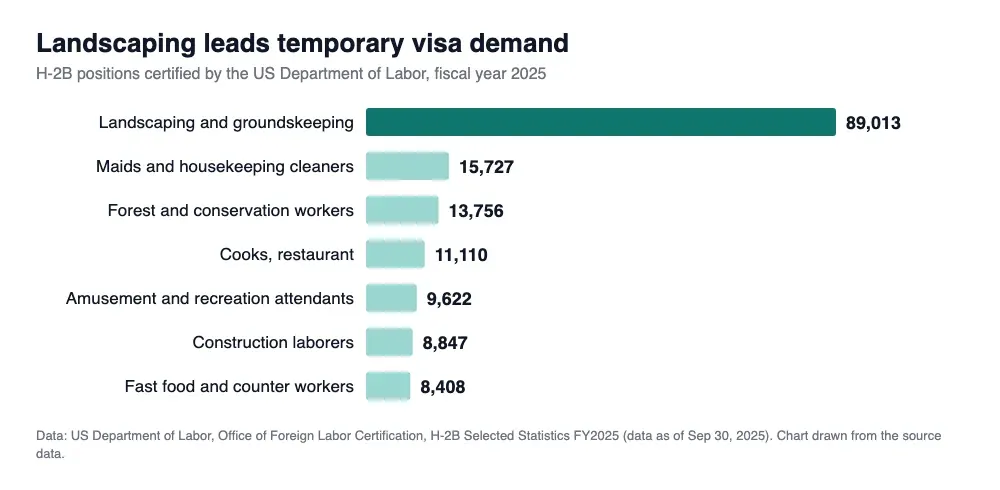 Figure 8: Landscaping is far ahead of every other occupation in temporary visa demand, a sign of how hard seasonal crews are to hire locally. Source: Department of Labor, H-2B Selected Statistics FY2025, Sep 2025. Chart drawn by us from the source data, captured 20 Oct 2026.
How big is the seasonal visa pipeline?
Large landscape firms lean on the H-2B program for summer crews, and the program is capped.
- The Department of Labor certified 232,434 H-2B positions in fiscal 2025 (Department of Labor H-2B Statistics, Sep 2025).
- Texas had 22,594 certified positions (Department of Labor H-2B Statistics, Sep 2025).
- Florida had 21,482 (Department of Labor H-2B Statistics, Sep 2025).
- Landscape Workshop LLC had 1,840 certified positions (Department of Labor H-2B Statistics, Sep 2025).
- BrightView Landscapes had 1,178 (Department of Labor H-2B Statistics, Sep 2025).
- Congress set the H-2B cap at 66,000 a year, with 33,000 for each half of the fiscal year (USCIS H-2B Cap, Sep 2026).
How much have fuel prices climbed?
Crews burn gasoline in mowers and trimmers and diesel in trucks and larger equipment.
- West Coast regular gasoline averaged $5.557 a gallon on Oct 19, 2026 (EIA Gasoline and Diesel Fuel Update, Oct 2026).
- West Coast diesel averaged $7.394 (EIA Gasoline and Diesel Fuel Update, Oct 2026).
- Midwest gasoline averaged $4.145, up $1.340 from a year earlier (EIA Gasoline and Diesel Fuel Update, Oct 2026).
When fuel and labor jump, a price list set in spring stops covering the job by fall. Shops that keep one current price book and quote from it can reprice in an afternoon. For how service pricing works across trades, see pricing data.
How dangerous is the work?
Landscape work carries real risk, and tree work carries the most.
- 239 grounds maintenance workers died on the job in 2024 (BLS Census of Fatal Occupational Injuries, Feb 2026).
- The wider group of building and grounds cleaning and maintenance occupations lost 356 workers (BLS Census of Fatal Occupational Injuries, Feb 2026).
- Tree trimmers and pruners have one of the highest rates of injuries and illnesses of all occupations (BLS Occupational Outlook Handbook, Sep 2026).
What is happening to labor costs?
Hourly pay for crew members is rising, and the largest commercial landscaper reports few union members.
- Average hourly earnings of production and nonsupervisory workers in landscaping services were $26.38 in January 2026 and $27.71 in August (BLS Current Employment Statistics, Sep 2026).
- About 5% of BrightView employees are covered by collective bargaining agreements (BrightView 10-K, Nov 2025).
For more on the labor squeeze across the trades, see skilled trade shortage data.
Methodology and Sources
Each figure comes from the agency, regulator or company that produced it, and each link points to the report, data table or filing. No roundups, market research resellers or blog summaries are used. Federal data files were downloaded and read directly, and company figures come from annual reports filed with the SEC. Landscaping services means NAICS 561730 for employer data and NAICS 56173 for nonemployer data. Census firm counts by state count a firm in every state where it operates, so state numbers add to more than the national total. The 2025 Current Population Survey averages exclude October because of the federal government shutdown. OEWS counts wage and salary jobs only, so it is lower than the Occupational Outlook Handbook, which includes the self-employed. Figures marked preliminary may change. The page is reviewed and refreshed monthly.
Glossary
- NAICS: North American Industry Classification System, the code system that groups businesses by industry.
- SUSB: Statistics of U.S. Businesses, a Census Bureau series on firms, establishments, employment, payroll and receipts.
- Nonemployer firm: a business with no paid employees, usually a sole proprietor.
- QCEW: Quarterly Census of Employment and Wages, a BLS count of jobs and wages from unemployment insurance records.
- OEWS: Occupational Employment and Wage Statistics, a BLS survey of wage and salary jobs by occupation.
- CES: Current Employment Statistics, the monthly BLS payroll survey.
- CPS: Current Population Survey, the monthly household survey behind US unemployment data.
- H-2B: a US visa for temporary non-farm workers, capped by Congress.
- EBITDA: earnings before interest, taxes, depreciation and amortization.
- NALP: National Association of Landscape Professionals.
Sources
- Census Bureau, Statistics of U.S. Businesses 2022, Apr 2025
- Census Bureau, SUSB by receipts size, Apr 2025
- Census Bureau, SUSB by state, Apr 2025
- Census Bureau, Nonemployer Statistics 2024, Sep 2026
- Census Bureau, Characteristics of New Housing highlights, Jul 2026
- Census Bureau, lot size of new houses table, Jul 2026
- BLS, Occupational Outlook Handbook, Grounds Maintenance Workers, Sep 2026
- BLS, Occupational Employment and Wages, May 2025, Table 1, May 2026
- BLS, Current Employment Statistics, landscaping services employment, Sep 2026
- BLS, Current Employment Statistics, seasonally adjusted employment, Sep 2026
- BLS, Current Employment Statistics, average weekly hours, Sep 2026
- BLS, Current Employment Statistics, average hourly earnings, Sep 2026
- BLS, Quarterly Census of Employment and Wages, NAICS 561730 annual 2025, Aug 2026
- BLS, Employment Projections, employment and output by industry, Sep 2026
- BLS, Current Population Survey, Table 11, Feb 2026
- BLS, Current Population Survey, Table 11b, Feb 2026
- BLS, Current Population Survey, Table 39, Feb 2026
- BLS, Consumer Expenditure Survey, 2024 detailed means, Aug 2026
- BLS, American Time Use Survey, Table 1, Jun 2026
- BLS, Census of Fatal Occupational Injuries, Table 3, Feb 2026
- USDA NASS, 2024 Census of Horticultural Specialties, Feb 2026
- Department of Labor, H-2B Selected Statistics FY2025, Sep 2025
- USCIS, H-2B Temporary Non-Agricultural Workers, Sep 2026
- EPA, WaterSense Statistics and Facts, Mar 2026
- NASA Earth Observatory, Turf Grass, Nov 2005
- EIA, Gasoline and Diesel Fuel Update, Oct 2026
- National Golf Foundation, Golf Industry Research, Dec 2025
- National Association of REALTORS, 2023 Remodeling Impact Report: Outdoor Features, Mar 2023
- BrightView Holdings, Form 10-K for fiscal 2025, Nov 2025
- Scotts Miracle-Gro, Form 10-K for fiscal 2025, Nov 2025
- Toro Company, Form 10-K for fiscal 2025, Dec 2025
- Home Depot, Form 10-K for fiscal 2025, Mar 2026
- Lowe’s, Form 10-K for fiscal 2025, Mar 2026
- SiteOne Landscape Supply, Form 10-K for fiscal 2025, Feb 2026