HVAC technician statistics describe a trade that is big, steady and open to people without a four-year degree. This page puts the numbers in one place and ties each one to the agency, school group or regulator that produced it, with a date.
The data comes in three layers. Labor agencies count jobs, pay, age and growth. Schools and federal education files count who is training. Regulators and states decide who may handle refrigerant or run a shop. We keep the layers apart so you can see where each number came from.
If you run a small HVAC shop, start with pay, training and licenses. They set what a technician costs you and what a new hire still needs before the first solo call. The shortage itself has its own page: see skilled trade shortage statistics. For the market around the trade, see HVAC industry statistics.
Key Takeaways
- HVAC technicians held 440,900 jobs in 2025. (BLS Occupational Outlook Handbook, Aug 2026)
- The median HVAC technician earned $61,010 in May 2025. The median for all occupations was $50,980. (BLS Occupational Outlook Handbook, Aug 2026)
- HVAC technician employment is projected to add 48,200 jobs by 2035, growing faster than the repair trades as a group (5%) and all jobs (3%). (BLS Occupational Outlook Handbook, Aug 2026)
- 68% of HVAC technicians work for plumbing, heating and air-conditioning contractors. (BLS Occupational Outlook Handbook, Aug 2026)
- Florida has more HVAC technicians than any other state, 39,160 in May 2025. (BLS OEWS, May 2026)
- Workers aged 25 to 34 are the largest age group, at 159,000 of 561,000 employed HVAC technicians. (BLS Current Population Survey, Feb 2026)
- 41.6% of HVAC technicians list a high school diploma or equivalent as their highest education. (BLS Employment Projections, Sep 2026)
- Two-year HVACR programs enrolled 30,495 students in spring 2026, up 16.7% in a year. (National Student Clearinghouse Research Center, Jun 2026)
- US schools awarded 11,688 HVAC certificates of one to two years in 2023-24. (NCES IPEDS, Sep 2025)
- EPA lists 87 programs approved to give the Section 608 refrigerant exam. (EPA, Aug 2026)
- Section 608 certification credentials do not expire. (EPA, Jul 2026)
- Plumbing, heating and air-conditioning contractors logged 3.0 recordable injuries per 100 full-time workers in 2024, against 2.3 across private industry. (BLS Survey of Occupational Injuries and Illnesses, Jan 2026)
- Traditional HVAC employment fell by 26,965 in 2025 while Certified HVAC employment grew by 16,248. (DOE USEER, Aug 2026)
- 58% of HVAC technicians work outdoors in all weather every day. (O*NET OnLine, Aug 2026)
How many HVAC technicians work in the United States?
There is no single headcount. Each agency counts a different group of people, and the gaps between the counts are part of the story.
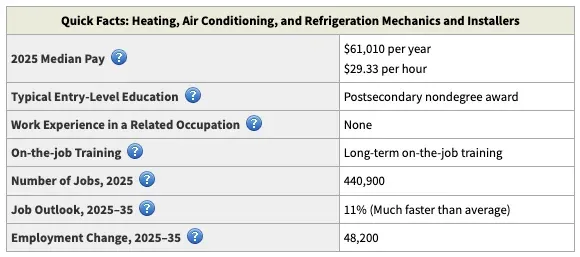 Figure 1: BLS counts the trade, names how people enter it and expects it to keep growing, which is why every count on this page starts from these quick facts. Source: BLS, Occupational Outlook Handbook, Heating, Air Conditioning, and Refrigeration Mechanics and Installers, Aug 2026. Screenshot of the source page, captured 20 Oct 2026.
Why do the government counts differ?
Two BLS surveys and one Department of Energy survey each count a different slice, so the right number depends on the question.
- The employer survey counted 409,670 wage and salary HVAC technician jobs in May 2025 (BLS OEWS, May 2026).
- That survey leaves out the self-employed and the owners of unincorporated firms (BLS OEWS, May 2026).
- The household survey, where people describe their own job, counted 561,000 employed HVAC technicians in 2025 (BLS Current Population Survey, Feb 2026).
- The Department of Energy counted 582,351 jobs at businesses doing traditional HVAC work in 2025. That count takes in jobs of every kind at those businesses, not only technicians (DOE USEER, Aug 2026).
- In the wider energy efficiency sector, installation or repair jobs made up 33.5% of employment, or 798,500 workers, in 2024 (DOE USEER, Aug 2025).
What kinds of employers hire HVAC technicians?
Most work for contractors, and a small group works in distribution and schools.
- Wholesale trade, schools and retail each employ 3% of HVAC technicians (BLS Occupational Outlook Handbook, Aug 2026).
- Construction firms accounted for 317,235 of the traditional HVAC jobs in the Department of Energy count (DOE USEER, Aug 2026).
- Professional and business services firms accounted for 156,889 (DOE USEER, Aug 2026).
- Wholesale trade accounted for 61,369 (DOE USEER, Aug 2026).
Which states employ the most HVAC technicians?
Florida leads the country, as the Key Takeaways show. A few other large states hold much of the rest of the work.
- California employed 35,130 HVAC technicians in May 2025 (BLS OEWS, May 2026).
- Texas employed 34,730 (BLS OEWS, May 2026).
- New York employed 24,430 (BLS OEWS, May 2026).
What is the HVAC technician salary, according to the Bureau of Labor Statistics?
Pay is solid for a job with no degree requirement, and it sits below electricians and plumbers. The averages also hide a wide spread between states and employer types.
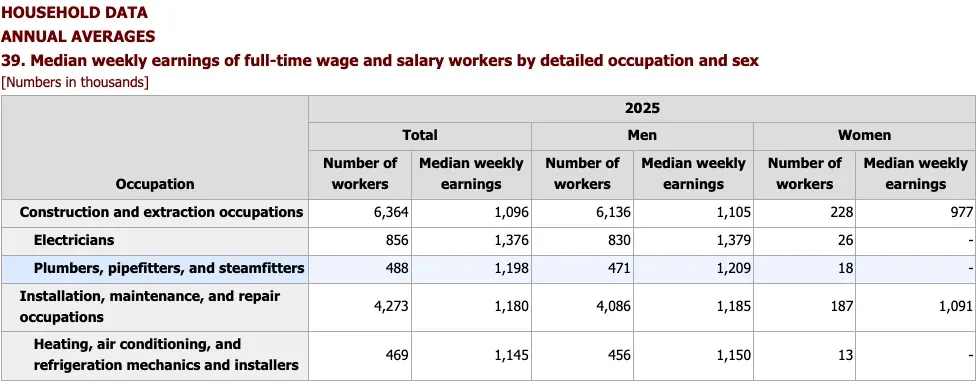 Figure 2: Full-time HVAC technicians earn less per week than electricians and plumbers, and a little less than the repair trades as a group. Source: BLS, Current Population Survey table 39, Feb 2026. Screenshot of the source table with unrelated rows hidden, captured 20 Oct 2026.
What is the average HVAC technician wage?
BLS reports the mean and the median, and they tell the same story from two sides.
- The mean wage was $64,780 a year, or $31.14 an hour, in May 2025 (BLS OEWS, May 2026).
- The lowest 10% earned less than $40,050 and the highest 10% earned more than $95,210 (BLS Occupational Outlook Handbook, Aug 2026).
- Across all jobs the mean wage was higher, at $69,770 (BLS OEWS, May 2026).
- These wages count commissions and production bonuses but leave out overtime pay (BLS OEWS, May 2026).
How does pay change by employer?
The employer type moves the median by more than $10,000.
- HVAC technicians in wholesale trade had a median wage of $71,190 (BLS Occupational Outlook Handbook, Aug 2026).
- Those at HVAC contractors had a median of $60,030 (BLS Occupational Outlook Handbook, Aug 2026).
How does HVAC pay compare with other trades?
HVAC pays about the same as the repair trades and a little less than the two trades closest to it.
- The median for installation, maintenance and repair occupations as a group was $59,620 (BLS Occupational Outlook Handbook, Aug 2026).
- Electricians had a median of $63,190 and plumbers had $63,800 (BLS Employment Projections, Aug 2026).
- Full-time HVAC technicians had median weekly earnings of $1,145, against $1,376 for electricians and $1,198 for plumbers (BLS Current Population Survey, Feb 2026).
Which states pay HVAC technicians the most and the least?
The gap between the top and bottom states is large. A technician in Washington earns far more than one in Arkansas.
- Washington had a mean wage of $78,860 (BLS OEWS, May 2026).
- Massachusetts had a mean wage of $77,760 (BLS OEWS, May 2026).
- Arkansas had a mean wage of $51,150 (BLS OEWS, May 2026).
What does that pay mean for pricing a job?
A technician’s wage is one cost inside the price of a job. A shop also pays for the truck, parts, tools, insurance and the hours nobody bills. A flat rate price book turns those costs into one price that the customer sees before work starts.
Who are HVAC technicians?
The typical technician is mid-career, and the trade is a little younger than the workforce as a whole.
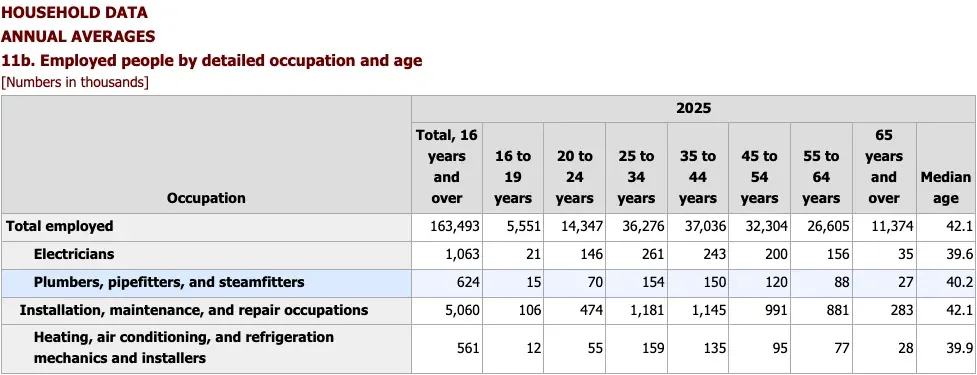 Figure 3: The 25 to 34 group is the largest, and the median age of HVAC technicians sits close to electricians and plumbers and below the average for all workers. Source: BLS, Current Population Survey table 11b, Feb 2026. Screenshot of the source table with unrelated rows hidden, captured 20 Oct 2026.
How old are HVAC technicians?
The age spread is wide, with strong numbers in the middle and a smaller group near retirement.
- The median age of HVAC technicians was 39.9, against 39.6 for electricians, 40.2 for plumbers and 42.1 for all workers (BLS Current Population Survey, Feb 2026).
- Another 135,000 were aged 35 to 44, and 95,000 were aged 45 to 54 (BLS Current Population Survey, Feb 2026).
- Another 77,000 were aged 55 to 64 (BLS Current Population Survey, Feb 2026).
- Only 55,000 were aged 20 to 24 and 12,000 were aged 16 to 19 (BLS Current Population Survey, Feb 2026).
What is the ethnic makeup of HVAC technicians?
The Hispanic share is above the national average for all workers and close to the other building trades.
- 26.7% of HVAC technicians were Hispanic or Latino, against 20.0% of all employed people (BLS Current Population Survey, Feb 2026).
- 10.4% were Black or African American and 4.4% were Asian (BLS Current Population Survey, Feb 2026).
- Among electricians, 25.0% were Hispanic or Latino, and among plumbers the share was 30.3% (BLS Current Population Survey, Feb 2026).
How do people train to become HVAC technicians?
Most technicians learn in a short school program or on the job, and the schools are filling up. A four-year degree is rare in this trade.
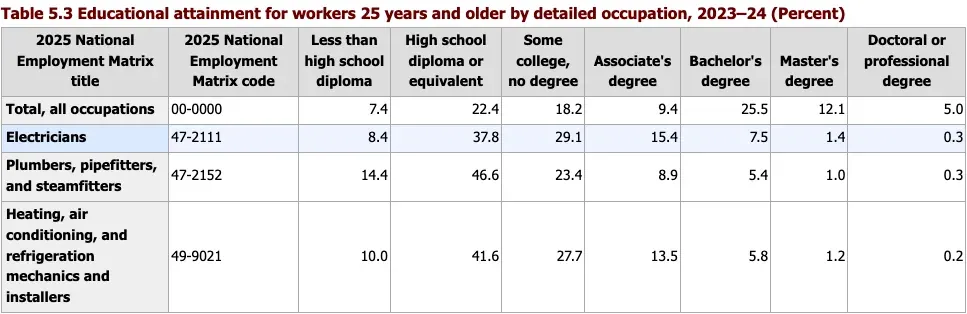 Figure 4: HVAC technicians cluster at a high school diploma and some college, while only a small share hold a bachelor’s degree compared with all workers. Source: BLS, Employment Projections table 5.3, Sep 2026. Screenshot of the source table with unrelated rows hidden, captured 20 Oct 2026.
What schooling do working HVAC technicians have?
Most have a diploma or some college, and a small group left school early.
- 27.7% have some college but no degree (BLS Employment Projections, Sep 2026).
- 13.5% hold an associate’s degree (BLS Employment Projections, Sep 2026).
- 5.8% hold a bachelor’s degree, against 25.5% across all occupations (BLS Employment Projections, Sep 2026).
How long does the training take?
The answer depends on the path, and two federal sources describe the same range.
- Postsecondary HVAC programs generally last from 6 months to 2 years and lead to a certificate or an associate’s degree (BLS Occupational Outlook Handbook, Aug 2026).
- Apprenticeships usually last several years and pay for on-the-job training each year (BLS Occupational Outlook Handbook, Aug 2026).
- O*NET puts the trade in Job Zone 3, where workers typically need one to two years of on-the-job and informal training (O*NET OnLine, Aug 2026).
- Construction registered apprenticeship served 480,399 apprentices in 2025, up 28% over five years (Apprenticeship.gov, Oct 2026).
How many students are enrolled in HVAC programs?
Enrollment is growing much faster than the schools that surround it.
- Enrollment in two-year HVACR programs rose 30.3% in spring 2025, to 26,139 from 20,054 a year earlier (National Student Clearinghouse Research Center, Jun 2026).
- Spring 2021 enrollment in the same programs was 18,621 (National Student Clearinghouse Research Center, Jun 2026).
- Four-year institutions enrolled 1,031 HVACR students in spring 2026, up 35.6% (National Student Clearinghouse Research Center, Jun 2026).
- Associate-focused schools that also grant some bachelor’s degrees enrolled 2,233, up 16.0% (National Student Clearinghouse Research Center, Jun 2026).
- All mechanic and repair programs at two-year schools enrolled 133,987, up 9.8% (National Student Clearinghouse Research Center, Jun 2026).
- Enrollment at vocation-focused public two-year colleges rose only 2.8% (National Student Clearinghouse Research Center, Jun 2026).
- Undergraduate certificate programs of all kinds grew 10.2% (National Student Clearinghouse Research Center, Jun 2026).
What awards do HVAC programs hand out?
Certificates dominate. The counts below are first majors reported under the HVACR program code in the 2023-24 completions file.
- 8,836 awards were certificates of at least 12 weeks but less than one year (NCES IPEDS, Sep 2025).
- 2,254 were associate’s degrees (NCES IPEDS, Sep 2025).
- 319 were certificates of less than 12 weeks (NCES IPEDS, Sep 2025).
- 154 were certificates of at least two but less than four years (NCES IPEDS, Sep 2025).
- 430 institutions awarded at least one certificate of one to two years (NCES IPEDS, Sep 2025).
- 276 institutions awarded at least one certificate of 12 weeks to a year (NCES IPEDS, Sep 2025).
- 221 institutions awarded at least one associate’s degree (NCES IPEDS, Sep 2025).
What certifications and licenses do HVAC technicians need?
The federal rule is short. If you handle refrigerant, you need a Section 608 card. Everything else depends on your state.
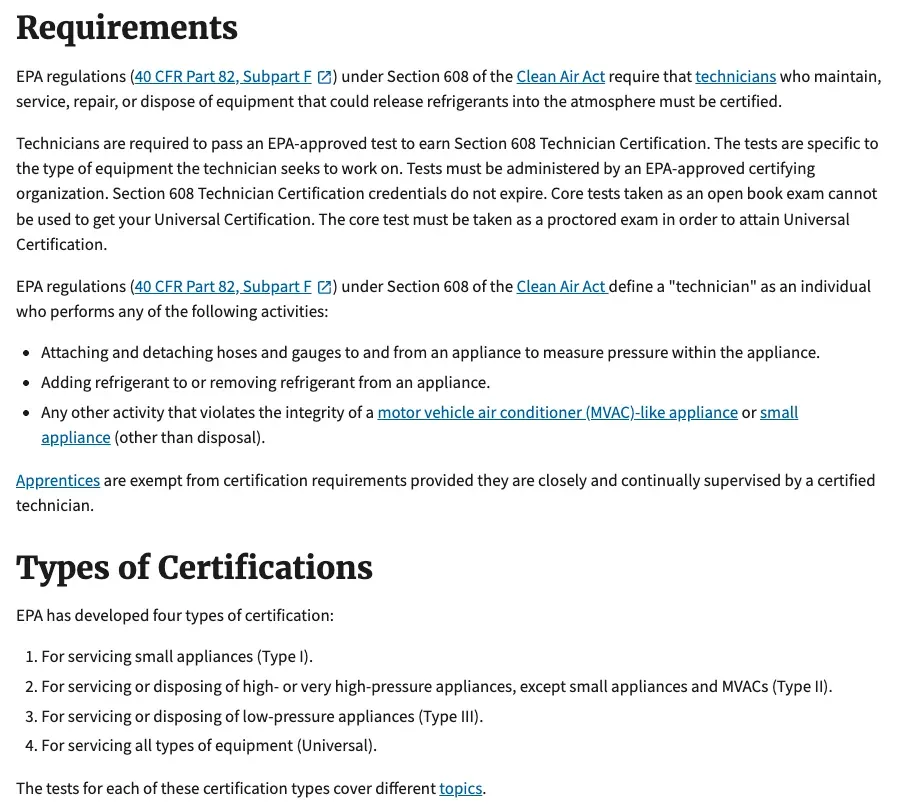 Figure 5: EPA defines technician work by what a person does to a system, exempts supervised apprentices and sets four certification types by equipment. Source: EPA, Section 608 Technician Certification Requirements, Jul 2026. Screenshot of the source page, captured 20 Oct 2026.
What does EPA require?
Four tests cover four kinds of equipment, and one card can cover them all.
- Type I covers servicing small appliances (EPA, Jul 2026).
- Type II covers servicing or disposing of high-pressure and very high-pressure appliances (EPA, Jul 2026).
- Type III covers servicing or disposing of low-pressure appliances (EPA, Jul 2026).
- Universal covers all types of equipment (EPA, Jul 2026).
- Apprentices are exempt if a certified technician closely and continually supervises them (EPA, Jul 2026).
- The core test must be proctored to count toward Universal certification (EPA, Jul 2026).
- 12 of the listed programs offer remote testing (EPA, Aug 2026).
- 8 of the listed programs offer the test in Spanish (EPA, Aug 2026).
How does NATE certification work?
NATE is a private industry credential. It is separate from the EPA card.
- NATE was founded in 1997 (NATE, Oct 2026).
- The traditional pathway takes two exams, a 50-question Core exam and a 100-question Specialty exam (NATE, Oct 2026).
- A score of 70% passes: 35 of 50 on the Core exam and 70 of 100 on an installation or service specialty exam (NATE, Oct 2026).
- The Senior Level Efficiency Analyst exam has a passing score of 75% (NATE, Oct 2026).
- The Certified HVAC Professional pathway uses five exams (NATE, Oct 2026).
- NATE certifications must be renewed every two years (NATE, Oct 2026).
- Renewal takes 16 hours of continuing education or a retake of the specialty exam (NATE, Oct 2026).
- A 120-day grace period follows expiration (NATE, Oct 2026).
- ESCO Institute says it has issued more than 2 million credentials across nearly 100 certifications (ESCO Institute, Oct 2026).
What does Texas require of technicians?
Texas shows how far state rules can go. It registers helpers, certifies skilled technicians and licenses contractors.
- Anyone who helps a licensed contractor with air conditioning and refrigeration maintenance or repair must register as a technician (Texas TDLR, Oct 2026).
- The registration fee is $20 and the applicant must be at least 16 (Texas TDLR, Oct 2026).
- A registration is valid for one year (Texas TDLR, Oct 2026).
- A registered technician works under a licensed contractor and may not advertise services (Texas TDLR, Oct 2026).
- A certified technician needs at least 24 months of supervised experience, or a state-approved training program finished in the past 48 months (Texas TDLR, May 2026).
- The certified technician application fee is $50 (Texas TDLR, May 2026).
- A contractor license needs 48 months of experience in the past 72 months, or 36 months in the past 48 months for a certified technician of a year or more (Texas TDLR, Oct 2026).
- The contractor application fee is $115 and the applicant must be at least 18 (Texas TDLR, Oct 2026).
- A Class B license covers cooling systems of 25 tons and under and heating systems of 1.5 million BTUs an hour and under (Texas TDLR, Oct 2026).
What does Florida require of a contractor?
Florida’s contractor application shows the path for an owner, and it counts experience in hours.
- A Class B air-conditioning contractor can qualify with four years of experience as a worker or foreman, at least one year as a foreman (Florida DBPR, Jul 2024).
- The state counts one year of experience as 2,000 hours (Florida DBPR, Jul 2024).
- The initial certification fee is $145 or $245, depending on the licensing cycle (Florida DBPR, Jul 2024).
- An applicant with a credit score under 660 must complete a 14-hour financial responsibility course (Florida DBPR, Jul 2024).
- The minimum liability coverage for this category is $100,000 for public liability and $25,000 for property damage (Florida DBPR, Jul 2024).
What is the work like day to day?
The job mixes constant talk with customers and hard physical conditions. O*NET asks working technicians how often they face each one.
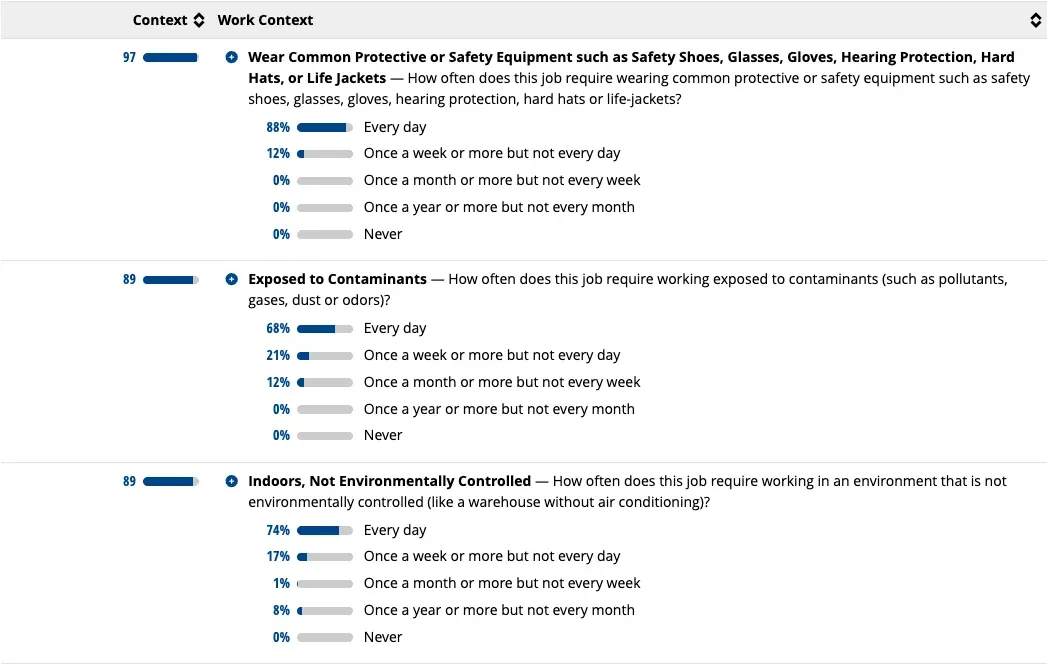 Figure 6: Most technicians wear protective equipment every day, and most work in uncontrolled indoor spaces and around contaminants. Three of the work context items are shown. Source: O*NET OnLine, Work Context for 49-9021.00, Aug 2026. Screenshot of the source page with other rows hidden, captured 20 Oct 2026.
What conditions do HVAC technicians work in?
Weather, heat and heights are part of an ordinary week.
- 74% work in indoor spaces without climate control every day (O*NET OnLine, Aug 2026).
- 50% work outdoors under cover every day (O*NET OnLine, Aug 2026).
- 34% face very hot or very cold temperatures every day (O*NET OnLine, Aug 2026).
- 31% work in high places every day (O*NET OnLine, Aug 2026).
- 58% spend time in an enclosed vehicle or enclosed equipment every day (O*NET OnLine, Aug 2026).
What hazards come with the job?
The risk data comes from two sources. O*NET records exposure, and BLS records injuries.
- 88% wear common protective equipment every day (O*NET OnLine, Aug 2026).
- 68% work around contaminants such as gases, dust or odors every day (O*NET OnLine, Aug 2026).
- 45% are exposed to hazardous equipment every day (O*NET OnLine, Aug 2026).
- 28% are exposed to hazardous conditions every day (O*NET OnLine, Aug 2026).
- 34% wear specialized protective equipment, such as breathing apparatus, every day (O*NET OnLine, Aug 2026).
- Injuries that caused days away, restriction or transfer ran at 1.7 per 100 full-time workers at plumbing, heating and air-conditioning contractors, against 1.4 across private industry (BLS Survey of Occupational Injuries and Illnesses, Jan 2026).
- Across all construction, the recordable injury rate was 2.2 per 100 full-time workers (BLS Survey of Occupational Injuries and Illnesses, Jan 2026).
How much time goes to people, calls and judgment?
The trade is a customer job as much as a mechanical one.
- 98% have face-to-face discussions every day (O*NET OnLine, Aug 2026).
- 81% are in constant contact with others (O*NET OnLine, Aug 2026).
- 79% use email every day (O*NET OnLine, Aug 2026).
- 60% take phone calls every day (O*NET OnLine, Aug 2026).
- 77% say working on a team is extremely important (O*NET OnLine, Aug 2026).
- 55% say being exact is extremely important (O*NET OnLine, Aug 2026).
- 44% say a mistake that is hard to fix would be extremely serious (O*NET OnLine, Aug 2026).
- 42% say the job gives them a lot of freedom to make decisions (O*NET OnLine, Aug 2026).
- 47% report very high responsibility for the health and safety of other workers (O*NET OnLine, Aug 2026).
How much paperwork follows each job?
Every call ends with a record of what was done. The paperwork is part of the job description, not an extra.
- BLS says technicians must keep complete records of the work, including the time it took and the parts and equipment used (BLS Occupational Outlook Handbook, Aug 2026).
- Residential technicians may also sell service contracts that cover periodic maintenance (BLS Occupational Outlook Handbook, Aug 2026).
Writing a record by hand at night, or retyping notes from the truck, is time that no customer pays for. Quoting and invoicing tools exist so the record made on site is the same record that becomes the invoice.
How many hours do HVAC technicians work?
The week is mostly a standard one, with spikes in peak seasons.
- 83% report a typical week of 40 hours, and 17% report more than 40 (O*NET OnLine, Aug 2026).
- Schedules can include evenings and weekends, on-call emergencies and overtime in peak heating and cooling seasons (BLS Occupational Outlook Handbook, Aug 2026).
What is the job outlook for HVAC technicians?
The outlook is good, and it rests on equipment that is already installed. Repair and replacement are a large part of the work, so demand does not hinge on new construction alone.
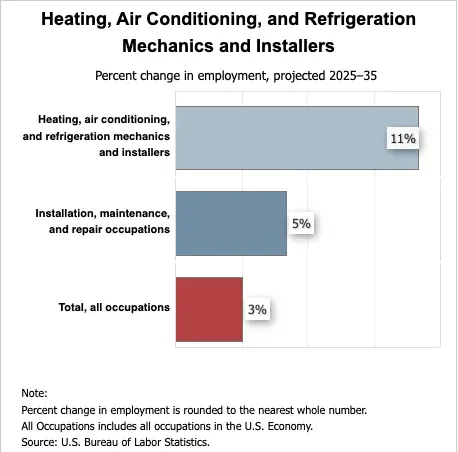 Figure 7: BLS expects HVAC technician employment to grow faster than the repair trades as a group and faster than the whole job market. Source: BLS, Occupational Outlook Handbook, Job Outlook, Aug 2026. The source’s own chart, cropped from a screenshot of the page and captured 20 Oct 2026.
How does the growth compare with other trades?
HVAC is growing, but it is not the only building trade that is.
- Electricians are projected to grow 9.2% by 2035, and plumbers 6.8% (BLS Employment Projections, Aug 2026).
What drives HVAC technician demand?
BLS and the Department of Energy name the same forces.
- BLS says commercial construction, including data centers, and residential building construction are expected to drive HVAC employment growth (BLS Occupational Outlook Handbook, Aug 2026).
- BLS adds that technicians will be needed to retrofit, upgrade or replace existing climate-control systems (BLS Occupational Outlook Handbook, Aug 2026).
- The Department of Energy expects demand for HVAC technicians to grow as states and Tribes run home energy rebate programs (DOE USEER, Aug 2026).
How often do technicians leave the trade?
Fewer HVAC technicians leave the labor force than workers in general, which helps the trade hold on to its people.
- The labor force exit rate for HVAC technicians is 2.7% a year, against 4.2% for all occupations (BLS Employment Projections, Aug 2026).
- The total separation rate, which adds moves to other occupations, is 7.7% a year, against 9.7% for all occupations (BLS Employment Projections, Aug 2026).
How is HVAC work changing?
The mix of work is moving toward efficient and heat pump equipment, and the Department of Energy shows it in its job counts.
- Certified HVAC employment, which excludes heat pumps, reached 218,968 in 2025 (DOE USEER, Aug 2026).
- Other high-efficiency HVAC work that falls outside certification employed 152,069 (DOE USEER, Aug 2026).
- The Department of Energy ties some of the Certified HVAC growth to households buying before federal tax credits ended at the close of 2025 (DOE USEER, Aug 2026).
- It also links part of the traditional HVAC decline to workers spending more time on certified equipment (DOE USEER, Aug 2026).
Methodology and Sources
Every number comes from the agency, school group or regulator that produced it. We did not use roundups or salary blogs. BLS pages were read from the official release or table. The OEWS state figures were read from the BLS public data series, and each citation links to the series page. We checked the series against the BLS release. The national figures match, and the 51 state employment values add up to within 20 jobs of the national total.
Three datasets were read from their files. The enrollment counts are from the appendix to the National Student Clearinghouse Research Center spring 2026 report. The award counts are first majors in the 2023-24 IPEDS Completions file under the HVACR program code. The Department of Energy counts are from the 2026 public data file. State and trade-group pages that carry no date are dated to the month we checked them, October 2026. BLS publishes more than one job count, which is why the counts in the first section differ. The page is reviewed monthly and each number is re-read from its source.
Glossary
- BLS: Bureau of Labor Statistics, the US agency that counts jobs, pay and injuries.
- CPS: Current Population Survey, the monthly household survey that BLS runs.
- DART: days away from work, job restriction or transfer, a BLS injury measure.
- DOE: US Department of Energy.
- EPA Section 608: the part of the Clean Air Act that requires a certification to handle refrigerants.
- HVACR: heating, ventilation, air conditioning and refrigeration.
- IPEDS: Integrated Postsecondary Education Data System, the college data file kept by NCES.
- NATE: North American Technician Excellence, a private HVACR certification group.
- NCES: National Center for Education Statistics.
- O*NET: Occupational Information Network, the US Department of Labor job database.
- OEWS: Occupational Employment and Wage Statistics, the BLS employer wage survey.
- USEER: US Energy and Employment Report from the Department of Energy.
Sources
- BLS, Occupational Outlook Handbook, Heating, Air Conditioning, and Refrigeration Mechanics and Installers, Aug 2026
- BLS, Occupational Employment and Wages, May 2025, Table 1, May 2026
- BLS, Occupational Employment and Wages, May 2025, news release PDF, May 2026
- BLS, OEWS state series for HVAC technicians in Florida, May 2026
- BLS, OEWS state series for HVAC technicians in California, May 2026
- BLS, OEWS state series for HVAC technicians in Texas, May 2026
- BLS, OEWS state series for HVAC technicians in New York, May 2026
- BLS, OEWS state wage series for HVAC technicians in Washington, May 2026
- BLS, OEWS state wage series for HVAC technicians in Massachusetts, May 2026
- BLS, OEWS state wage series for HVAC technicians in Arkansas, May 2026
- BLS, Current Population Survey table 11, Feb 2026
- BLS, Current Population Survey table 11b, Feb 2026
- BLS, Current Population Survey table 39, Feb 2026
- BLS, Employment Projections table 1.2, Aug 2026
- BLS, Employment Projections table 1.10, Aug 2026
- BLS, Employment Projections table 5.3, Sep 2026
- BLS, Survey of Occupational Injuries and Illnesses, Table 1, 2024, Jan 2026
- O*NET OnLine, Work Context for 49-9021.00, Aug 2026
- O*NET OnLine, Summary Report for 49-9021.00, Aug 2026
- National Student Clearinghouse Research Center, Final Spring Enrollment Trends 2026, Jun 2026
- NCES, IPEDS Completions 2023-24 data file, Sep 2025
- DOE, 2026 US Energy and Employment Report, public data, Aug 2026
- DOE, 2026 US Energy and Employment Report, national report, Aug 2026
- DOE, 2025 US Energy and Employment Report, Aug 2025
- Apprenticeship.gov, Construction, Oct 2026
- EPA, Section 608 Technician Certification Requirements, Jul 2026
- EPA, Certification Programs for Section 608 Technicians, Aug 2026
- NATE, Frequently Asked Questions, Oct 2026
- NATE, Traditional Pathway, Oct 2026
- NATE, Getting Started, Oct 2026
- ESCO Institute, About, Oct 2026
- Texas TDLR, Technician Registration, Oct 2026
- Texas TDLR, Certified Technician Application, May 2026
- Texas TDLR, Contractor License, Oct 2026
- Florida DBPR, Class B Air-Conditioning Contractor Application, Jul 2024