Online review statistics tell a plain story for a home service shop. Nearly every customer checks reviews before a call, and most want a rating of four stars or more. This page keeps each number tied to the group that published it, so you can check it yourself.
The data comes from regulators, platforms and research firms. The FTC, the UK competition regulator, Google, Yelp, Trustpilot, Angi and BrightLocal each publish their own figures. Trade data comes from The ACHR News with Clear Seas Research, which asked 400 homeowners about HVAC contractors, and from Jobber and Scorpion, which surveyed home service owners and homeowners.
A few numbers are old and we say so. Pew’s study of how Americans read reviews dates from 2016, and the Yelp revenue study was written in 2011 and revised in 2016. Both are still the best primary data on their questions. We update this page every month. Updated November 2026.
Key Takeaways
- 97% of consumers read reviews for local businesses (BrightLocal, Feb 2026).
- 68% of consumers will only use a business with four or more stars, up from 55% a year earlier (BrightLocal, Feb 2026).
- 91% of homeowners rate online reviews as important when they choose an HVAC contractor (Clear Seas Research, Sep 2024).
- 87% of homeowners will not hire a home service business rated below 4 stars (Scorpion via ACHR News, Feb 2026).
- 47% of consumers will not use a business with fewer than 20 reviews (BrightLocal, Feb 2026).
- Reviews rank second of 16 factors for Google Local Services Ads placement in an expert survey (Whitespark, Nov 2025).
- 43% of HVAC contractors do not answer reviews on third-party sites (Clear Seas Research, Sep 2024).
- 83% of consumers who were asked to write a review went on to leave one (BrightLocal, Feb 2026).
- Google blocked or removed more than 240 million policy-violating reviews in 2024 (Google, Apr 2025).
- Trustpilot detected and removed 7.8 million fake reviews in 2025 (Trustpilot, Dec 2025).
- 96% of HomeAdvisor-rated businesses averaged above 4 stars in an FTC economist’s sample of local businesses (Devesh Raval, FTC, May 2024).
- Angi generally does not give approved status to pros with an average consumer rating below 3.5 (Angi, Feb 2026).
- The FTC fake review rule carries a maximum civil penalty of $53,088 per violation (Federal Register, Jan 2025).
Do customers read reviews before they hire a service business?
Yes, and the habit is getting stronger. A shop with no reviews is not seen at the moment a customer decides.
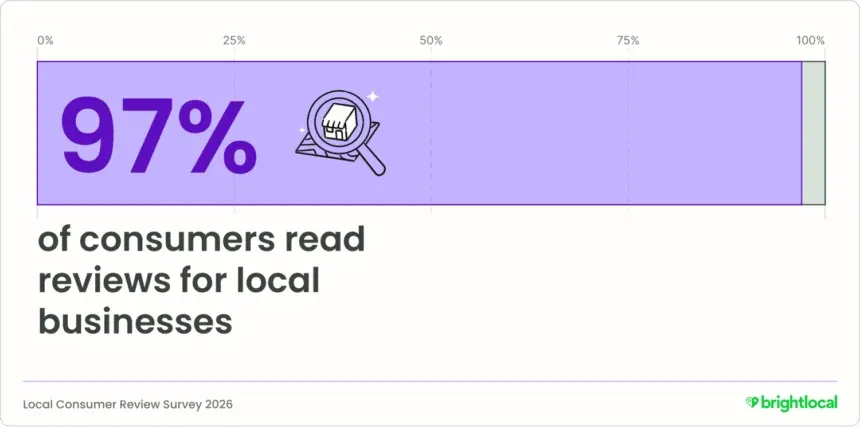 Figure 1: Almost every consumer in the survey reads reviews for local businesses, so a missing or thin review profile costs jobs before the phone rings. Source: BrightLocal, Local Consumer Review Survey 2026, Feb 2026. Chart published by the source, captured 20 Oct 2026.
How many people read reviews first?
Most adults read them, and a growing group reads them every time.
- 41% of consumers always read reviews when they look for a business, up from 29% a year earlier (BrightLocal, Feb 2026).
- The average consumer uses six different review sites when choosing a business (BrightLocal, Feb 2026).
- 82% of US adults at least sometimes read online ratings or reviews before buying something for the first time (Pew Research Center, Dec 2016).
- 40% of US adults always or almost always read them (Pew Research Center, Dec 2016).
- 53% of adults aged 18 to 29 and 47% of those aged 30 to 49 always or almost always read reviews, against 34% of ages 50 to 64 and 23% of ages 65 and up (Pew Research Center, Dec 2016).
How do homeowners weigh reviews when they pick an HVAC or home service pro?
HVAC homeowners treat reviews as a basic check, and they start the search online.
- In the same Clear Seas survey, 26% of homeowners called reviews extremely important, 35% very important and 30% important (Clear Seas Research, Sep 2024).
- Only 8% called reviews not very important and 1% not at all important (Clear Seas Research, Sep 2024).
- In the 2023 round of the survey, 27% of homeowners called reviews extremely important (Clear Seas Research, Jan 2024).
- 83% of homeowners start their search online, according to a survey of 2,000 homeowners (Scorpion via ACHR News, Feb 2026).
- Home service owners say positive reviews or ratings matter to 51% of their customers when they choose a provider, behind competitive pricing at 62% (Jobber, Feb 2026).
Does reading a review lead to a booking?
For many people it leads to a booking. For others it leads to more checking.
- 85% of consumers are more likely to use a business after reading positive reviews, and 77% are less likely to choose one after reading negative reviews (BrightLocal, Feb 2026).
- After positive reviews, 37% of consumers go on to read more reviews and 24% visit the business’s social media channels (BrightLocal, Feb 2026).
- 34% of consumers are ready to buy or book after a positive review, and 66% do more research first (BrightLocal, Feb 2026).
- 93% of consumers have made a purchase after reading reviews, and 27% have spent more than $1,000 and 13% more than $5,000 after reading them (BrightLocal, Feb 2026).
- 49% of consumers trust online reviews as much as personal recommendations (BrightLocal, Feb 2026).
- Among Americans who read reviews, 54% pay more attention to extremely negative ones and 43% to extremely positive ones (Pew Research Center, Dec 2016).
What star rating do customers want to see?
Four stars is the new floor. A shop under that line loses customers who never call, and they never say why.
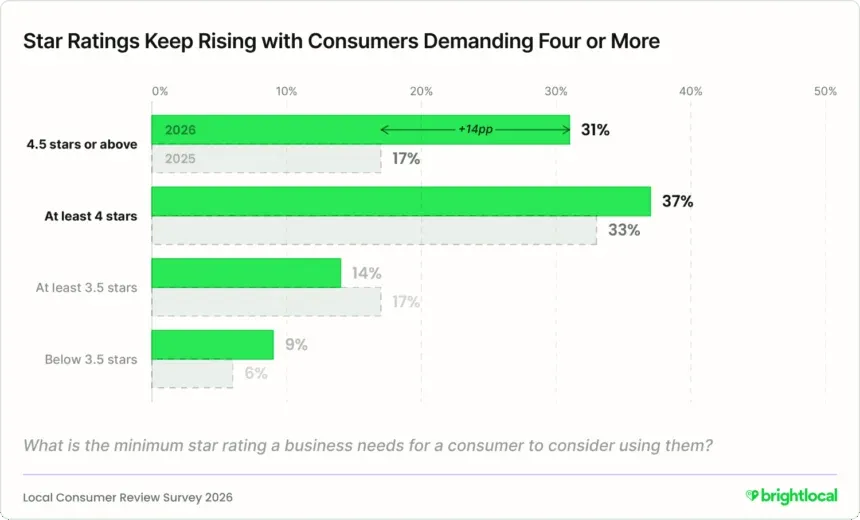 Figure 2: The share of consumers who demand 4.5 stars or more nearly doubled in one year, so a rating that passed in 2025 may now lose bids. Source: BrightLocal, Local Consumer Review Survey 2026, Feb 2026. Chart published by the source, captured 20 Oct 2026.
What is the minimum rating a consumer accepts?
Most want four stars, a large group wants 4.5, and few insist on a perfect five.
- 92% of consumers care about star ratings when they choose a business (BrightLocal, Feb 2026).
- 31% will only use a business rated 4.5 stars or more, up from 17% in 2025 (BrightLocal, Feb 2026).
- Only 10% will only use a business with a five-star rating (BrightLocal, Feb 2026).
- 9% would consider a business rated below 3.5 stars (BrightLocal, Feb 2026).
How do trade platforms and top shops handle ratings?
The lead platforms set a floor of their own, and strong shops sit well above it.
- Jobber’s top-performing customers hold a Google rating of 4.5 stars or higher and have 50 or more reviews (Jobber, Feb 2026).
- On Angi, consumers rate pros on a one- to five-star scale based on a variety of criteria (Angi, Feb 2026).
Is a perfect five-star score the best score?
No. Shoppers read a perfect score as too good to be true, and the data shows it.
- Purchase likelihood typically peaks at ratings in the 4.0 to 4.7 range and falls as ratings near 5.0 (Northwestern Medill Spiegel Research Center, Dec 2025).
- A verified buyer badge raises the odds of a purchase by 15% (Northwestern Medill Spiegel Research Center, Dec 2025).
- A one-star increase in a Yelp rating raised restaurant revenue by 5 to 9 percent in a study of 3,582 Washington State restaurants using Seattle data (Harvard Business School, Mar 2016).
- That revenue effect came from independent restaurants and did not appear for chains (Harvard Business School, Mar 2016).
How many reviews does a shop need, and how new must they be?
More is better up to a point, and fresh beats old. A review profile is a running record, not a one-time job.
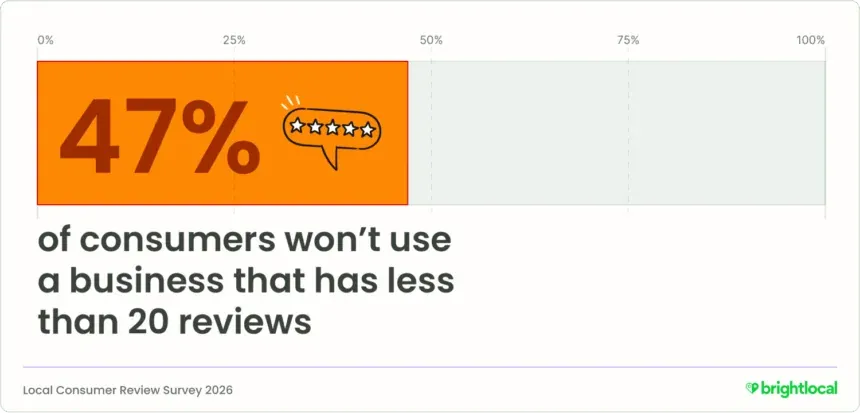 Figure 3: Almost half of consumers walk away from a business with fewer than 20 reviews, which makes a steady flow of new reviews a sales task. Source: BrightLocal, Local Consumer Review Survey 2026, Feb 2026. Chart published by the source, captured 20 Oct 2026.
What is the least number of reviews that earns trust?
Five is the start, and twenty is the bar many customers set.
- Only 9% of consumers are willing to use a business with five or fewer reviews (BrightLocal, Feb 2026).
- A product with five reviews has a purchase likelihood 270% greater than a product with none, and the gain shrinks after the first five (Northwestern Medill Spiegel Research Center, Dec 2025).
- Google recommends that a Local Services Ads provider have 5 or more reviews, and some business types need 5 reviews to show (Google, Oct 2026).
How recent do reviews need to be?
Customers want the last few weeks, and the window is getting shorter.
- 18% of consumers are only swayed by reviews written in the last week, and 32% look for reviews from the last two weeks, up from 20% a year earlier (BrightLocal, Feb 2026).
- 74% of consumers only care about reviews written in the last three months (BrightLocal, Feb 2026).
What makes one review more believable than another?
Agreement across many reviews beats one glowing review.
- 56% say a review is believable when other reviews with similar sentiment back it up (BrightLocal, Feb 2026).
- 46% look for a written review that describes a positive experience, and 44% want it posted within the last month (BrightLocal, Feb 2026).
- 42% look for a high star rating, and 37% look for a reply from the owner (BrightLocal, Feb 2026).
- Only 26% say a long, detailed review matters, so a short happy review does the job (BrightLocal, Feb 2026).
Where do homeowners read and write reviews?
Google leads, but the shop website is a close second, and homeowners spread their checks across several sites.
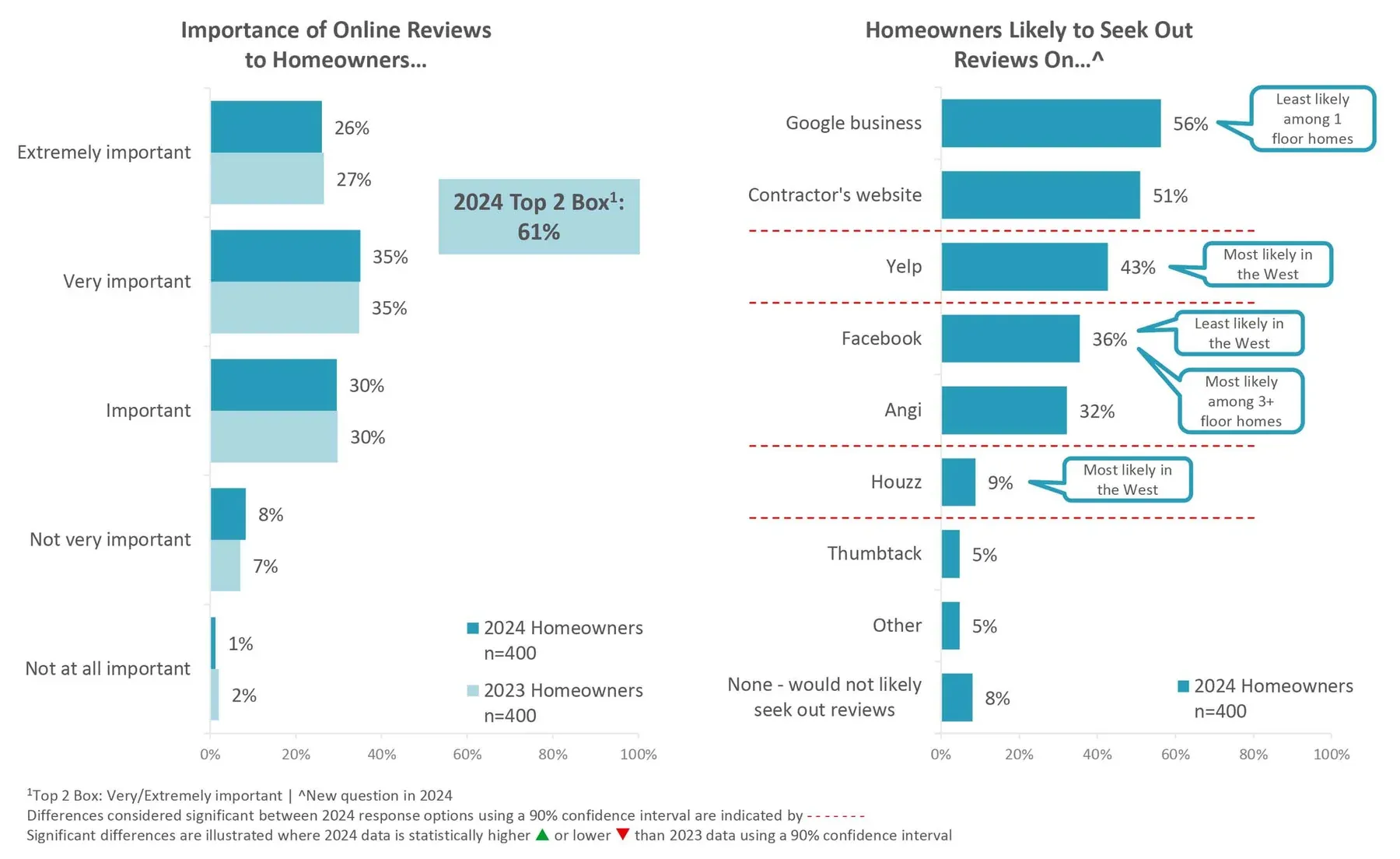 Figure 4: Left, how important homeowners rate online reviews in 2023 and 2024. Right, where they are likely to look for contractor reviews, with Google first and the contractor’s own website second. Source: Clear Seas Research with The ACHR News, 91% of Homeowners Rely on Online Reviews Before Picking Contractors, Sep 2024. Chart published by the source, captured 20 Oct 2026.
Which sites do homeowners check for contractors?
Homeowners in the 400-person HVAC survey named these sites.
- 56% would likely seek out reviews on Google, 51% on a contractor’s website and 43% on Yelp (Clear Seas Research, Sep 2024).
- 36% would look on Facebook and 32% on Angi (Clear Seas Research, Sep 2024).
- 9% would look on Houzz and 5% on Thumbtack, while 8% would not likely seek out reviews at all (Clear Seas Research, Sep 2024).
- Google’s share of consumers who read reviews there fell from 83% in 2025 to 71% in 2026, while Apple Maps rose from 14% to 27% (BrightLocal, Feb 2026).
Where do customers write reviews?
They write where they already read, so a shop needs a link for each major site.
- 45% of consumers left a Google review in the past year, 34% left a Facebook review and 24% left a Yelp review (BrightLocal, Feb 2026).
- 17% left a review on Apple Maps, and 16% each left one on Tripadvisor and the Better Business Bureau (BrightLocal, Feb 2026).
How big are the review platforms?
The big platforms hold hundreds of millions of reviews, so one more review is small unless it is on your own profile.
- Yelp had 330 million cumulative reviews as of December 31, 2025 (Yelp, Dec 2025).
- Trustpilot had more than 400 million active reviews as of December 2025 (Trustpilot, Dec 2025).
- More than 300 million contributors share experiences on Google Maps each year, covering more than 250 million places (Google, Nov 2023).
How much do reviews affect local search and ad rankings?
A great deal. Reviews are the second biggest weight group for the Google map pack, and they drive the paid Local Services Ads auction.
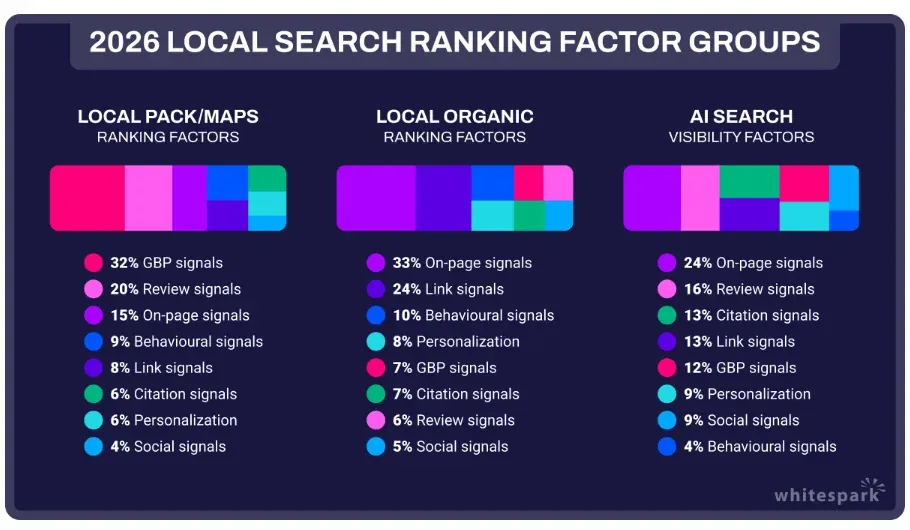 Figure 5: Local SEO experts put review signals at about one fifth of the weight for map pack rankings, second only to Google Business Profile signals. Source: Whitespark, 2026 Local Search Ranking Factors, Nov 2025. Screenshot of the source page, captured 20 Oct 2026.
What weight do experts give review signals?
The figures are expert opinion, not Google data, and Google does not publish its weights.
- 47 local search experts scored 187 factors for the 2026 report (Whitespark, Nov 2025).
- Experts gave review signals 20% of the weight for local pack and maps rankings, behind Google Business Profile signals at 32% (Whitespark, Nov 2025).
- Review signals carry 6% of the weight for local organic results and 16% for AI search visibility (Whitespark, Nov 2025).
Which review factors rank highest for the map pack?
Rating, count, freshness and steady flow all land in the top 15 of 187 factors.
- High numerical Google ratings rank 6th and the quantity of native Google reviews with text ranks 9th (Whitespark, Nov 2025).
- Recency of reviews ranks 11th and a sustained influx of reviews over time rather than bursts ranks 14th (Whitespark, Nov 2025).
- Owner responses to most reviews rank 122nd for map pack rankings but 17th for conversion impact (Whitespark, Nov 2025).
- High numerical Google ratings rank first of all conversion factors (Whitespark, Nov 2025).
How do reviews affect Google Business Profile and Local Services Ads?
Google says so in its own help pages, and it names rating, count and reply speed.
- Google says a business with more reviews and positive ratings can see a better local ranking (Google, Oct 2026).
- Local Services Ads rank on bid and profile quality, and profile quality includes rating, number of reviews and average response time (Google, Oct 2026).
- Google says providers with higher star ratings and more reviews stand out and typically book more jobs (Google, Oct 2026).
- A new review can take up to 2 weeks to change a Google review score (Google, Oct 2026).
- Response times rank 4th of 16 Local Services Ads factors (Whitespark, Nov 2025).
Should a shop reply to reviews, and how fast?
Yes, to every review, and quickly. Many HVAC shops still skip this, and customers notice.
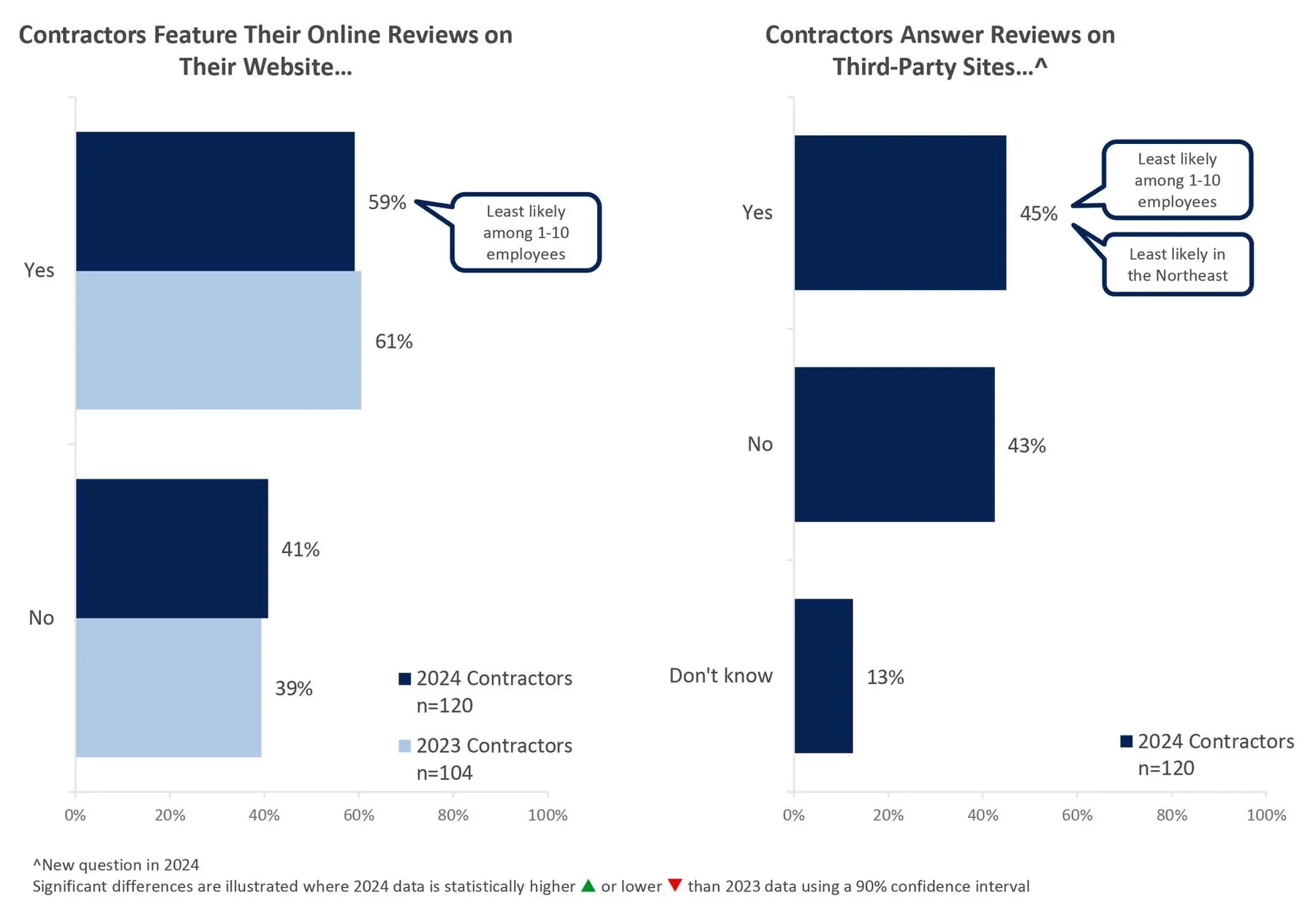 Figure 6: Fewer than half of surveyed HVAC contractors answer reviews on third-party sites, and the smallest firms are the least likely to do it. Source: Clear Seas Research with The ACHR News, 91% of Homeowners Rely on Online Reviews Before Picking Contractors, Sep 2024. Chart published by the source, captured 20 Oct 2026.
How many contractors answer their reviews?
Less than half do, and small shops lag.
- 45% of HVAC contractors answer reviews on third-party sites, and 13% say they do not know (Clear Seas Research, Sep 2024).
- 59% of contractors feature reviews on their own website, down from 61% the year before (Clear Seas Research, Sep 2024).
- Contractors with 1 to 10 employees were the least likely group to show reviews on their website and the least likely to answer reviews on third-party sites (Clear Seas Research, Sep 2024).
What do customers expect from a reply?
They expect a reply, a fast one and a personal one.
- 89% of consumers expect business owners to respond to reviews (BrightLocal, Feb 2026).
- 80% of consumers say they are likely to use a business that responds to all of its reviews, and 42% say they are unlikely to use one that never replies (BrightLocal, Feb 2026).
- Only 45% are likely to use a business that replies to positive reviews alone, and 47% a business that replies to negative reviews alone (BrightLocal, Feb 2026).
- Generic or templated replies make 50% of consumers unlikely to choose a business (BrightLocal, Feb 2026).
- 19% of consumers expect a reply the same day, up from 6% last year, and 81% expect one within a week (BrightLocal, Feb 2026).
- Google advises shops to personalize replies and to respond in a timely manner to negative reviews (Google, Oct 2026).
How many customers write a review when asked?
Most of them, if you ask. The shops with thin profiles are mostly shops that do not ask often enough.
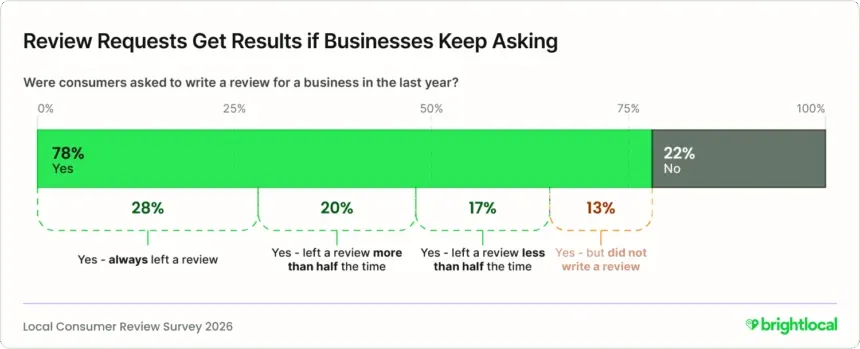 Figure 7: More than three in four consumers were asked for a review last year, and the large majority of them wrote one at least some of the time. Source: BrightLocal, Local Consumer Review Survey 2026, Feb 2026. Chart published by the source, captured 20 Oct 2026.
How often are customers asked, and how often do they say yes?
Asking works, and the share who always say yes is climbing.
- 78% of consumers were asked to write a review in the last 12 months (BrightLocal, Feb 2026).
- 28% say they always write a review when asked, up from 16% in 2025 (BrightLocal, Feb 2026).
- 94% of consumers are open to writing reviews, and 69% wrote one in the last 12 months (BrightLocal, Feb 2026).
- 60% of consumers wrote about a positive experience in the last year and 29% about a negative one (BrightLocal, Feb 2026).
- The typical consumer writes 4 to 6 reviews a year, and 20% wrote more than 10 in 2025 (BrightLocal, Feb 2026).
- Around one in ten Americans nearly always post their own reviews of services they have used (Pew Research Center, Dec 2016).
Why do shops struggle to collect reviews?
Collecting reviews is a habit problem, and owners say it is hard.
- 67% of home service business leaders struggle to consistently collect reviews (Scorpion via ACHR News, Feb 2026).
- Customers must be signed in to a Google Account to leave a Google review (Google, Oct 2026).
What are the rules on rewards for reviews?
Rewards for reviews are risky. Platforms ban most of them, and the FTC bans rewards tied to a positive rating.
- Requests for discounts in exchange for reviews fell from 45% of consumers in 2024 to 36% in 2025 and 27% in 2026 (BrightLocal, Feb 2026).
- 11% of consumers were offered an incentive to write a positive review (BrightLocal, Feb 2026).
- Google treats offering free or discounted goods or services in exchange for reviews as fake and misleading content that is strictly prohibited (Google, Oct 2026).
- The FTC rule does not prohibit incentives for reviews, as long as there is no express or implied requirement that the reviews express a particular sentiment (Federal Trade Commission, Nov 2024).
- The FTC warns marketers against asking for reviews only from customers they think will leave positive ones (Federal Trade Commission, Jan 2022).
How common are fake reviews?
Common enough that every large platform runs a removal program, and a small shop can be hit from both sides: fakes for a rival and fakes against you.
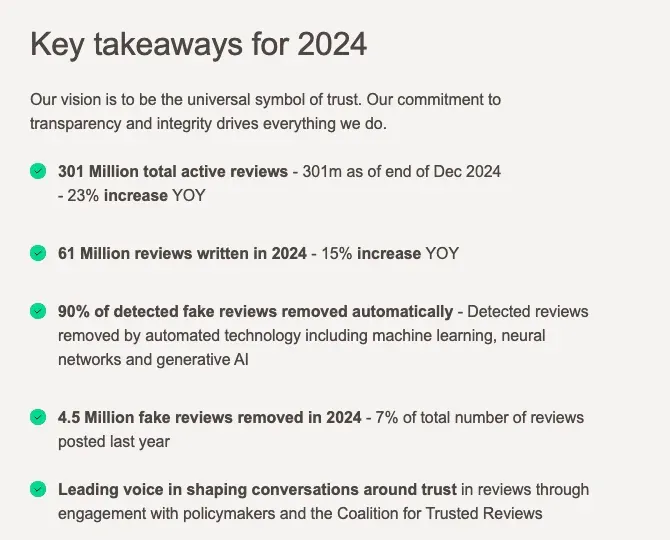 Figure 8: Trustpilot’s own count of fake reviews removed in 2024, about 7 percent of everything posted, with nine in ten caught by software. Source: Trustpilot, Trust Report 2025, May 2025. Screenshot of the source page, captured 20 Oct 2026.
How many fake reviews do platforms remove?
Platforms remove millions a year, and the share is rising as detection improves.
- Google also blocked or removed more than 70 million policy-violating edits to places on Maps in 2024 and more than 12 million fake Business Profiles (Google, Apr 2025).
- Google placed posting restrictions on more than 900,000 accounts that repeatedly broke its policies (Google, Apr 2025).
- Trustpilot removed 4.5 million fake reviews in 2024, which was 7.4% of the reviews submitted, against 6.1% in 2023 (Trustpilot, May 2025).
- 90% of the fake reviews Trustpilot removed in 2024 were caught by its automated detection models (Trustpilot, May 2025).
- Trustpilot checks almost 200,000 submitted reviews per day with automated detection (Trustpilot, May 2025).
- Yelp’s software recommended 70% of the roughly 22 million reviews it received in 2025 and did not recommend 17% of them (Yelp, Feb 2026).
- Yelp’s staff removed 11% of 2025 reviews for policy violations, and reviewers removed 2% themselves (Yelp, Feb 2026).
What do review rings and extortion look like for a small shop?
Review rings trade fake praise, and extortion scams flood a profile with one-star reviews.
- Yelp closed 1,991 user accounts tied to review exchange rings or other suspicious review activity in 2025 (Yelp, Feb 2026).
- Yelp made over 1,020 reports to other platforms about people trading or paying for reviews, and 60% led to action (Yelp, Feb 2026).
- Yelp rejected more than 50,700 potential new business pages in 2025, with extra checks in emergency service categories such as locksmiths, garage door repairs and plumbing (Yelp, Feb 2026).
- Yelp says review extortion incidents hit businesses on Google in Las Vegas, Philadelphia and New York in 2025 (Yelp, Feb 2026).
- Google describes the scam as a sudden rise in 1-star and 2-star reviews followed by a demand for money to remove them, and tells owners not to pay (Google, Oct 2026).
- One California HVAC contractor was flooded with fake one-star reviews and then offered removal for a fee (ACHR News, May 2026).
How much do customers worry about fakes?
Many customers doubt what they read. Most want real penalties.
- 48% of Americans who read reviews say it is often hard to tell if reviews are truthful and unbiased, and 51% say they generally paint an accurate picture (Pew Research Center, Dec 2016).
- 83% of review readers would avoid a business if they learned it had fake or compensated reviews (Yelp, Feb 2025).
- 91% of review readers want platforms to disclose if a business was ever the subject of suspicious review activity (Yelp, Feb 2025).
- 70% of consumers have made a purchase they later regretted after reading reviews, and 14% regretted spending more than $1,000 (BrightLocal, Feb 2026).
- Only 3% of consumers think there should be no consequences for fake reviews (BrightLocal, Feb 2026).
- 57% of consumers think a business caught using fake reviews should be banned from review platforms, and 63% say review platforms should be responsible for catching them (BrightLocal, Feb 2026).
How big is the problem by the FTC’s estimate?
The FTC put a dollar figure on it when it wrote the rule.
- The FTC approximated that $34.1 billion of review-dependent service industry sales involve some review manipulation, using a share of about 10 percent of products or businesses (Federal Register, Aug 2024).
- A study the FTC relied on found fake reviews cost consumers $0.12 for every dollar spent in an experimental setting (Federal Register, Aug 2024).
- The FTC learned in another investigation of more than 4,500 merchants that automatically published only 4- or 5-star consumer reviews (Federal Register, Aug 2024).
Can star ratings on home service sites be trusted?
Ratings on lead sites run high no matter how good the business is. Read the text, not just the stars.
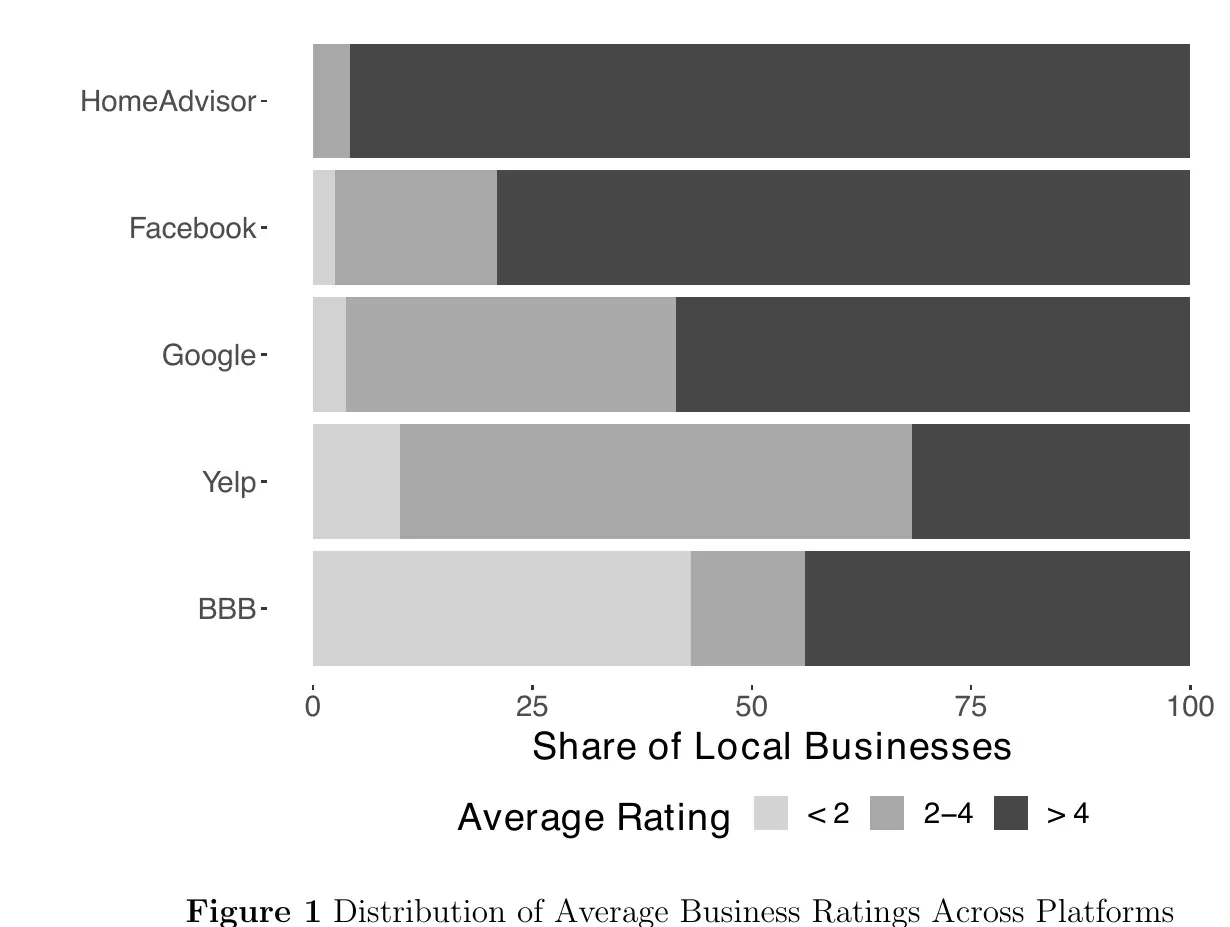 Figure 9: On HomeAdvisor, Facebook and Google most local businesses average above 4 stars, while Yelp and the Better Business Bureau spread ratings out much more. Source: Devesh Raval, Federal Trade Commission, Do Bad Businesses Get Good Reviews?, May 2024. Source’s own figure, cropped from the PDF, captured 20 Oct 2026.
How do ratings differ by platform?
An FTC economist matched over one hundred thousand businesses to listings on five platforms.
- 59% of businesses on Google and 79% on Facebook averaged above 4 stars (Devesh Raval, FTC, May 2024).
- No HomeAdvisor business averaged below 2 stars, against 4% on Google and 2% on Facebook (Devesh Raval, FTC, May 2024).
- On Yelp, 10% of businesses averaged below 2 stars and 32% above 4 stars (Devesh Raval, FTC, May 2024).
- On the Better Business Bureau, 43% of businesses averaged below 2 stars and 44% above 4 stars (Devesh Raval, FTC, May 2024).
Do ratings track business quality?
Barely on some sites. The paper used Better Business Bureau grades and complaints as the quality signal.
- From an A+ business to an F business, average ratings fall 0.9 stars on Yelp, 0.8 on Google, 0.6 on Facebook and 0.3 on HomeAdvisor (Devesh Raval, FTC, May 2024).
- A high quality business is rated at or below a low quality business 16% of the time on HomeAdvisor, 10% on Google and 9% on Yelp (Devesh Raval, FTC, May 2024).
- Google ratings run about a half star higher than Yelp for high quality businesses and about a star higher for low quality ones (Devesh Raval, FTC, May 2024).
What does the FTC fake review rule ban?
Six practices, and it lets the FTC seek fines for the first time. A small shop is most likely to trip over the incentive, insider and suppression rules.
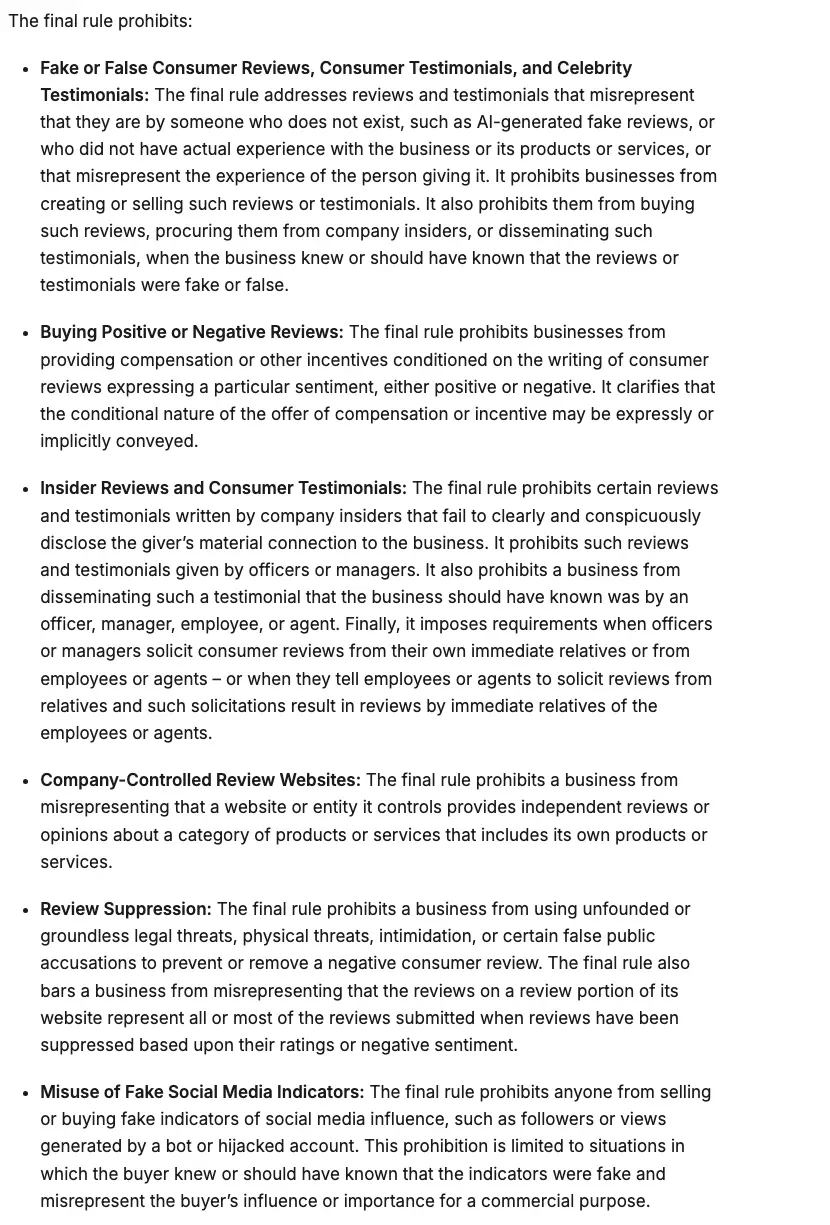 Figure 10: The FTC’s own list of what the final rule prohibits, from fake and bought reviews to review suppression and fake social media indicators. Source: Federal Trade Commission, Federal Trade Commission Announces Final Rule Banning Fake Reviews and Testimonials, Aug 2024. Screenshot of the source page, captured 20 Oct 2026.
When did the rule start and how was it made?
It took nearly two years of public comment and a unanimous vote.
- The FTC announced the final rule on August 14, 2024, and the vote to approve it was 5-0 (Federal Trade Commission, Aug 2024).
- The rule took effect on October 21, 2024, and runs 46 pages in the Federal Register (Federal Register, Aug 2024).
- The FTC received 42 responsive comments on its advance notice and 100 on its proposed rule (Federal Register, Aug 2024).
- The FTC said in September 2026 that its civil penalty amounts remain unchanged during 2026 (Federal Register, Sep 2026).
What counts as a violation for a small business?
The rule covers fake reviews, bought reviews, undisclosed insiders and threats to remove bad reviews.
- The FTC says the rule does not specifically prohibit review gating, but the practice could violate the FTC Act (Federal Trade Commission, Nov 2024).
- The FTC assumed that 74 percent of 34.75 million small companies had an online consumer review presence when it counted compliance costs (Federal Register, Aug 2024).
- The Consumer Review Fairness Act bars form contract terms that restrict or penalize a customer who reviews a company (Federal Trade Commission, Feb 2017).
What have FTC review cases cost companies?
Cases before the rule show the pattern, and the rule now adds civil penalties.
- Fashion Nova agreed to pay $4.2 million to settle FTC claims that it blocked negative reviews from its website, in a case filed on January 25, 2022 (Federal Trade Commission, Mar 2022).
- The FTC and six states filed a proposed order requiring Jonathan Martinez, who allegedly sold Roomster tens of thousands of fake reviews, to pay $100,000 (Federal Trade Commission, Aug 2022).
- The FTC announced approval of its final order against Sunday Riley in November 2020, after employees posted fake reviews at the CEO’s direction (Federal Trade Commission, Nov 2020).
How is AI changing reviews?
AI is now both a reader of your reviews and a tool for faking them. Customers say they trust AI picks as much as they trust reviews.
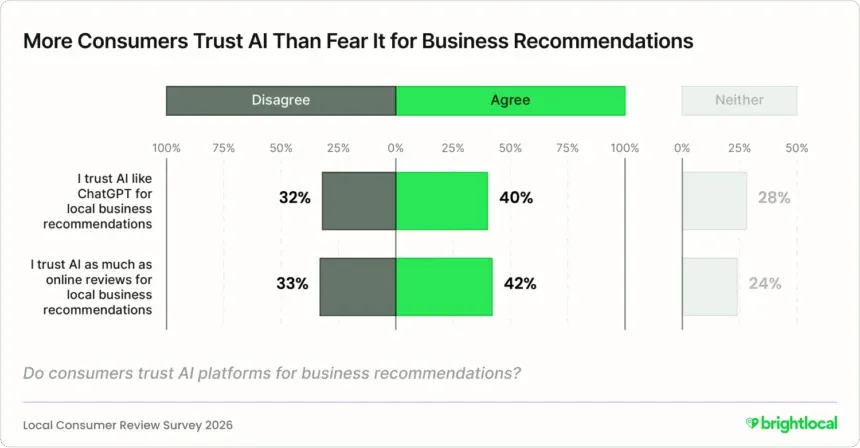 Figure 11: More consumers say they trust AI tools like ChatGPT for local business picks than say they do not, which ties a shop’s reviews to how AI describes it. Source: BrightLocal, Local Consumer Review Survey 2026, Feb 2026. Chart published by the source, captured 20 Oct 2026.
Do customers use AI to find local businesses?
A fast-growing share does, and homeowners use it too.
- 40% of consumers trust AI platforms to provide business recommendations and 32% do not, and 42% trust AI as much as traditional reviews (BrightLocal, Feb 2026).
- 82% of consumers read AI-generated review summaries, and 23% would rely on the summary alone (BrightLocal, Feb 2026).
- 22% of homeowners use AI tools such as ChatGPT to research or find recommendations (Scorpion via ACHR News, Feb 2026).
- 80% of home service business leaders are unsure how to appear in AI-driven search results (Scorpion via ACHR News, Feb 2026).
Are AI-written fake reviews a problem?
Yes, and platforms and regulators both address it.
- Yelp’s systems filtered out nearly 500,000 suspected AI-generated reviews in 2025 (Yelp, Feb 2026).
- 88% of review readers say AI-generated reviews should not be allowed on review platforms (Yelp, Feb 2025).
- The FTC final rule covers reviews by someone who does not exist, such as AI-generated fake reviews (Federal Trade Commission, Aug 2024).
- The FTC alleged that some Rytr subscribers used its AI service to produce hundreds, and in some cases tens of thousands, of reviews that could contain false information (Federal Trade Commission, Dec 2025).
- The FTC reopened and set aside the Rytr order on December 22, 2025 (Federal Trade Commission, Dec 2025).
How do other countries police fake reviews?
The UK now treats fake reviews as an unfair practice that can bring fines. The US rule covers much of the same ground, and the UK shows where enforcement may go.
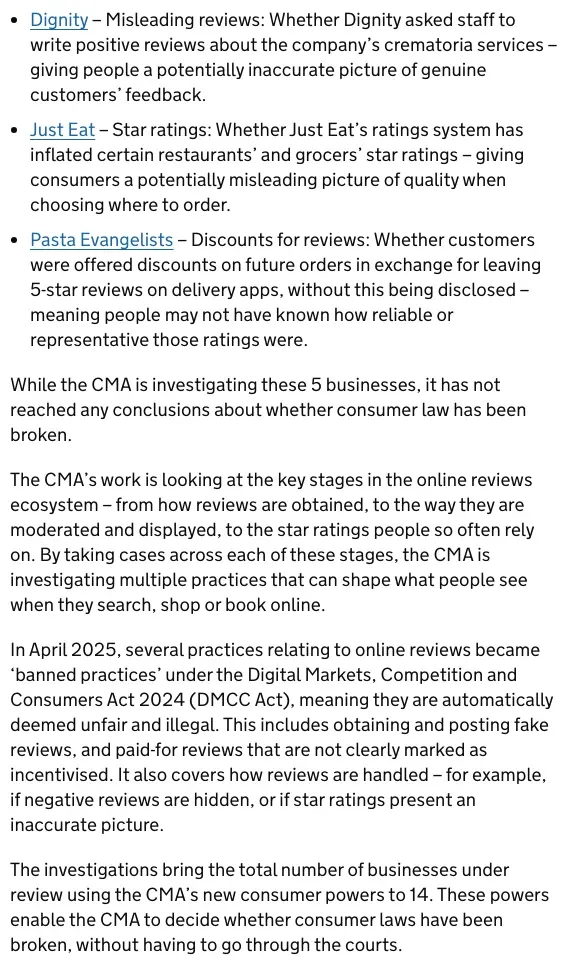 Figure 12: The UK regulator opened five new fake review cases in 2026, bringing its total to 14 under its new direct fining powers. Source: UK Competition and Markets Authority, Fake and misleading reviews: 5 businesses under CMA investigation, Mar 2026. Screenshot of the source page, captured 20 Oct 2026.
What can the UK regulator do?
It can decide that the law was broken without going to court, and it can fine.
- The CMA can impose fines of up to 10% of global turnover if it finds an infringement (UK Competition and Markets Authority, Mar 2026).
- The CMA swept over 100 review publishers and sent advisory letters to 54 firms, and 90% made changes in response (UK Competition and Markets Authority, Mar 2026).
- The new UK regime took effect on 6 April 2025 (UK Competition and Markets Authority, Jun 2025).
What have Google and Amazon agreed to do?
They agreed to sanction fake review buyers and writers.
- The CMA estimated that as much as £23 billion of UK consumer spending is potentially influenced by online reviews each year (UK Competition and Markets Authority, Jan 2025).
- Google’s undertakings run for 3 years of reporting to the CMA, and firms that repeatedly use fake reviews can have all their reviews deleted for 6 months or more (UK Competition and Markets Authority, Jan 2025).
- Amazon gave undertakings in June 2025 that include bans from selling for businesses that use fake reviews to boost ratings (UK Competition and Markets Authority, Jun 2025).
Methodology and Sources
We picked figures from the group that ran the survey, kept the study, or wrote the rule. We did not use roundup pages. Every link was opened and read in October 2026. Where a page is a live help page with no print date, such as the Google help pages, we dated it by the month we read it. Two figures come from trade press that reported a vendor’s own survey (Scorpion), and we say so in the source name. Survey figures are survey figures: they show what people say, not what they do. We refresh this page every month.
Sources
Every source cited above is linked inline. The main publishers are BrightLocal, Pew Research Center, the Northwestern Medill Spiegel Research Center, the Federal Trade Commission and the Federal Register, Clear Seas Research with The ACHR News, Google, Yelp, Trustpilot, Whitespark, Jobber, Angi, Harvard Business School and the UK Competition and Markets Authority.
Related pages: Home services industry statistics, Field service industry statistics and Pricing statistics.
Glossary
- FTC: Federal Trade Commission, the US consumer protection agency.
- CMA: Competition and Markets Authority, the UK competition regulator.
- DMCC Act: Digital Markets, Competition and Consumers Act 2024, the UK law that bans fake reviews.
- LSA: Local Services Ads, Google’s pay-per-lead ads for home service shops.
- GBP: Google Business Profile, the free listing that shows a shop on Google Maps and Search.
- Review gating: asking only happy customers for a review.
- Local pack: the short map list that shows near the top of local searches.