Updated November 2026
HVAC missed calls lost revenue statistics all point to the same place: the shop’s own phone. Across home services, only 52% of callers reach a person (Invoca, Jul 2026). The ad was paid for, the homeowner dialed, and nobody answered.
This page gathers the numbers a shop owner can act on. Each one comes from the group that ran the study or the agency that counted. It covers answer rates, what a missed call costs, how long callers wait, why people ignore unknown numbers, and when the phone rings most.
The data is clear on one point. HVAC is one of the hardest trades to reach by phone. Read the Key Takeaways first, then jump to the section you need.
Key Takeaways
- Only 34% of calls to HVAC businesses are answered by a person (Invoca, Jul 2026).
- 43% of HVAC phone leads convert on the call (Invoca, Jul 2026).
- 28% of inbound calls go unanswered on average (CallRail, Jun 2026).
- Missed calls can cost the average business $126,360 a year (CallRail, Jun 2026).
- 79% of home services consumers say they will switch to a competitor that responds faster (Invoca, May 2026).
- 55% of home services businesses do not ask phone leads to buy or book the job (Invoca, Jul 2026).
- Only 48% of home services businesses answer after-hours inquiries right away (CallRail, Dec 2025).
- An estimated 52.5 billion robocalls hit US phones in 2025 (YouMail, Sep 2026).
- Only one in four businesses use robocall-blocking tools (Ruby, Aug 2023).
- 80.0% of US adults live in wireless-only households (CDC, Sep 2026).
- Summer 2026 temperature-driven energy demand ran at 233% of average (NOAA, Aug 2026).
- 64% of residential contractors still rely on phone calls as the dominant form of communication (ServiceTitan, Mar 2025).
How many calls do home service shops miss?
HVAC shops answer fewer calls than almost any other trade, and the gap is not small. The numbers below come from call-tracking data, not from owner surveys.
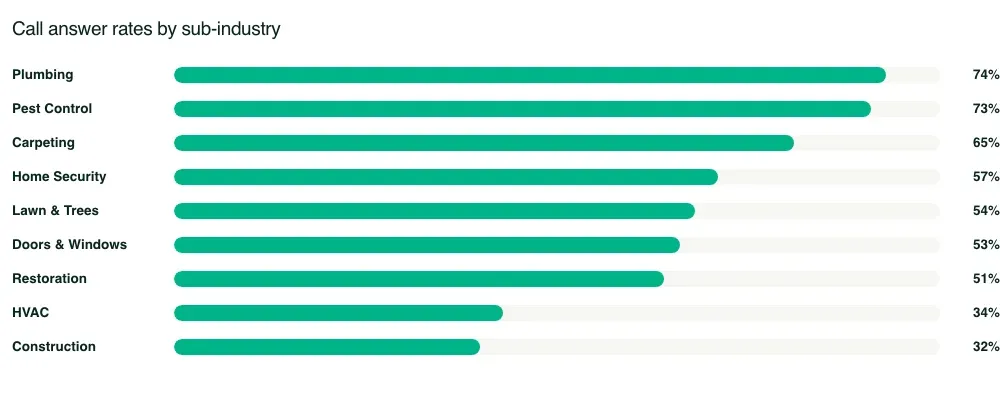 Figure 1: HVAC sits second from the bottom of nine home services trades for calls answered by a person, well below plumbing and pest control. Source: Invoca, The Home Services Lead Conversion Benchmarks Report 2026, Jul 2026. Screenshot of the source page, captured 20 Oct 2026.
What do missed call statistics for home services show across trades?
- Plumbing businesses answer 74% of calls, the best of the nine trades Invoca measured (Invoca, Jul 2026).
- Construction answers 32%, the lowest of the nine (Invoca, Jul 2026).
- When the count leaves out calls under 15 seconds, the home services answer rate rises to 65% (Invoca, Jul 2026).
- For calls longer than 30 seconds, the answer rate is 73% (Invoca, Jul 2026).
How does that compare with other industries?
- Across all industries, 56% of business calls are answered by a live person (Invoca, Aug 2026).
- Travel businesses lead the list at 64% (Invoca, Aug 2026).
- Telecom is the lowest on that list at 51% (Invoca, Aug 2026).
- The benchmarks draw on more than 70 million tracked calls (Invoca, Jul 2026).
What is a missed call worth?
- Raising the answer rate, lead rate and conversion rate by five points each would give about 38% more conversions from the same calls (Invoca, Jul 2026).
- 92% of the calls a business receives are opportunities to win, keep or lose business (Ruby, Aug 2022).
- The share of calls that are sales leads grew 9.6% between 2019 and 2022 (Ruby, Aug 2023).
How many answered calls turn into booked jobs?
Picking up is step one. A call still has to end with a date on the calendar, and many shops lose the job in the last two minutes.
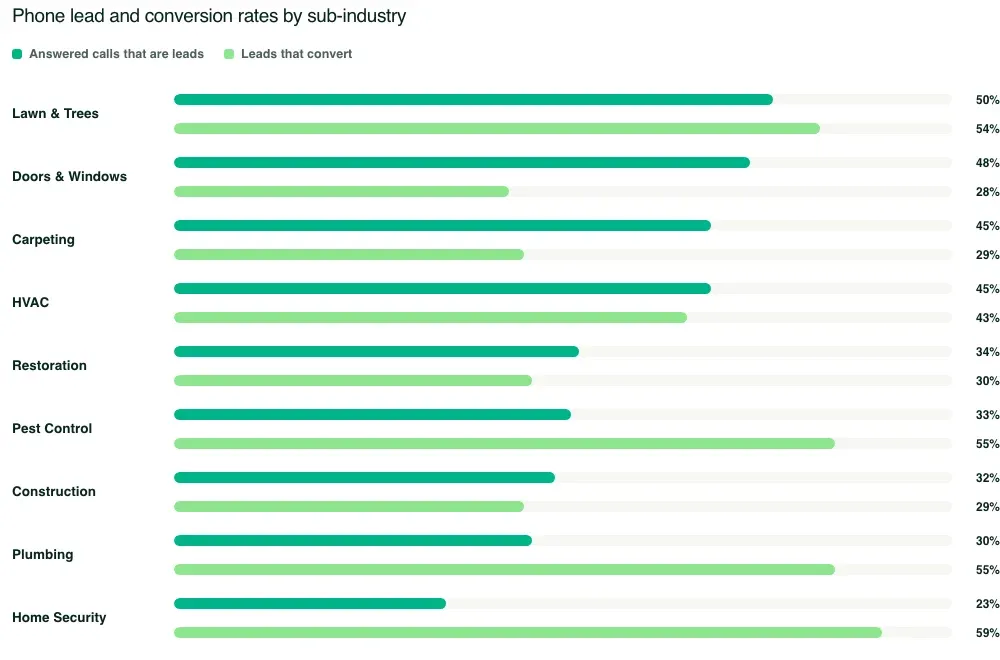 Figure 2: HVAC has a high share of answered calls that are real leads, and about four in ten of those leads book on the call. Source: Invoca, The Home Services Lead Conversion Benchmarks Report 2026, Jul 2026. Screenshot of the source page, captured 20 Oct 2026.
How many answered calls are real jobs?
- 38% of answered home services calls are leads (Invoca, Jul 2026).
- 45% of those leads convert on the call (Invoca, Jul 2026).
- In HVAC, 45% of answered calls are leads (Invoca, Jul 2026).
- Top-earning trades contractors book 62% of their inbound lead calls (ServiceTitan, May 2026).
- All other contractors average 39%, a gap of 23 points (ServiceTitan, May 2026).
What happens on the call itself?
- 81% of home services calls get a proper greeting (Invoca, Jul 2026).
- 72% get a proper closing (Invoca, Jul 2026).
- Staff get the caller’s information on 62% of calls (Invoca, Jul 2026).
- Only 58% of calls score as excellent (Invoca, Jul 2026).
Why do shops lose leads after the call?
- 66% of home services businesses name lead follow-up and conversion as their biggest operational challenge (CallRail, Dec 2025).
- 57% point to gaps in sales and customer service training (CallRail, Dec 2025).
- Home services consumers who call a business during a high-stakes purchase most often want more information (Invoca, May 2026).
- 26% call because the answer was not on the company’s website (Invoca, May 2026).
Which call sources bring the best HVAC leads?
Where a homeowner found the shop changes how likely the call is to become work. The best sources are the ones a shop controls, like its Google listing.
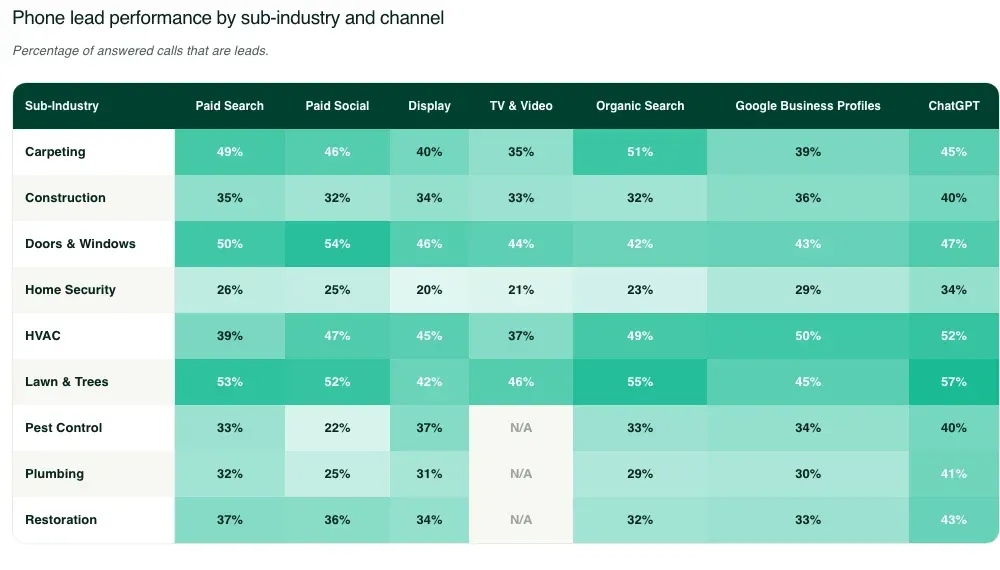 Figure 3: In the HVAC row, calls from Google Business Profiles, organic search and ChatGPT are the most likely to be leads, and TV and paid search the least. Source: Invoca, The Home Services Lead Conversion Benchmarks Report 2026, Jul 2026. Screenshot of the source page, captured 20 Oct 2026.
Which sources send HVAC calls that are leads?
- 50% of HVAC calls from Google Business Profiles are leads (Invoca, Jul 2026).
- 52% of HVAC calls referred by ChatGPT are leads (Invoca, Jul 2026).
- Only 39% of HVAC calls from paid search are leads (Invoca, Jul 2026).
Which sources send HVAC leads that book?
- 49% of HVAC leads from Google Business Profiles convert on the call (Invoca, Jul 2026).
- 48% of HVAC leads from ChatGPT convert (Invoca, Jul 2026).
- 40% of HVAC leads from TV and video convert (Invoca, Jul 2026).
How fast do callers give up on a slow shop?
Callers do not wait for a callback. If the first shop does not pick up, the second one gets the job.
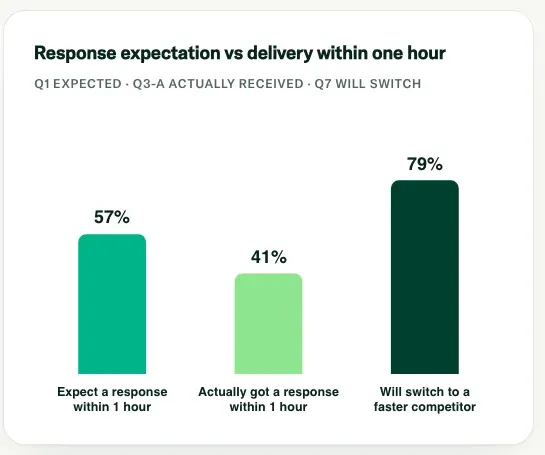 Figure 4: Most buyers expect an answer within the hour, fewer get one, and nearly all would move to a faster rival. The survey covers 134 home services consumers in the US and UK. Source: Invoca, Home Services Buyer Experience Report 2026, May 2026. Screenshot of the source page, captured 20 Oct 2026.
How fast do home service customers expect an answer?
- 57% of home services consumers expect a response within one hour (Invoca, May 2026).
- Only 41% say they actually got one within the hour (Invoca, May 2026).
- 34% of home services businesses wait until the next morning to answer after-hours inquiries (CallRail, Dec 2025).
What do callers do when no one picks up?
- 66% of home services consumers say they hung up after being held too long (Invoca, May 2026).
- 51% say one bad experience would make them stop doing business with a company (Invoca, May 2026).
- 37% prefer to call when they have a problem and need help, more than any other channel (Invoca, May 2026).
- That preference for calling was 47% a year earlier (Invoca, May 2026).
When do calls arrive outside office hours?
- Calls outside normal operating hours rose by more than 18% from 2020 to 2021 (Ruby, Aug 2022).
- Calls between 4 a.m. and 6 a.m. rose 10% from 2020 to 2022 (Ruby, Aug 2023).
- Ruby’s small business customers got about 35,000 calls a day over the two years it studied (Ruby, Aug 2022).
- In June 2025, 14.1% of inbound calls to residential HVAC shops on ServiceTitan arrived outside business hours (ServiceTitan, Jun 2026).
- In October the share fell to 9.8%, the low for the year (ServiceTitan, Jun 2026).
- That is about a 45% relative jump in off-hours call share in the busy season (ServiceTitan, Jun 2026).
- Weekend calls peaked at 4.9% of inbound calls in August, against 2.95% in October (ServiceTitan, Jun 2026).
Why do people stop answering unknown numbers?
Spam calls teach people to ignore numbers they do not know. A shop calling back a new customer is one of those numbers.
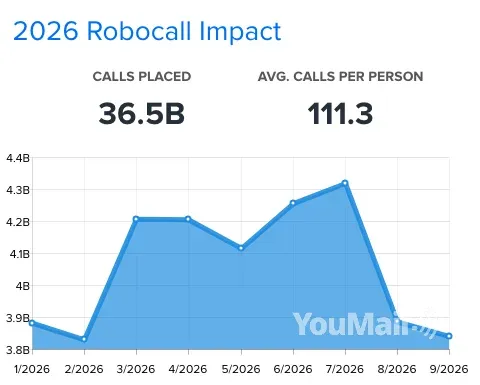 Figure 5: Robocalls ran near 4 billion a month through 2026, peaking in July. Source: YouMail, Robocall Index, Sep 2026. Screenshot of the source page, captured 20 Oct 2026.
How often do people answer a call from an unknown number?
- Only 14% of consumers answer a call from a number they do not recognize right away, in a Hiya survey of more than 12,000 people in six countries (Hiya, Apr 2026).
- 28% reject the call at once (Hiya, Apr 2026).
- 41% ignore it and wait to see if the caller leaves a voicemail (Hiya, Apr 2026).
- 73% agree that businesses should identify themselves with caller ID (Hiya, Apr 2026).
- In Hiya’s 2025 survey, 48% of consumers said they never answer unidentified calls (Hiya, Oct 2025).
- Another 32% said they only sometimes answer them (Hiya, Oct 2025).
How many robocalls reach US phones?
- YouMail estimates 3.8 billion robocalls were placed in September 2026 (YouMail, Sep 2026).
- That is about 128.0 million a day (YouMail, Sep 2026).
- The average person received 11.7 of them in the month (YouMail, Sep 2026).
- 36.5 billion robocalls were placed in the first nine months of 2026 (YouMail, Sep 2026).
- The 2024 total was 52.8 billion (YouMail, Sep 2026).
- The 2023 total was 55.0 billion (YouMail, Sep 2026).
- The record in YouMail’s series is 58.5 billion, set in 2019 (YouMail, Sep 2026).
What do spam and scam calls cost?
- The FCC estimated that stopping illegal scam robocalls would save more than $3 billion a year in wasted time and nuisance (FCC, Mar 2020).
- It also said fraudulent robocall schemes cost Americans about $10 billion a year (FCC, Mar 2020).
- A Harris Poll survey for Truecaller found 56.2 million US adults were affected by spam and scam calls in 2023 (Truecaller, Mar 2024).
- It put their collective losses at $25.4 billion (Truecaller, Mar 2024).
- The average loss per victim was about $452 (Truecaller, Mar 2024).
- 8% of the calls Ruby handled for small businesses were spam or robocalls (Ruby, Aug 2022).
Do homeowners call from cell phones?
Most callers are on a mobile phone, not a landline. A shop that plans only around a desk phone is planning for the past.
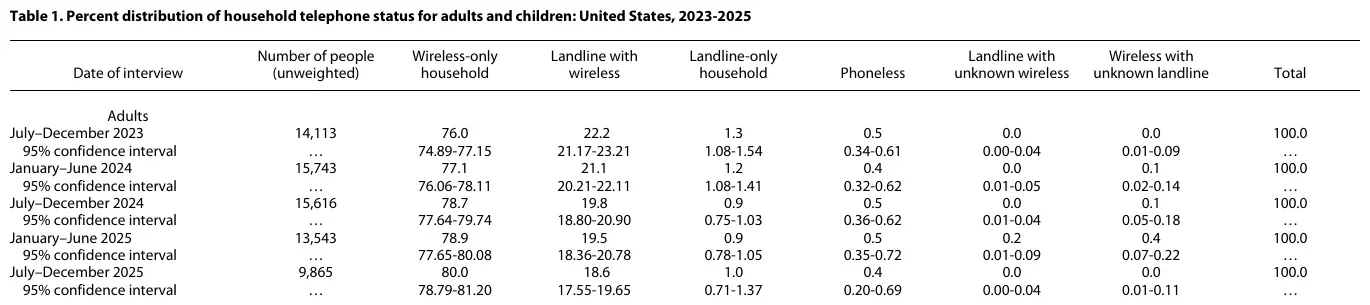 Figure 6: The share of adults in wireless-only households rose every period shown, from 76.0% in late 2023 to 80.0% in late 2025. Source: CDC National Center for Health Statistics, Wireless Substitution Early Release, July to December 2025, Sep 2026. Screenshot of the source page, captured 20 Oct 2026.
How many adults live without a landline?
- The wireless-only share of adults was 76.0% in the second half of 2023 (CDC, Sep 2026).
- 18.6% of adults live in homes with both a landline and a wireless phone (CDC, Sep 2026).
- Only 1.0% live in landline-only households (CDC, Sep 2026).
- 0.4% have no phone at all (CDC, Sep 2026).
Do homeowners differ from renters?
- 75.4% of adults who own or are buying their home are wireless-only (CDC, Sep 2026).
- 88.8% of renters are wireless-only (CDC, Sep 2026).
- Among adults 65 and over, 63.4% are wireless-only (CDC, Sep 2026).
- In the Northeast, 67.7% of adults are wireless-only (CDC, Sep 2026).
- In the South, 83.6% of adults are wireless-only (CDC, Sep 2026).
- Among adults 35 to 44, 88.3% are wireless-only (CDC, Sep 2026).
How many adults own a smartphone?
- 91% of adults ages 50 to 64 own a smartphone (Pew Research Center, Oct 2026).
- 97% of adults ages 30 to 49 own one (Pew Research Center, Oct 2026).
- 79% of adults 65 and over own one (Pew Research Center, Oct 2026).
- 88% of rural adults own one (Pew Research Center, Oct 2026).
- 80% of adults in households earning under $30,000 own one (Pew Research Center, Oct 2026).
- 16% of adults are smartphone-only internet users with no home broadband (Pew Research Center, Oct 2026).
When does the phone ring the most?
Weather sets the pace for cooling and heating demand. Invoca points to Monday mornings, the first cold snap and the after-storm rush as common times for missed calls to spike (Invoca, Jul 2026). A shop that is closed or booked solid then gives those calls away.
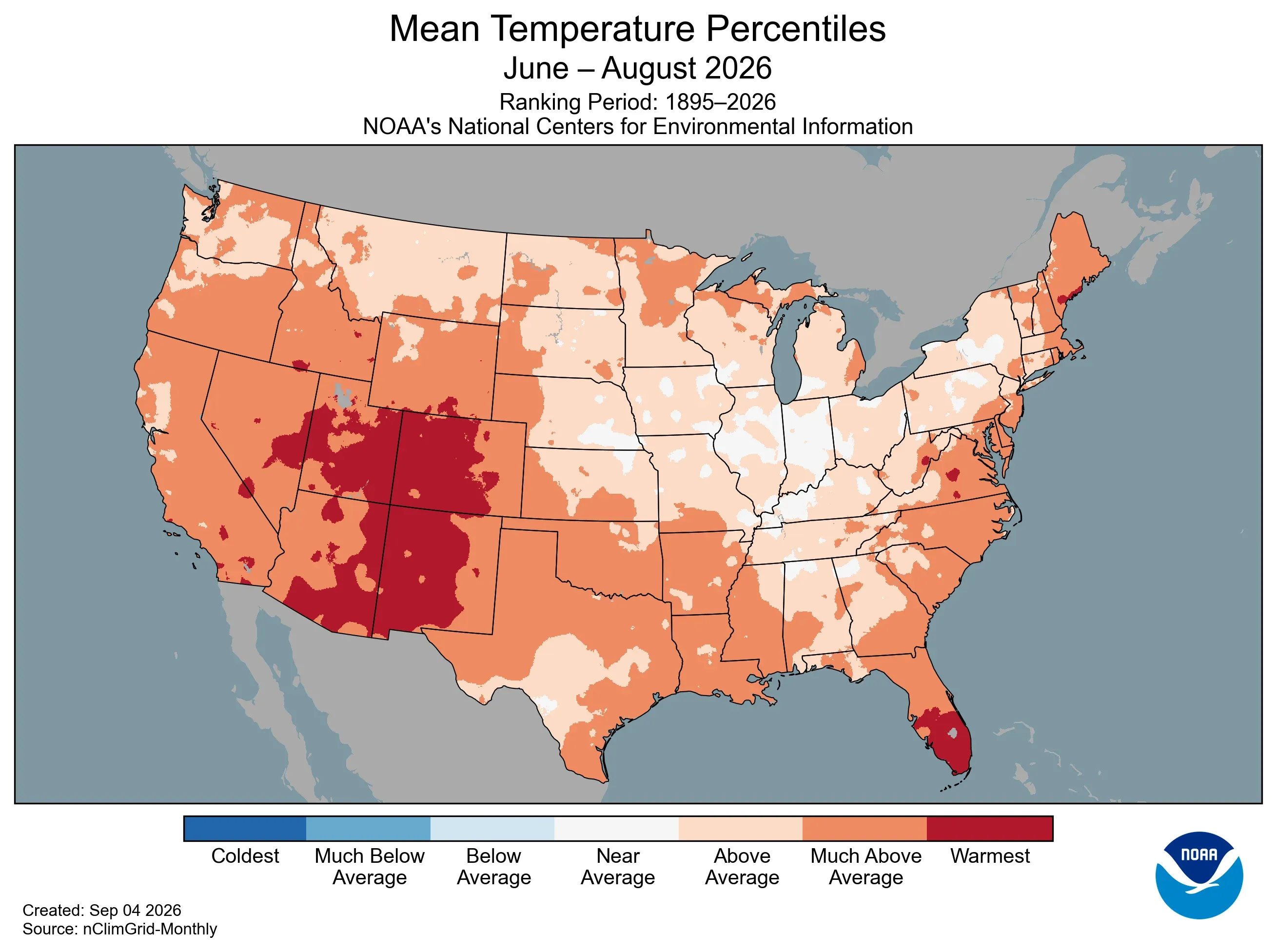 Figure 7: Summer 2026 ran above average across most of the country, with record warmth in parts of the Southwest and southern Florida. Source: NOAA National Centers for Environmental Information, National Climate Report August 2026, Aug 2026. Chart published by the source, captured 20 Oct 2026.
How hot was summer 2026?
- The contiguous US averaged 74.37°F from June to August, the warmest summer in 132 years of records (NOAA, Aug 2026).
- Summer nights averaged 61.71°F, the warmest on record (NOAA, Aug 2026).
- August alone averaged 75.58°F, the warmest August on record (NOAA, Aug 2026).
- Temperature-driven energy demand in August was 236% of average, the highest in 132 years (NOAA, Aug 2026).
- 8.3% of the contiguous US had its warmest summer on record (NOAA, Aug 2026).
How many homes depend on air conditioning?
- 109.51 million US homes use air-conditioning equipment (EIA, Mar 2023).
- 15.63 million homes have main cooling equipment under 2 years old (EIA, Mar 2023).
- 21.76 million have equipment 2 to 4 years old (EIA, Mar 2023).
- 30.08 million have equipment 5 to 9 years old (EIA, Mar 2023).
- 20.49 million have equipment 10 to 14 years old (EIA, Mar 2023).
Who answers the phone at a small shop?
Firms with a big front office are rare. When the owner is on a job, nobody is left to answer, and hiring a person for the phone costs real money.
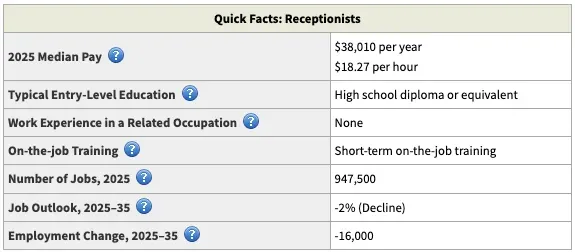 Figure 8: A full-time receptionist at the median costs $38,010 a year in pay alone, and the job count is shrinking. Source: U.S. Bureau of Labor Statistics, Occupational Outlook Handbook: Receptionists, May 2025. Screenshot of the source page, captured 20 Oct 2026.
How big are HVAC shops?
The Census Bureau counts plumbing, heating and air-conditioning contractors together (NAICS 238220), so these counts include plumbing firms. They are 2022 counts of firms.
- 63,588 firms in plumbing, heating and air-conditioning contracting have fewer than 5 employees (U.S. Census Bureau, Apr 2025).
- 20,175 firms have 5 to 9 employees (U.S. Census Bureau, Apr 2025).
- 12,459 firms have 10 to 19 employees (U.S. Census Bureau, Apr 2025).
- 96,222 firms have fewer than 20 employees (U.S. Census Bureau, Apr 2025).
- Those firms employ 409,383 people between them (U.S. Census Bureau, Apr 2025).
- Only 215 firms have 500 or more employees (U.S. Census Bureau, Apr 2025).
What does it cost to staff the phones?
- The median receptionist earns $38,010 a year, or $18.27 an hour (BLS, May 2025).
- The US has 947,500 receptionist jobs (BLS, May 2025).
- BLS projects receptionist employment to fall 2% from 2025 to 2035 (BLS, May 2025).
- It still expects about 105,100 receptionist openings a year as people leave the job (BLS, May 2025).
- The median customer service representative earns $44,770 a year (BLS, May 2025).
- The US has 2,666,000 customer service representative jobs (BLS, May 2025).
- BLS projects that job count to fall 5% from 2025 to 2035 (BLS, May 2025).
How do contractors run their phones and booking?
- Among thriving residential service businesses, 10% prioritize online booking forms (ServiceTitan, Mar 2025).
- 7% of those thriving businesses prioritize text messaging (ServiceTitan, Mar 2025).
Methodology and Sources
Every number above comes from the group that produced it: a federal agency, a regulator, or a research team that ran its own survey or counted its own calls. Roundup pages were not used. Each link was opened and the figure read on the page or in the downloaded file. Vendor figures from Invoca, CallRail, Ruby, ServiceTitan and Hiya describe those companies’ customers and survey panels, so they show patterns in the home services trade and may not match every shop. Invoca’s buyer survey covers 134 consumers in the US and UK. The Census counts group plumbing with heating and air conditioning. The page is checked and refreshed monthly.
For related numbers, see the other pages in this series on field service and home services.
Glossary
- SUSB: Statistics of U.S. Businesses, the Census Bureau’s yearly count of firms by size.
- NAICS: the North American Industry Classification System, the code that sorts businesses by trade.
- REDTI: NOAA’s Residential Energy Demand Temperature Index, which scores how much heating and cooling demand the weather drives.
- Robocall: an automated, often unwanted phone call.
- Wireless-only: a household that has cell phones and no landline.
- Google Business Profile: the free listing that shows a shop on Google Search and Maps.
Sources
- Invoca, The Home Services Lead Conversion Benchmarks Report 2026
- Invoca, Call Answer Rate: 2026 Benchmarks and Tips to Improve
- Invoca, The Home Services Buyer Experience Report 2026
- CallRail, How to close the missed call customer gap
- CallRail, 5 marketing trends shaping home services in 2026
- Ruby, 2023 Call Trends Report
- Ruby, 4 highlights from Ruby’s 2022 call trends report
- ServiceTitan, Residential Services Report 2025
- ServiceTitan, HVAC summer after-hours call spike
- ServiceTitan, What top performing contractors do differently
- Hiya, Eroding trust is crippling the voice channel
- Hiya, Survey: voice calls are critical for businesses and consumers
- YouMail, Robocall Index
- YouMail, Historical Robocalls By Time
- FCC, STIR/SHAKEN caller ID authentication order news release
- Truecaller, The True Cost of Spam and Scam Calls in America
- CDC National Center for Health Statistics, Wireless Substitution Early Release, July to December 2025
- Pew Research Center, Americans’ Use of Mobile Devices in 2026
- NOAA National Centers for Environmental Information, National Climate Report August 2026
- U.S. Energy Information Administration, RECS 2020 Table HC7.1
- U.S. Census Bureau, Statistics of U.S. Businesses 2022
- U.S. Bureau of Labor Statistics, Receptionists
- U.S. Bureau of Labor Statistics, Customer Service Representatives