Late payment statistics tell a plain story. Small shops do the work first and wait for the money, and the wait is long enough to hurt. This page collects the numbers from the groups that produced them, such as the Federal Reserve Banks, the Treasury, the Consumer Financial Protection Bureau, credit insurers, accounting software makers and trade groups.
It is written for owners of small HVAC and home service shops, and for anyone who needs the numbers. The United States has 36,207,130 small businesses, and 6,395,635 of them have paid staff (SBA Office of Advocacy, Feb 2026). Nearly all of them give credit to someone, even if it is only a few days on an invoice.
Every number links to its source and carries a date. We do not cite roundups. Where two sources measure different things, we say so. Many surveys cover all small businesses or all builders, not HVAC alone, and the text says which. The newest data runs through September 2026. The page is updated monthly.
Key Takeaways
- 59% of US small businesses had invoices overdue by 30 days or more in 2026, up from 47% a year earlier. (Intuit QuickBooks, Jul 2026)
- US small businesses were paid 8.5 days late on average in the June 2026 quarter. (Xero Small Business Insights, Jul 2026)
- Half of small employer firms (50%) named uneven cash flow, which includes collecting on receivables, as a financial challenge. (Federal Reserve Banks, Small Business Credit Survey, Mar 2026)
- 39% of owners said one late payment made it hard to cover payroll or bills in the past year. (Intuit QuickBooks, Jul 2026)
- The median small repair and maintenance business held 18 days of cash. (JPMorgan Chase Institute, Sep 2016)
- Only 12% of construction businesses said they are always paid on time. (Levelset, May 2022)
- Subcontractors on commercial jobs waited a median of 50 days to be paid in the 12 months to mid-2026. (Built, Aug 2026)
- 48% of home service businesses are paid the same day the job ends, while 11% wait more than a week. (Jobber, Feb 2026)
- Accounts placed for collection have risen in 48 of the last 49 months, according to US credit managers. (NACM, Sep 2026)
- 55% of US suppliers say their business customers delay invoice payments. (Atradius, Sep 2026)
- 63% of US adults could cover a $400 emergency with cash or its equivalent, the same share as in each of the three years before. (Federal Reserve Board, May 2026)
- UK businesses hit by late payments spend an average of 86 hours a year chasing them. (UK Government, Jul 2026)
- US checks fell to 9.2 billion payments in 2024, from 17.0 billion in 2015. (Federal Reserve Board, Jul 2026)
- The US Treasury rate for late federal vendor payments is 4.75% from July to December 2026. (Bureau of the Fiscal Service, Jul 2026)
How common are overdue and unpaid invoices?
Late pay is the normal case, not the rare one. Most owners have an invoice that is past due, and the dollars are big enough to matter to a shop with a few trucks.
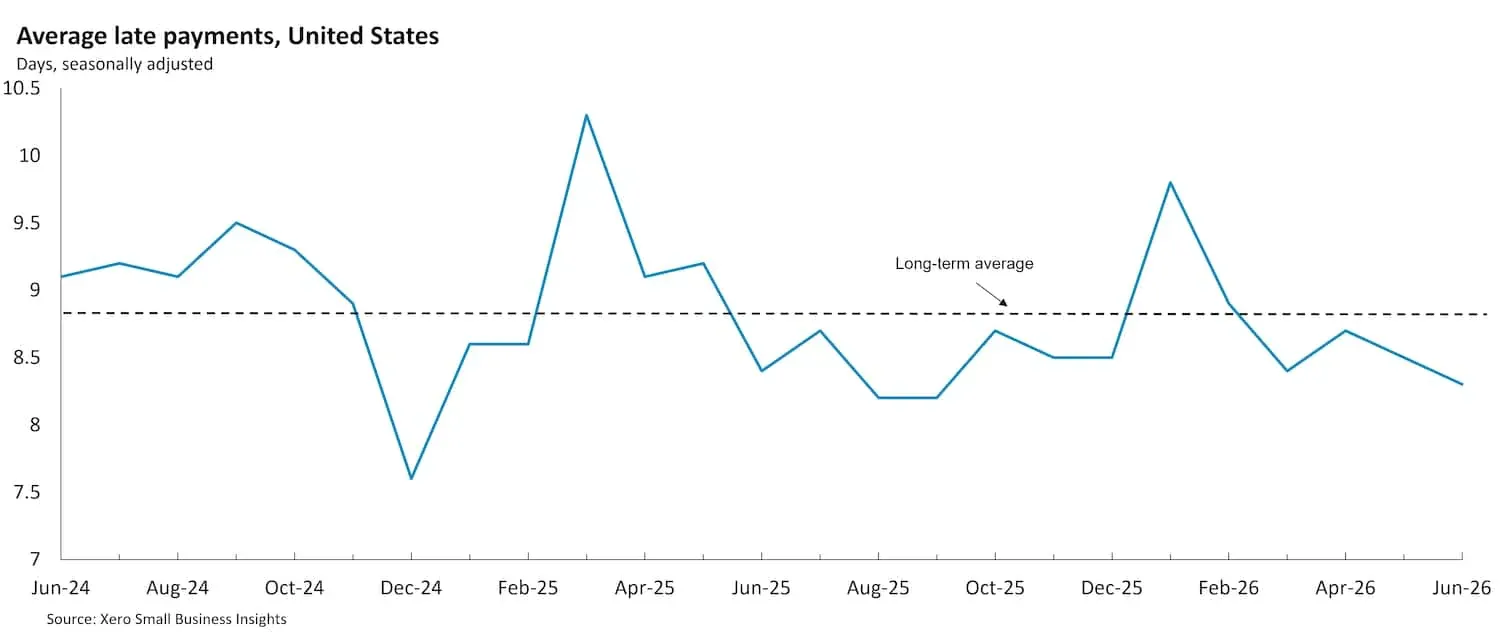 Figure 1: US small businesses were paid between about 7.6 and 10.3 days late in every month from June 2024 to June 2026, and the line stays close to its long-term average, so a late customer is a steady cost and not a one-off shock. Source: Xero, United States Small Business Insights, Jun 2026. Chart published by the source, captured 20 Oct 2026.
How many small businesses are owed money?
More than half of small businesses were owed money on unpaid invoices in early 2025, and the share with invoices past 30 days rose in 2026.
- 56% of surveyed US small businesses said they were owed money from unpaid invoices (Intuit QuickBooks, May 2025).
- Nearly 1 in 10 invoices at the average firm was overdue by more than 30 days (Intuit QuickBooks, May 2025).
- 22% of businesses had at least a fifth of their invoices unpaid past 30 days (Intuit QuickBooks, Jul 2026).
- Businesses with unpaid invoices were owed $17.7K on average, close to the $17.5K a year earlier (Intuit QuickBooks, Jul 2026).
- About 7 in 10 US companies still face late payments from business customers (Atradius, Sep 2026).
- Late payments affect an average of 22% of US B2B receivables (Atradius, Sep 2026).
- US businesses sell 45% of their B2B sales on credit and take the rest up front (Atradius, Sep 2026).
What do unpaid invoice statistics say about how late the money is?
Most late invoices are late by days, not months, but a small share turns into long-term debt.
- Across all US industries, the average days beyond terms held at 10.9 to 11 days from 2023 through mid-2025 (Creditsafe, Sep 2025).
- The share of bills 1 to 30 days late jumped to 41.5% in June 2024, then fell to 1.9% by May 2025 (Creditsafe, Sep 2025).
- Bills 91 or more days late rose to 5.7% in February 2025, then fell to 0.3% by May 2025 (Creditsafe, Sep 2025).
- Creditsafe drew these figures from payment data on more than 32 million US businesses (Creditsafe, Sep 2025).
Is it getting better or worse?
It is flat to slightly worse. The average lateness eased in the June 2026 quarter, but the credit managers who chase the money say the trend under the average is weaker.
- Late payment time fell 0.5 days in the June 2026 quarter, to 8.5 days (Xero Small Business Insights, Jul 2026).
- By month, late payment time was 8.7 days in April, 8.5 in May and 8.3 in June (Xero Small Business Insights, Jul 2026).
- The NACM index for dollars beyond terms lost 3.4 points in September 2026 and sits at 48.5, below the 50 line that separates growth from contraction (NACM, Sep 2026).
- The NACM Dollar Collections index fell from 64.0 in August to 59.3 in September 2026 (NACM, Sep 2026).
- NACM credit managers report that many customers are unilaterally changing contract terms to pay-when-paid (NACM, Sep 2026).
Do shorter payment terms help?
Yes. Shops that ask for money sooner have fewer overdue invoices.
- 55% of businesses on net-30 terms have overdue invoices, against 26% of those on immediate terms (Intuit QuickBooks, Jul 2026).
- 64% of businesses with no overdue invoices require immediate payment, against 34% of those with overdue invoices (Intuit QuickBooks, Jul 2026).
How long do small businesses wait to get paid?
The wait is about a month, and it is getting longer even as the days past due ease. Where you work changes it by nearly 12 days.
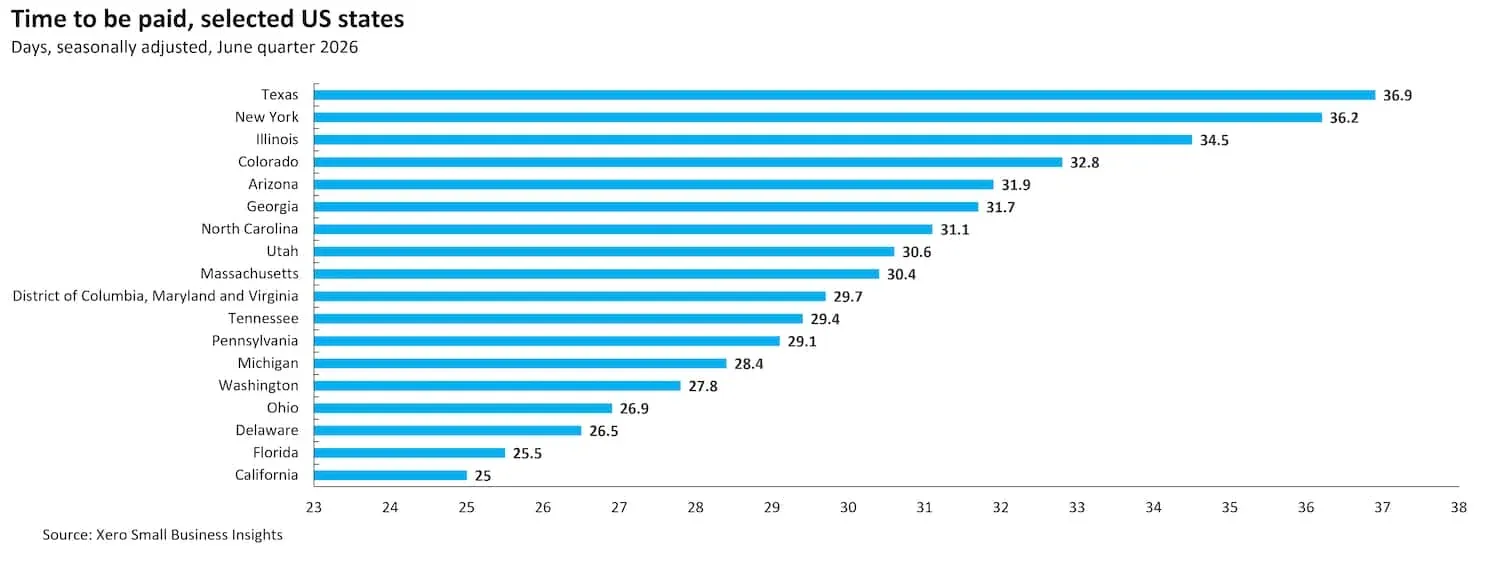 Figure 2: Small businesses in Texas waited 36.9 days to be paid in the June 2026 quarter, while those in California waited 25 days, so the same invoice can sit nearly 12 days longer depending on the state. Source: Xero, United States Small Business Insights, Jun 2026. Chart published by the source, captured 20 Oct 2026.
What is the average time to be paid?
Small businesses waited 29.3 days on average in the June 2026 quarter.
- The wait rose from 28.6 days in the March quarter to 29.3 days in the June quarter (Xero Small Business Insights, Jul 2026).
- The June quarter figure compares with a historical average of 28.9 days (Xero Small Business Insights, Jul 2026).
- The wait beat that historical average in only one of the first six months of 2026 (Xero Small Business Insights, Jul 2026).
- New York small businesses waited 36.2 days and Florida small businesses waited 25.5 days (Xero Small Business Insights, Jul 2026).
What payment terms do suppliers give?
About three in five US suppliers let customers pay within 30 days of the invoice.
- About three in five US suppliers let other businesses pay within 30 days, and half that many give one to two months (Atradius, Sep 2026).
- Medium-to-large construction companies usually offer the longest payment times of any group (Atradius, Sep 2026).
- Most US customers settle overdue invoices within one month past due, which puts cash in the bank about two months after invoicing (Atradius, Sep 2026).
- In the UK, micro and small firms give average terms of 46 days, against 56 days for large firms (Coface, Oct 2025).
How do the biggest companies pay?
Large buyers pay slowly on purpose, and that sets the tone for small suppliers.
- The top 1,000 US public nonfinancial companies took 59 days to pay their own bills on average (The Hackett Group, Aug 2025).
- Those companies have $1.7 trillion trapped in excess working capital (The Hackett Group, Aug 2025).
- Days sales outstanding worsened for a second straight year as customer bargaining power stretched payment terms (The Hackett Group, Aug 2025).
- Receivables are the largest part of that excess, a $600 billion opportunity, driven by an 18-day gap in days sales outstanding between top and median performers (The Hackett Group, Aug 2025).
What do late payments do to cash flow?
Slow pay does not stay on the invoice. It reaches payroll, bills and the owner’s own pocket. Half of small firms name cash flow as a problem, and the smaller the firm, the more likely it is.
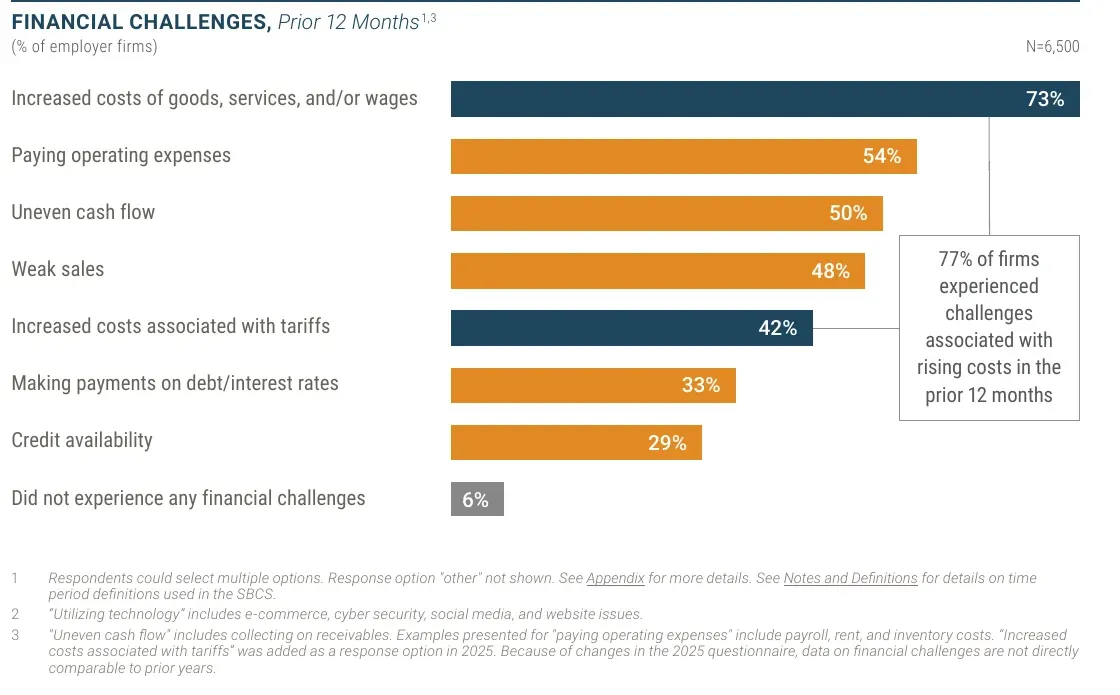 Figure 3: Uneven cash flow, which the survey defines to include collecting on receivables, ranks third among financial challenges for small employer firms, behind rising costs and paying operating expenses. Source: Federal Reserve Banks, 2026 Report on Employer Firms, Mar 2026. Crop of the source report PDF, captured 20 Oct 2026.
Who feels cash flow strain most?
Small firms and riskier firms feel it most.
- 51% of firms with 1 to 4 employees reported uneven cash flow (Federal Reserve Banks, Small Business Credit Survey, Mar 2026).
- 52% of firms with 5 to 9 employees reported it, against 37% of firms with 50 to 499 employees (Federal Reserve Banks, Small Business Credit Survey, Mar 2026).
- 51% of firms in the group that includes construction, wholesale and transportation reported it (Federal Reserve Banks, Small Business Credit Survey, Mar 2026).
- 47% of low credit risk firms reported it, 60% of medium risk firms and 69% of high risk firms (Federal Reserve Banks, Small Business Credit Survey, Mar 2026).
- 54% of firms named paying operating expenses as a financial challenge (Federal Reserve Banks, Small Business Credit Survey, Mar 2026).
How does a late invoice reach payroll?
Even small misses do damage when margins are thin.
- 27% of owners said a missed payment under $5,000 made it harder to cover payroll or bills (Intuit QuickBooks, Jul 2026).
- 12% said a late payment under $1,000 was enough to cause the strain (Intuit QuickBooks, Jul 2026).
- 51% of businesses with overdue invoices say cash flow is a problem, against 36% of those without (Intuit QuickBooks, Jul 2026).
- 60% of businesses with longer payment terms reported cash flow problems, against 40% of those with immediate terms (Intuit QuickBooks, May 2025).
- 53% of businesses with overdue invoices said outside pressures delayed their own outgoing payments, against 26% of those with none (Intuit QuickBooks, Jul 2026).
- 24% of businesses with invoices overdue 30 days or more said delayed revenue was the specific reason they could not pay contractors, suppliers or vendors on time (Intuit QuickBooks, Jul 2026).
- 62% of European businesses say delays in getting paid make them pay their own suppliers late (Intrum, Apr 2026).
How many days of cash do small shops hold?
Not many. A shop with a few weeks of cash cannot wait on a customer for six weeks without borrowing or skipping something.
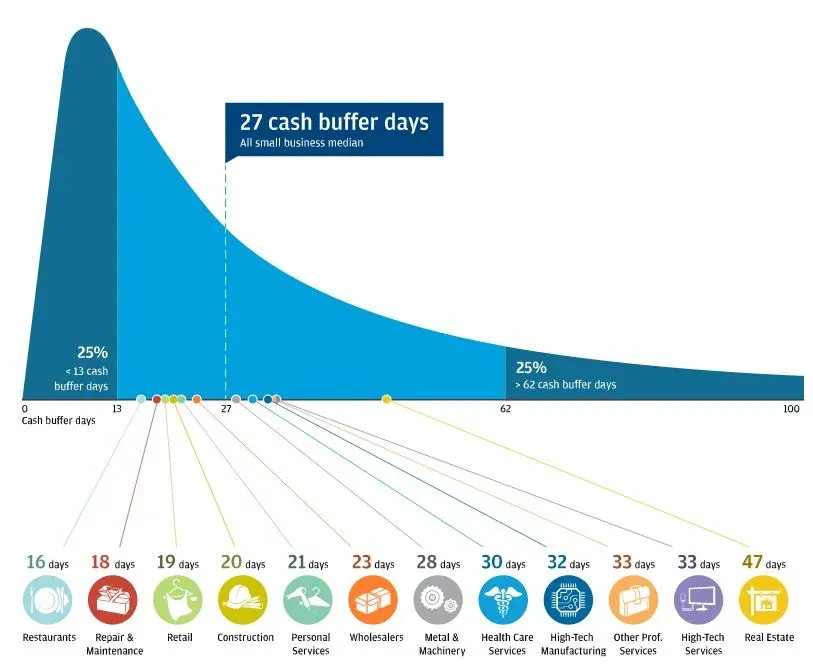 Figure 4: The median small business holds 27 days of cash, repair and maintenance firms hold 18 and construction firms hold 20, so a single slow customer can use up most of the cushion. Source: JPMorgan Chase Institute, Cash Flows, Balances, and Buffer Days, Sep 2016. Chart published by the source, captured 20 Oct 2026.
What is a cash buffer day?
A cash buffer day is one day of normal outflows that a business could pay from its cash balance if all inflows stopped.
- The median small business holds 27 cash buffer days (JPMorgan Chase Institute, Sep 2016).
- One in four small businesses holds fewer than 13 buffer days, and one in four holds more than 62 (JPMorgan Chase Institute, Sep 2016).
- The study covered 597,000 small businesses and more than 470 million transactions from February to October 2015 (JPMorgan Chase Institute, Sep 2016).
How much cash comes in and goes out?
The typical small business moves a few hundred dollars a day and keeps little in reserve.
- The median small business had average daily cash outflows of $374 and inflows of $381 (JPMorgan Chase Institute, Sep 2016).
- The median small business held an average daily cash balance of $12,100 (JPMorgan Chase Institute, Sep 2016).
- The median construction firm held $10,700 (JPMorgan Chase Institute, Sep 2016).
- Labor-intensive industries, a group that includes construction and repair and maintenance, hold fewer buffer days than capital-intensive ones (JPMorgan Chase Institute, Sep 2016).
- Construction companies in the CFMA benchmark held 23.5 days of cash in 2023 (Construction Financial Management Association, Oct 2024).
How bad is slow pay for contractors?
Worse than for most other trades. Contractors carry materials, labor and permits long before the customer pays, and many report that nobody pays them on time. These surveys cover builders of all sizes, so read them as the upper bound for a small residential shop. For the size of the industry itself, see our construction industry statistics.
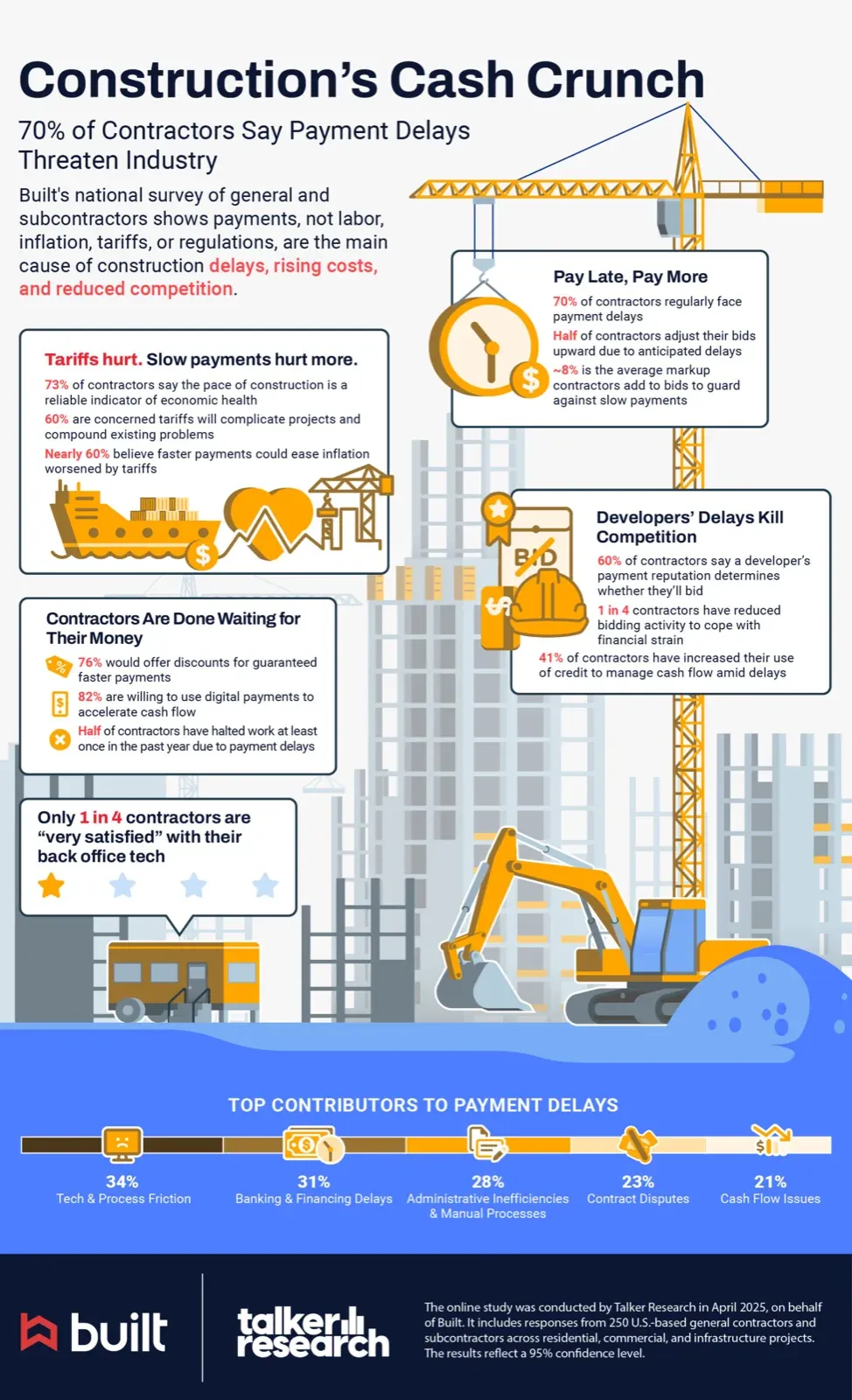 Figure 5: Seven in ten surveyed contractors regularly face delayed payments, half raise their bids to cover it and one in four has cut back on bidding, so slow pay is priced into the job. Source: Built, survey by Talker Research, May 2025. Chart published by the source, captured 20 Oct 2026.
How long do contractors wait?
Payment waits in construction run well past 30 days.
- The average wait on a commercial pay application was 57 days in a ledger of live construction payments (Built, Aug 2026).
- Owners paid general contractors in a median of 17 days and an average of 25 days (Built, Aug 2026).
- Fewer than half of construction companies are paid within 30 days on average (Levelset, May 2022).
- 10% of companies say the average customer takes more than 60 days to pay (Levelset, May 2022).
- Nearly 1 in 2 businesses on private residential projects are paid within 30 days, against 1 in 3 on private commercial projects and 1 in 5 on public projects (Levelset, May 2022).
- Construction companies in the CFMA benchmark took 56.6 days to collect receivables in 2023, up from 53.8 days in 2014 (Construction Financial Management Association, Oct 2024).
What does slow pay do to a contractor’s business?
It raises prices, delays work and wears down the people doing it.
- 70% of surveyed contractors regularly face delayed payments (Built, May 2025).
- Contractors add an average of 8% to bids to guard against slow payment (Built, May 2025).
- 35% have seen projects canceled or significantly delayed because of financing gaps (Built, May 2025).
- 60% say a developer’s payment reputation affects whether they bid at all (Built, May 2025).
- 76% would give a discount for guaranteed faster payment, and 82% would use digital payments to speed up cash flow (Built, May 2025).
- 95% of construction companies say they feel stress over slow payments (Levelset, May 2022).
- 45% say slow payment wastes resources, 41% say it cuts profit and 18% say it caused a failure to meet payroll (Levelset, May 2022).
- Construction businesses ask for credit more than twice as often as companies in many other industries (Experian, Feb 2026).
Do contractors chase what they are owed?
Many do not, and the reasons are mostly about fear of losing the customer.
- 1 in 4 construction companies do not send invoice reminders or make follow-up calls when payment is late (Levelset, May 2022).
- Just 25% would consider filing a mechanics lien in response to a late payment (Levelset, May 2022).
- Just 13% of businesses say they will not work again with a subcontractor or supplier who files a lien (Levelset, May 2022).
- 15% of construction businesses say they are always paid in full (Levelset, May 2022).
How fast do home service shops get paid?
Faster than builders. Most home service work is paid for at the door, which is why shops of this size live on cash that arrives within days. The wider market is on our home services industry statistics page.
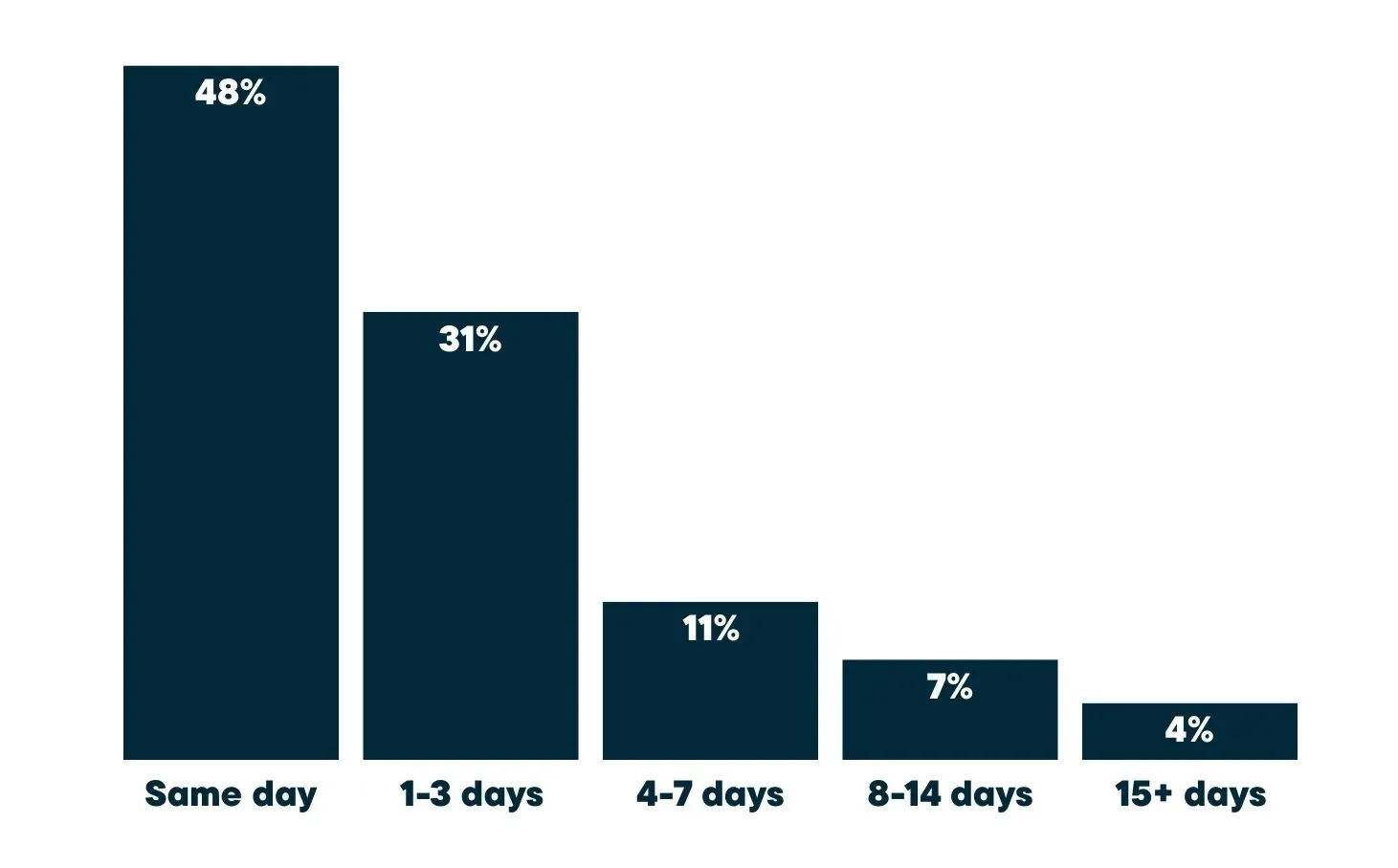 Figure 6: Almost half of surveyed home service businesses are paid the same day and 79% within three days (our sum of the first two bars), but a long tail waits more than two weeks, and that tail is where the cash crunch starts. Source: Jobber, 2026 Home Service Trends Report, Dec 2025. Chart published by the source, captured 20 Oct 2026.
How long after the job does the money arrive?
Nearly 80% of service pros get paid within three days of finishing the job (Jobber, Feb 2026).
- 31% are paid within one to three days (Jobber, Feb 2026).
- 7% wait 8 to 14 days (Jobber, Feb 2026).
- 4% wait 15 days or more (Jobber, Feb 2026).
- 73% of newer businesses report same-day payment, probably because their work is small, residential and paid on completion (Jobber, Feb 2026).
- The survey covered 1,050 US home service business owners, including HVAC, in December 2025 (Jobber, Feb 2026).
What helps get paid faster?
Taking payment online and asking for a deposit.
- Pros who accept online payments get paid four times faster than those who do not (Jobber, Feb 2026).
- Top businesses in Jobber’s benchmark take a deposit of 30% or more (Jobber, Feb 2026).
Is getting paid a top worry for home service owners?
It is a real worry but not the first one. Weather and competition come first.
- Weather or seasonality (34%) and competition (28%) were the most common biggest challenges (Jobber, Feb 2026).
- 17% of home service owners named cash flow as a biggest challenge (Jobber, Feb 2026).
- 12% named collecting payment (Jobber, Feb 2026).
- 28% said invoicing is one of their most time-consuming daily tasks, and 16% said the same of payments (Jobber, Feb 2026).
Can homeowners pay on the spot?
Many cannot pay a large repair bill from savings, and that is where invoices turn into waiting. The customer who wants the system fixed today may still need weeks to find the money.
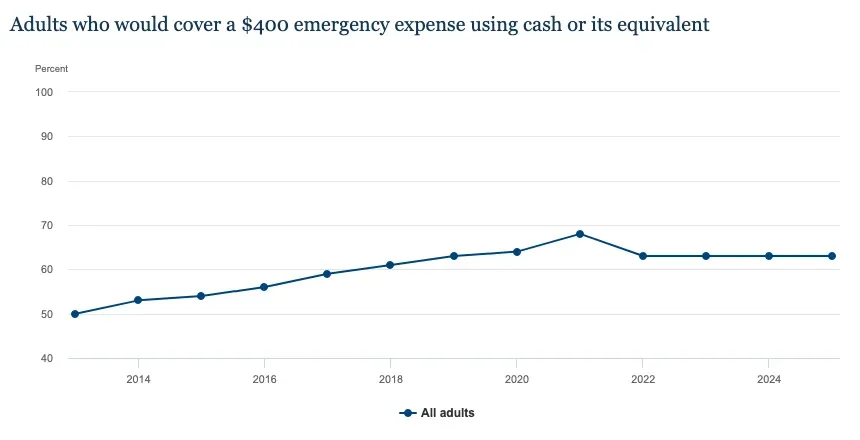 Figure 7: The share of US adults who could cover a $400 emergency with cash or its equivalent climbed from 50% in 2013 to a peak in 2021 and has held at 63% since 2022, which leaves more than a third of adults needing another way to pay a surprise bill. Source: Federal Reserve Board, Report on the Economic Well-Being of U.S. Households in 2025, May 2026. Screenshot of the source page, captured 20 Oct 2026.
How many households face a repair bill?
Repairs are common, and a house or appliance repair is one of the usual shocks.
- 59% of adults had at least one major unexpected expense in the prior 12 months (Federal Reserve Board, May 2026).
- 22% had a major house or appliance repair (Federal Reserve Board, May 2026).
- 75% of homeowners have had an emergency home repair, and 40% of those cost more than $3,000 (Synchrony, Mar 2026).
- Actual home repair and maintenance costs average more than $7,000 a year (Synchrony, Mar 2026).
How many households have the cash?
Fewer than half have $1,000 ready.
- 7 in 10 homeowners lack enough repair reserves (Synchrony, Mar 2026).
- 47% of Americans have enough liquidity or access to funds to cover a $1,000 emergency expense (Bankrate, Jan 2026).
- 29% have more credit card debt than emergency savings (Bankrate, Jan 2026).
- 16% of adults did not pay all of their bills in the prior month (Federal Reserve Board, May 2026).
- 73% of adults said they were doing okay financially or living comfortably (Federal Reserve Board, May 2026).
How much household debt is past due?
A small share, but a large dollar amount.
- 4.7% of outstanding household debt was in some stage of delinquency at the end of June 2026 (Federal Reserve Bank of New York, Aug 2026).
- Total household debt stood at $18.8 trillion (Federal Reserve Bank of New York, Aug 2026).
- Credit card balances were $1.26 trillion (Federal Reserve Bank of New York, Aug 2026).
What does chasing payment cost?
More than the invoice shows. Owners pay in hours, in fees, in debt and in their own pay. The cost lands on the shop even when the customer pays in the end.
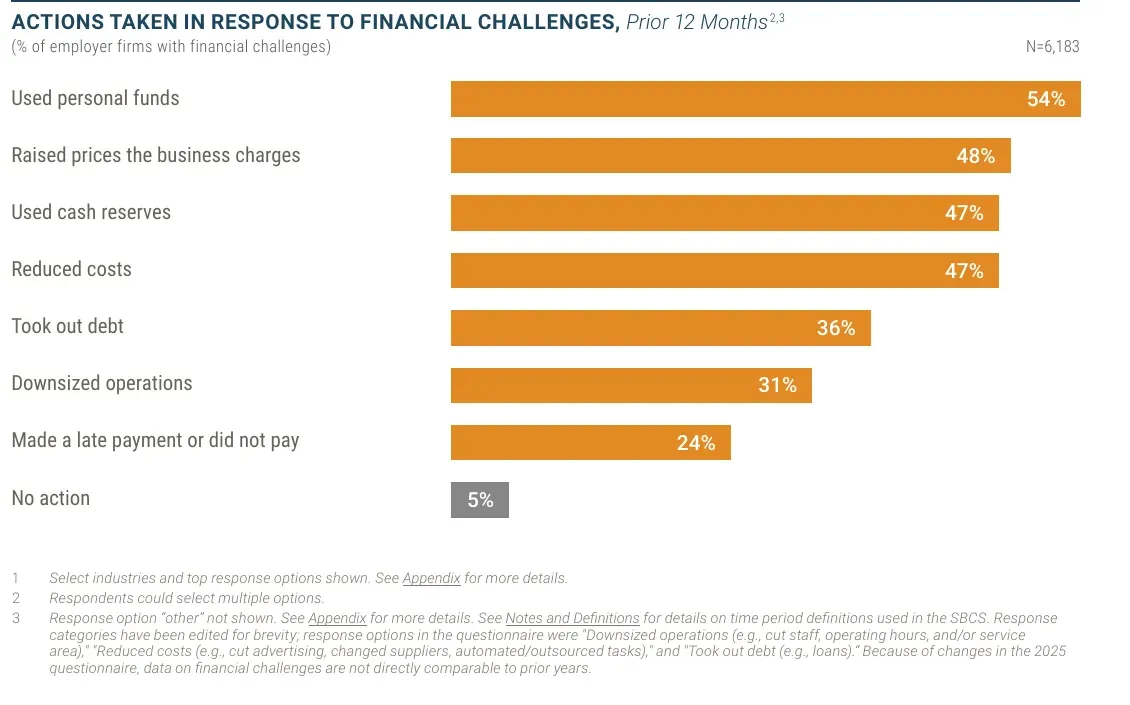 Figure 8: When cash runs short, more than half of small employer firms put in personal funds and one in four makes a late payment or does not pay, so one late customer can create more late invoices further down the chain. Source: Federal Reserve Banks, 2026 Report on Employer Firms, Mar 2026. Crop of the source report PDF, captured 20 Oct 2026.
How much time goes into chasing late invoices?
The best hours data comes from the UK, where the government commissioned a study.
- 22% of surveyed UK businesses spent staff time chasing late payments (UK Government, Jul 2026).
- That adds up to 133 million staff hours a year across all UK businesses (UK Government, Jul 2026).
- 15% of UK businesses avoided doing business with specific customers because of how they pay (UK Government, Jul 2026).
- Intrum estimates that AI in payments can cut the cost of chasing late payments by around 20% (Intrum, Apr 2026).
What do owners pay to get at their own money?
Fees, credit and their own salary.
- 59% of owners paid for instant transfer or fast deposit in 2025 (Intuit QuickBooks, Jul 2026).
- For 15% of owners, paying for fast deposit is routine (Intuit QuickBooks, Jul 2026).
- Processing delays caused 26% of owners to delay paying their own salary (Intuit QuickBooks, Jul 2026).
- Processing delays pushed 19% of owners to take on debt or use a credit card they otherwise would not have (Intuit QuickBooks, Jul 2026).
- Processing delays caused 18% of owners to pay a bill late and incur a fee or penalty (Intuit QuickBooks, Jul 2026).
- 38% of businesses with overdue invoices grew more reliant on credit cards in the past year, against 21% of those without (Intuit QuickBooks, Jul 2026).
- 54% of firms with financial challenges used personal funds, and 36% took out debt (Federal Reserve Banks, Small Business Credit Survey, Mar 2026).
- 59% of high credit risk firms made a late payment or did not pay, against 17% of low credit risk firms (Federal Reserve Banks, Small Business Credit Survey, Mar 2026).
Does it push prices up?
Yes. Shops hit hardest by late payments raise prices more often. Our pricing statistics page covers price rises in more depth.
- 30% of businesses more affected by late payments had recently raised prices, against 21% of less affected businesses (Intuit QuickBooks, May 2025).
- Their average increase was 16%, against 10% for less affected businesses (Intuit QuickBooks, May 2025).
- 47% of businesses with significant payment delays said hiring skilled workers is a problem, against 34% of the rest (Intuit QuickBooks, May 2025).
What do invoicing statistics show about manual work?
For most, yes, and manual work slows the money in both directions.
- 74% of businesses are not fully automated when it comes to managing and paying bills (Intuit QuickBooks, Jul 2026).
- 26% of owners say their most useful digital tools help them chase and collect unpaid invoices faster (Intuit QuickBooks, Jul 2026).
- 66% of European businesses use AI in payments (Intrum, Apr 2026).
Does the payment method change how fast you get paid?
It changes how fast the money is usable. Checks are fading, and cards and bank transfers carry the volume. Online payment options are tied to faster pay, as the home service data above shows.
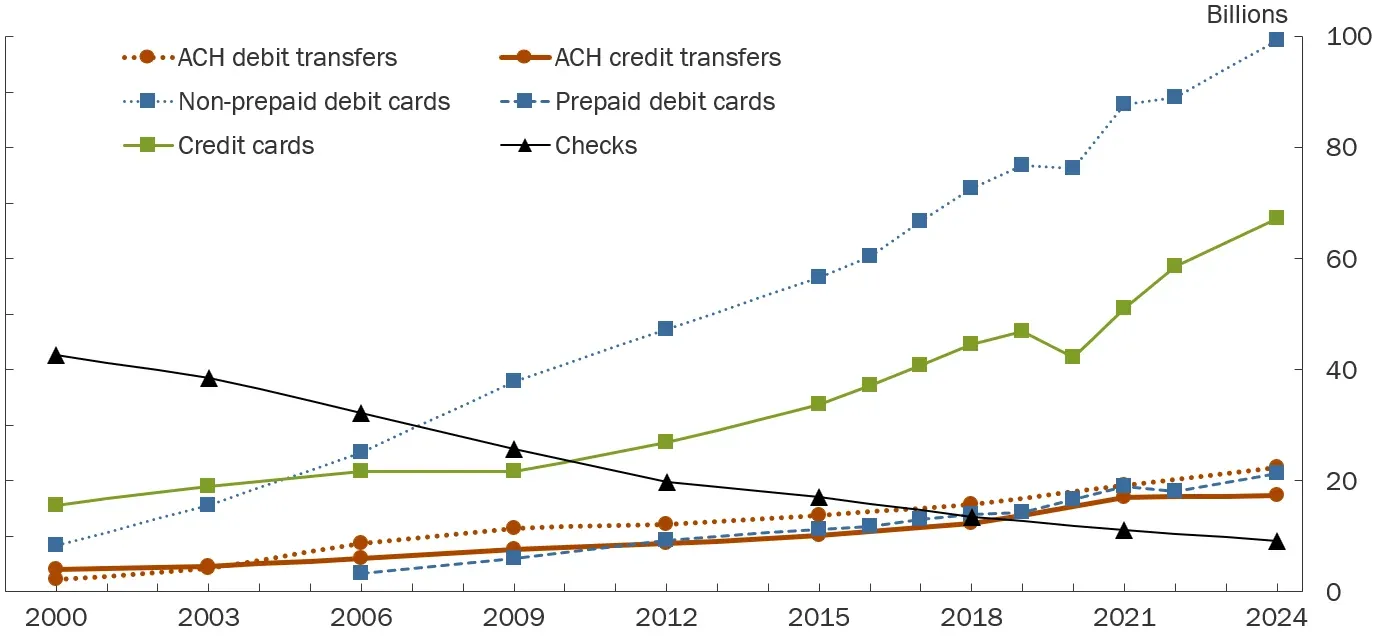 Figure 9: Checks fell from the most common noncash payment in 2000 to one of the least common by 2024, while non-prepaid debit and credit cards grew the most, so a shop that only takes checks relies on a method fewer customers use. Source: Federal Reserve Board, Federal Reserve Payments Study, Jul 2026. Chart published by the source, captured 20 Oct 2026.
How do Americans pay?
By card, mostly.
- Consumers and businesses made 236.6 billion noncash payments in 2024 (Federal Reserve Board, Jul 2026).
- Cards made up 187.7 billion of them (Federal Reserve Board, Jul 2026).
- ACH transfers numbered 39.7 billion and moved $104.06 trillion (Federal Reserve Board, Jul 2026).
- The average check was $2,653, against an average card payment of $61 (Federal Reserve Board, Jul 2026).
- Consumers made an average of 48 payments a month in October 2024 (Federal Reserve Financial Services, Oct 2024).
- Cash was 14% of all consumer payments (Federal Reserve Financial Services, Oct 2024).
- Mobile phones were used for 23% of all payments and 45% of remote payments (Federal Reserve Financial Services, Oct 2024).
Does getting paid mean the money is available?
Not always. A paid invoice can still take days to clear.
- ACH and card payments can take one to three business days to clear (Intuit QuickBooks, Jul 2026).
- 49% of owners say standard payment processing times create critical or moderate cash-flow gaps (Intuit QuickBooks, Jul 2026).
- The FedNow instant payment service settled 4,997,811 payments in the second quarter of 2026, up 83.2% from a year earlier (Federal Reserve Financial Services, Jun 2026).
- The average FedNow payment was $54,957 in that quarter, so the service mostly moves large payments for now (Federal Reserve Financial Services, Jun 2026).
What happens when an invoice goes to collections?
Fewer invoices get collected the longer they sit, and the credit managers who hand accounts to collectors say the number keeps rising. Collection is the last step, and it is rare for a small shop to get everything back.
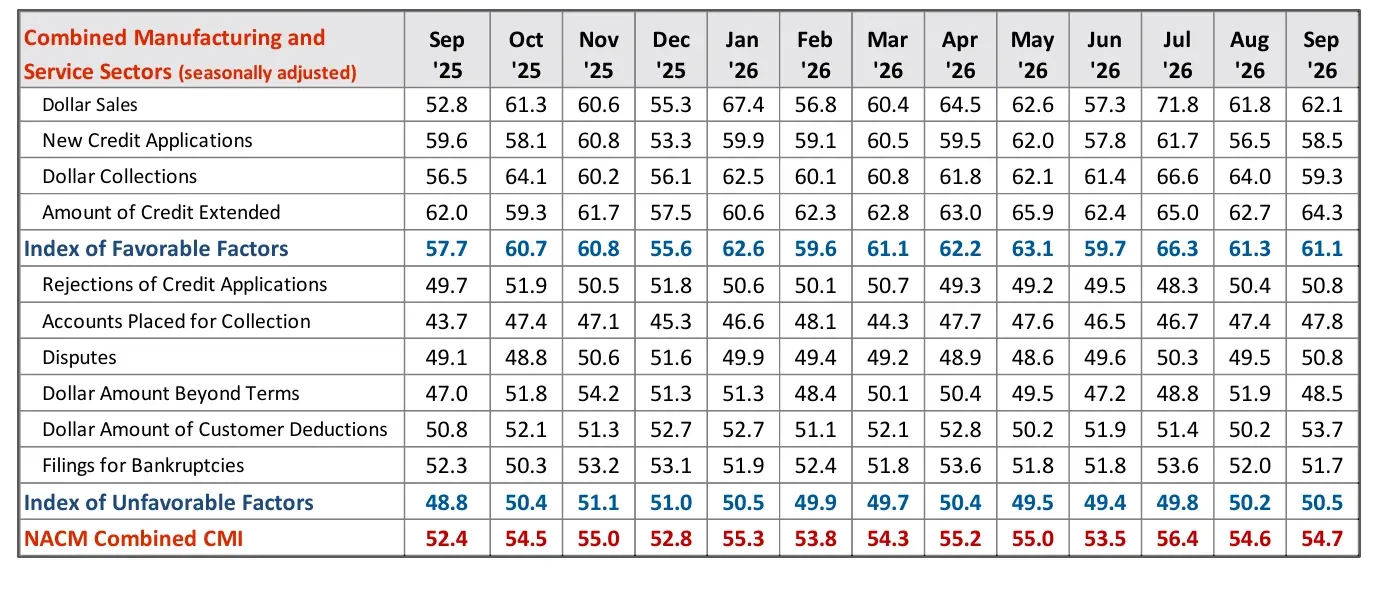 Figure 10: Accounts placed for collection stayed below the neutral 50 line in every month shown, from 43.7 to 48.1, which means credit managers sent more accounts to collection than the month before in every month. Source: NACM, Credit Managers’ Index, Report for September 2026, Sep 2026. Crop of the source report PDF, captured 20 Oct 2026.
How many invoices become bad debt?
Between 1% and 2% for most US firms.
- US companies often report losing 1% to 2% of their B2B invoices as bad debt (Atradius, Sep 2026).
- The main cause is invoices that stay unpaid for a long time, followed by customers who stop being active or cannot be reached (Atradius, Sep 2026).
- Around one in five US companies uses credit insurance (Atradius, Sep 2026).
- The NACM Service Sector index was 55.9 and the Manufacturing Sector index 53.6 in September 2026, both above the 50 line (NACM, Sep 2026).
How many consumers are in collections?
About one in twenty has a collection account on their credit report.
- 4.9% of consumers had a third-party collection account on their credit report in the second quarter of 2026 (Federal Reserve Bank of New York, Aug 2026).
- About 137,000 consumers had a bankruptcy notation added to their credit reports in that quarter (Federal Reserve Bank of New York, Aug 2026).
What do consumers complain about in collections?
Mostly that they do not owe the money. That is a reason to keep invoices clear and accurate.
- The CFPB received about 387,400 debt collection complaints in 2025 (CFPB, Consumer Response Annual Report, Mar 2026).
- It sent about 304,700 of them, 79%, to companies for response (CFPB, Consumer Response Annual Report, Mar 2026).
- Attempts to collect a debt the consumer says is not owed have been the top debt collection complaint issue since the CFPB began taking these complaints in 2013 (CFPB, FDCPA Annual Report, Nov 2025).
- Most consumers who said the debt was not owed said it was not their debt (60%) (CFPB, FDCPA Annual Report, Nov 2025).
What do the rules say, and how do other countries compare?
The US has strong rules for late payments by the federal government and few for late payments between private parties. Europe and the UK have gone further, and their numbers show what a stricter system looks like.
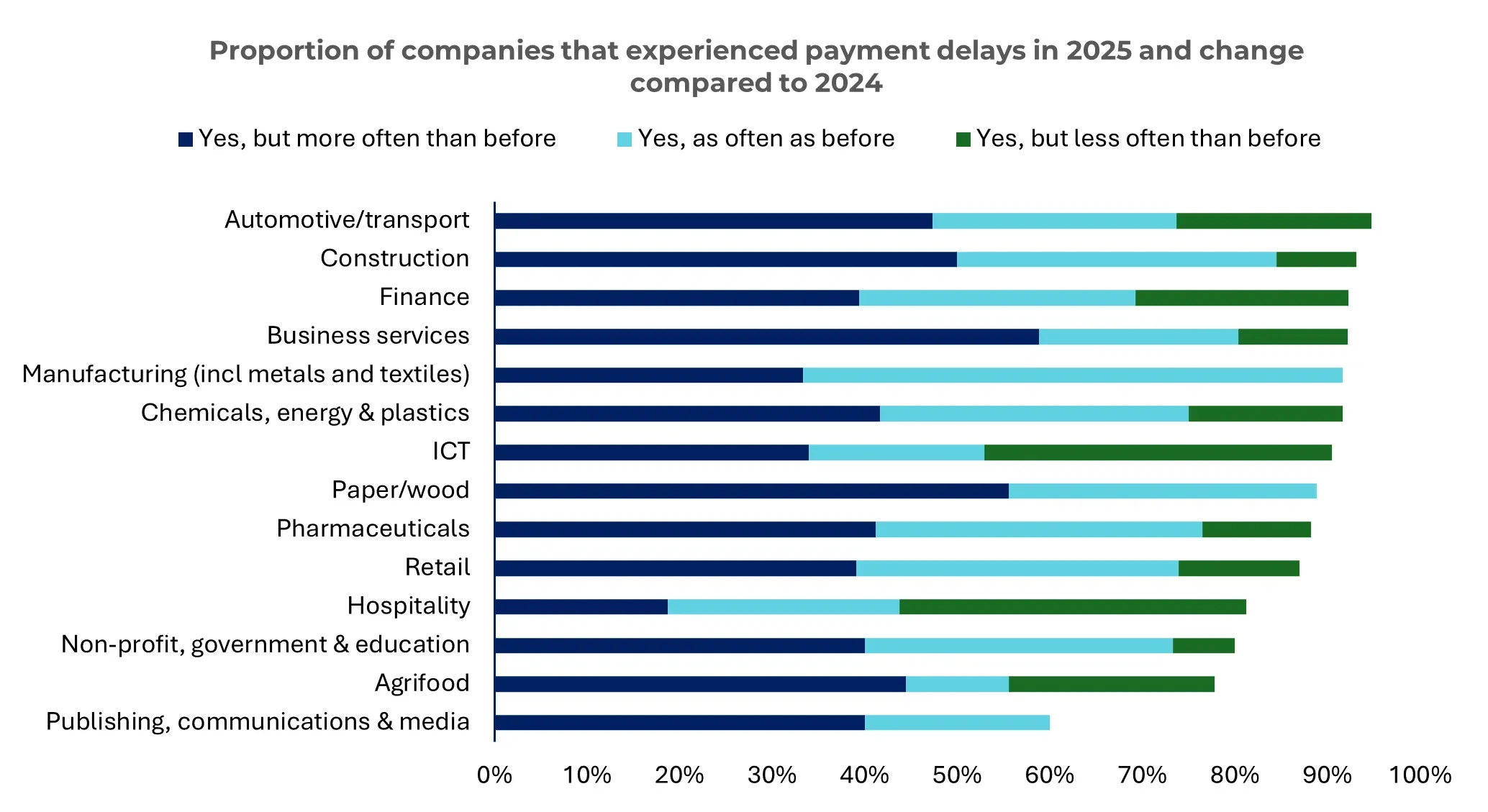 Figure 11: In the UK Coface survey, construction ranks second among 14 industries for the share of companies hit by payment delays in 2025, and about half of construction firms say delays are happening more often than before. Source: Coface, 2025 UK Payment Survey, Oct 2025. Chart published by the source, captured 20 Oct 2026.
What does the US federal government owe on late invoices?
Interest, set by the Treasury every six months.
- The Prompt Payment Act of 1982 requires federal agencies to pay interest when they pay vendors late (Bureau of the Fiscal Service, Jul 2026).
- The Treasury published the rate for July 1 to December 31, 2026 in the Federal Register on July 9 (Federal Register, Jul 2026).
What do other countries require?
The UK and the EU set statutory interest and fixed fees.
- Directive 2011/7/EU entitles a creditor to a fixed sum of at least EUR 40 when interest for late payment becomes payable (EUR-Lex, Directive 2011/7/EU, Feb 2011).
- The same directive sets payment periods for public authorities that normally do not exceed 30 calendar days, and never exceed 60 (EUR-Lex, Directive 2011/7/EU, Feb 2011).
- The UK government intends to cap payment terms between businesses at 60 days (UK Government, Jul 2026).
- It also intends to require a right to statutory interest at 8% above the Bank of England base rate in all commercial contracts (UK Government, Jul 2026).
What does the UK see in its own numbers?
Late payments cost the UK economy almost £11 billion a year.
- 14,000 UK businesses close each year because of late payments, equal to 38 a day (UK Government, Jul 2026).
- 28% of UK businesses, over 1.5 million, are affected by late payments each year (UK Government, Jul 2026).
- UK businesses are owed an estimated £26 billion at any time, an average of £17,000 per affected business (UK Government, Jul 2026).
- 90% of UK businesses face payment delays, and 44% say they face them more often than before (Coface, Oct 2025).
- The average UK delay is 32 days, and construction has the longest average delay at 38.2 days (Coface, Oct 2025).
What does Europe see?
Late money is now above the level firms say they can bear.
- About 12% of European revenues are received late, slightly above the level executives consider sustainable (Intrum, Apr 2026).
- The gap between actual payment time and agreed terms in the B2B sector widened from 16 days in 2023 to 20 days in 2026 (Intrum, Apr 2026).
- 53% of European businesses expect late or non-payment to increase in the next 12 months (Intrum, Apr 2026).
- 58% are strengthening their payment discipline (Intrum, Apr 2026).
- Intrum’s report draws on 8,385 businesses in 20 European countries (Intrum, Apr 2026).
Methodology and Sources
We chose each number for a clear definition, a named publisher and a date. Every figure comes from the group that ran the survey or kept the records, such as a central bank, a regulator, a credit insurer or a software maker reporting its own survey. We did not use roundups. Surveys by software and payment companies are marked by name, because they measure their own customers or panels. Figures from different surveys are not blended, and we avoid comparing them. For example, Atradius, Intuit and Xero each define late payment in their own way. Most data is for all small businesses or all builders, not HVAC alone, and the text says so. The page is checked and updated every month.
Glossary
- ACH: Automated Clearing House, the US bank transfer network.
- B2B: business to business, a sale from one company to another.
- Bad debt: an invoice the seller does not expect to collect.
- CFPB: Consumer Financial Protection Bureau.
- DSO: days sales outstanding, the average days it takes to collect after a sale.
- Net 30: an invoice due 30 days after the invoice date.
- NACM: National Association of Credit Management.
- Receivables: money customers owe a business for work already done.
- SBCS: Small Business Credit Survey, run by the Federal Reserve Banks.
Sources
- Atradius, Sep 2026
- Bankrate, Jan 2026
- Built, Aug 2026
- Built, May 2025
- Bureau of the Fiscal Service, Jul 2026
- CFPB, Consumer Response Annual Report, Mar 2026
- CFPB, FDCPA Annual Report, Nov 2025
- Coface, Oct 2025
- Construction Financial Management Association, Oct 2024
- Creditsafe, Sep 2025
- EUR-Lex, Directive 2011/7/EU, Feb 2011
- Experian, Feb 2026
- Federal Register, Jul 2026
- Federal Reserve Bank of New York, Aug 2026
- Federal Reserve Bank of New York, Aug 2026
- Federal Reserve Banks, Small Business Credit Survey, Mar 2026
- Federal Reserve Banks, Small Business Credit Survey, Mar 2026
- Federal Reserve Board, May 2026
- Federal Reserve Board, Jul 2026
- Federal Reserve Financial Services, Oct 2024
- Federal Reserve Financial Services, Jun 2026
- Intrum, Apr 2026
- Intuit QuickBooks, Jul 2026
- Intuit QuickBooks, May 2025
- Jobber, Feb 2026
- JPMorgan Chase Institute, Sep 2016
- Levelset, May 2022
- NACM, Sep 2026
- SBA Office of Advocacy, Feb 2026
- Synchrony, Mar 2026
- The Hackett Group, Aug 2025
- UK Government, Jul 2026
- Xero Small Business Insights, Jul 2026