Trades statistics point one way in 2026: more people are choosing short programs and paid training, and the money data backs the choice more often than most people expect. About 10.7 million US jobs typically start with a postsecondary nondegree award, and 42.9 million start with a bachelor’s degree (BLS Employment Projections, Sep 2026).
This page pulls the numbers from the agencies and research groups that produce them: the National Student Clearinghouse, the US Department of Education, the Department of Labor, the Bureau of Labor Statistics, the Federal Reserve, Gallup and Pew. Every figure links to its source and carries a date. We did not take any number from a roundup.
It covers six questions that shop owners, parents and young workers ask. How many people enroll in trade school? How many finish an apprenticeship? What do trade workers earn next to people with degrees? How much debt do students carry? What do Americans think of these paths? What is changing in federal policy?
Key Takeaways
- Undergraduate certificate programs grew 10.2% in spring 2026, the fastest of any credential type (National Student Clearinghouse Research Center, Jun 2026).
- Community colleges enrolled 752,000 students in certificate programs in fall 2025, up 28.3% since fall 2021 (National Student Clearinghouse Research Center, Jan 2026).
- The Department of Labor lists more than 800,000 apprentices a year across the nation (Apprenticeship.gov, Dec 2025).
- The national apprenticeship completion rate for fiscal year 2024 was 46.49% (Apprenticeship.gov, Oct 2026).
- Electrical installer certificate completers earned a median $44,469 one year after finishing, against $37,251 for psychology bachelor’s completers (U.S. Department of Education, College Scorecard, Oct 2026).
- Aircraft and avionics mechanics, a job that starts with a postsecondary award, had a 2025 median wage of $80,180 (BLS Occupational Outlook Handbook, Aug 2026).
- Americans owed $1.651 trillion in student debt in the second quarter of 2026 (Federal Reserve Bank of New York, Aug 2026).
- 10.6% of student loan balances were 90 or more days past due (Federal Reserve Bank of New York, Aug 2026).
- 42% of recent college graduates were underemployed in the second quarter of 2026 (Federal Reserve Bank of New York, Aug 2026).
- Only 12% of US adults say four-year colleges do a good job on affordability (Gallup, Jul 2026).
- 17% of parents most prefer a job training or certification program for their child after high school (Gallup, Jul 2026).
- The US is short about 712,000 certificates and associate degrees a year that lead to high-paying jobs without a bachelor’s degree (Georgetown University Center on Education and the Workforce, Jun 2025).
- Workforce Pell covers programs of 150 to 599 clock hours (Federal Register, May 2026).
- 85% of 2019 high school graduates took at least one career and technical education course (National Center for Education Statistics, May 2024).
How Many Students Enroll in Trade School?
Enrollment is growing at the short end of college and shrinking in a few places that used to look safe. The people filling trade programs are not a fringe group, and community colleges are where most of them go.
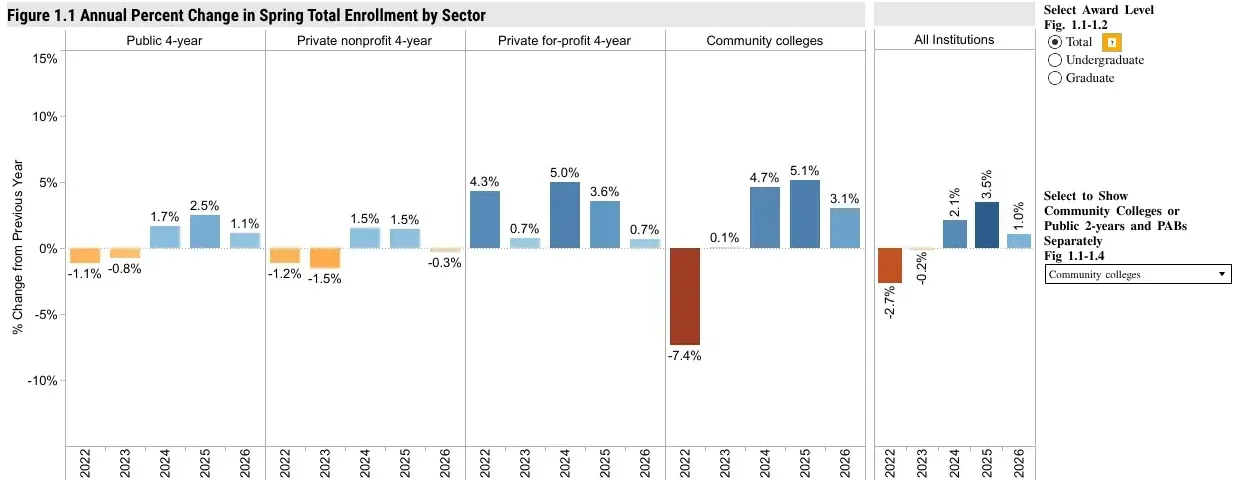 Figure 1: Community colleges, where most trade programs sit, have grown every spring since 2023 after a 7.4% drop in 2022, while private nonprofit four-year schools slipped in 2026. Source: National Student Clearinghouse Research Center, Final Spring Enrollment Trends, Jun 2026. Chart published by the source, cropped from the report dashboard, captured 20 Oct 2026.
How many people are in college right now?
- Total postsecondary enrollment was 18.6 million in spring 2026, up 1.0% or 192,000 students from a year earlier (National Student Clearinghouse Research Center, Jun 2026).
- Undergraduate enrollment rose 1.3% to 15.5 million (National Student Clearinghouse Research Center, Jun 2026).
- Community college enrollment reached 5.8 million, which is 5.2% above spring 2021 (National Student Clearinghouse Research Center, Jun 2026).
- Community colleges grew 3.1% in spring 2026, while public four-year schools grew 1.5% (National Student Clearinghouse Research Center, Jun 2026).
- Associate degree programs grew 1.3% and bachelor’s programs grew 1.0% (National Student Clearinghouse Research Center, Jun 2026).
- Fall 2025 enrollment topped 19.4 million, with 16.2 million undergraduates (National Student Clearinghouse Research Center, Jan 2026).
- Community college enrollment rose 3.0% in fall 2025, adding 173,000 students (National Student Clearinghouse Research Center, Jan 2026).
- Certificate programs grew 1.9% in fall 2025 and associate programs grew 2.2%, against 0.9% for bachelor’s programs (National Student Clearinghouse Research Center, Jan 2026).
- Community colleges enrolled 965,000 freshmen in fall 2025, only 4,000 more than a year earlier after three years of strong growth (National Student Clearinghouse Research Center, Jan 2026).
Which trade-related programs are growing?
- Two-year colleges enrolled 85,190 students in construction trades programs in spring 2026, up from 58,220 in 2021 (National Student Clearinghouse Research Center, Jun 2026).
- Precision production programs, which include welding and machining, enrolled 68,267 at two-year colleges, up from 47,920 in 2021 (National Student Clearinghouse Research Center, Jun 2026).
- Personal and culinary services programs enrolled 64,131 at two-year colleges, up from 48,168 in 2021 (National Student Clearinghouse Research Center, Jun 2026).
- Four-year colleges reported 3,342 students in construction trades, up 18.5% in a year (National Student Clearinghouse Research Center, Jun 2026).
- Four-year precision production enrollment rose 22.6% to 1,591 (National Student Clearinghouse Research Center, Jun 2026).
- Health professions enrollment at two-year colleges reached 805,721, up 7.1% (National Student Clearinghouse Research Center, Jun 2026).
Which programs are shrinking?
- Two-year transportation and materials moving programs slipped 4.1% to 13,293 students (National Student Clearinghouse Research Center, Jun 2026).
- Two-year computer and information science enrollment fell 11.2% to 195,247 (National Student Clearinghouse Research Center, Jun 2026).
- Four-year computer and information science enrollment fell 8.4% (National Student Clearinghouse Research Center, Jun 2026).
- Undergraduate health professions enrollment rose 6.0% to 7.1% at every award level and school type, the third straight year of growth (National Student Clearinghouse Research Center, Jun 2026).
Are students staying enrolled?
- Of the 2.62 million students who started college in fall 2024, 85.8% were enrolled again in spring 2025 (National Student Clearinghouse Research Center, Jun 2026).
- By fall 2025, 77.1% of that class was still enrolled (National Student Clearinghouse Research Center, Jun 2026).
- 69.1% were still at their starting school, and 8.0% had moved to another school (National Student Clearinghouse Research Center, Jun 2026).
How Many People Finish Trade Programs, and Is It Enough?
Finishing is where the supply of skilled workers is decided, and the count of completions is smaller than the job market needs. Public colleges carry most of the load.
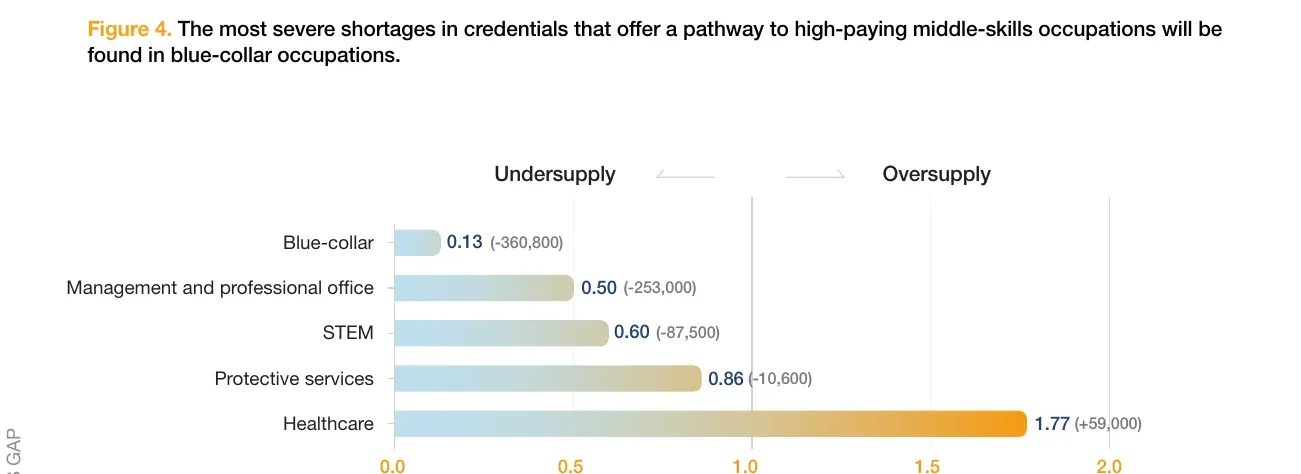 Figure 2: For every blue-collar job opening that pays well without a bachelor’s degree, schools produce about 13 aligned credentials for every 100 openings, the widest gap of any group. Source: Georgetown University Center on Education and the Workforce, Bridging the Middle-Skills Gap, Jun 2025. Chart published by the source, cropped from the report PDF, captured 20 Oct 2026.
How many trade awards do colleges hand out?
The counts below come from our sum of the federal completions file for 2023-24, first majors only.
- US colleges awarded 2,221,596 certificates and associate degrees in 2023-24, against 1,974,834 bachelor’s degrees, by our count of the file (National Center for Education Statistics, IPEDS, Sep 2025).
- Construction trades programs produced 54,545 certificates and associate degrees (National Center for Education Statistics, IPEDS, Sep 2025).
- Mechanic and repair programs produced 120,929 (National Center for Education Statistics, IPEDS, Sep 2025).
- Precision production programs produced 67,828 (National Center for Education Statistics, IPEDS, Sep 2025).
- Transportation and materials moving programs produced 26,898 (National Center for Education Statistics, IPEDS, Sep 2025).
- Personal and culinary services programs, which include cosmetology and culinary arts, produced 164,072 (National Center for Education Statistics, IPEDS, Sep 2025).
- In construction trades, 23,672 awards were certificates of one to two years and 7,094 were associate degrees (National Center for Education Statistics, IPEDS, Sep 2025).
- In mechanic and repair programs, 44,432 awards were certificates of 12 weeks to under a year (National Center for Education Statistics, IPEDS, Sep 2025).
Trade school statistics: who runs the programs?
- Public colleges gave out 72.0% of the 243,302 certificates and associate degrees in construction trades, mechanic and repair, and precision production, which is 175,169 awards (National Center for Education Statistics, IPEDS, Sep 2025).
- For-profit schools gave out 24.8%, or 60,424 awards (National Center for Education Statistics, IPEDS, Sep 2025).
- Private nonprofit schools gave out 3.2%, or 7,709 awards (National Center for Education Statistics, IPEDS, Sep 2025).
- 1,412 schools gave out at least one award in those three fields (National Center for Education Statistics, IPEDS, Sep 2025).
Does the country train enough skilled workers?
- Blue-collar credentials fall 360,800 short each year, a credentials-to-jobs ratio of 0.13 (Georgetown University Center on Education and the Workforce, Jun 2025).
- Management and professional office credentials fall 253,000 short, a ratio of 0.50 (Georgetown University Center on Education and the Workforce, Jun 2025).
- STEM credentials fall 87,500 short, a ratio of 0.60 (Georgetown University Center on Education and the Workforce, Jun 2025).
- Healthcare is the only group with a surplus, at 59,000 more credentials than jobs a year (Georgetown University Center on Education and the Workforce, Jun 2025).
- The study counts 107 high-paying middle-skills occupations, defined as jobs where more than half of workers aged 18 to 35 earn above $55,000 (Georgetown University Center on Education and the Workforce, Jun 2025).
- Workers in those jobs reach a median of $83,300 a year by mid-career (Georgetown University Center on Education and the Workforce, Jun 2025).
- Only one in four early-career middle-skills workers holds one of those jobs (Georgetown University Center on Education and the Workforce, Jun 2025).
How Many Apprentices Are There, and How Many Finish?
Apprenticeship is the one path where the worker is paid from day one, and the national numbers show it is big, growing and leaky. Fewer than half of the people counted in the latest federal completion data finished.
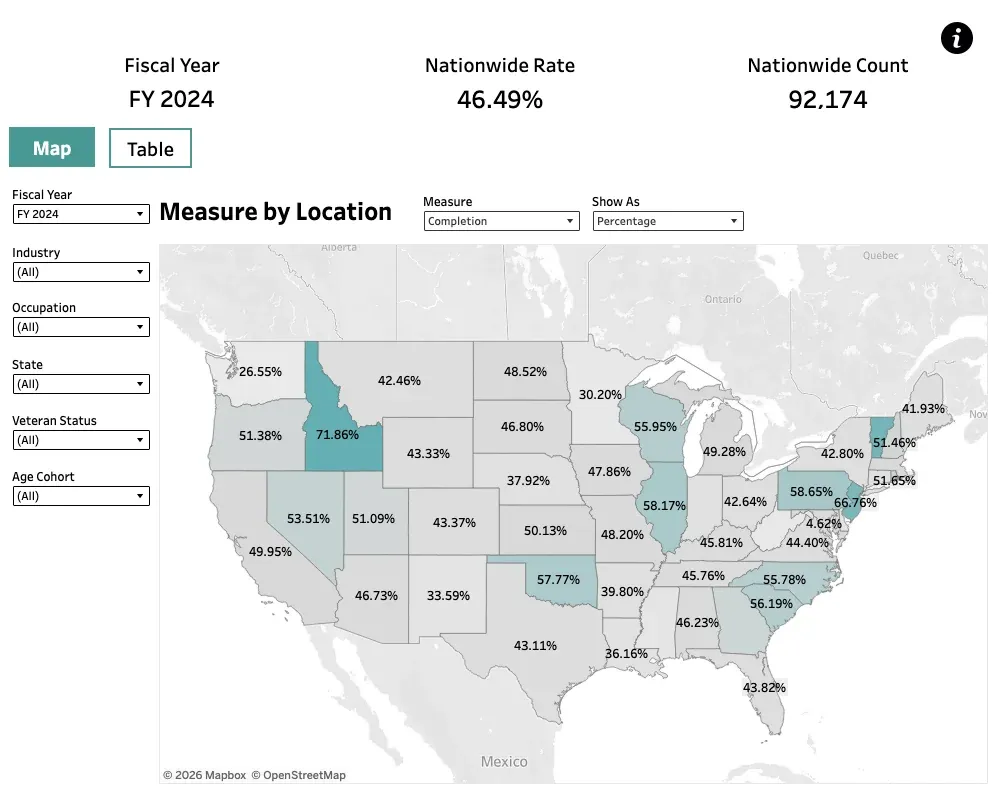 Figure 3: The national completion rate for fiscal year 2024 was 46.49%, and the state map shows 71.86% in Idaho and 26.55% in Washington, so where a person apprentices changes the odds. Source: U.S. Department of Labor, Apprentice Completion Rate Analysis, FY 2024. Screenshot of the source’s own dashboard, captured 20 Oct 2026.
How big is Registered Apprenticeship?
- Advanced manufacturing served 97,500 registered apprentices in 2025, up 20% in five years (Apprenticeship.gov, Oct 2026).
- Healthcare served 36,892, up 43% (Apprenticeship.gov, Oct 2026).
- Energy served 29,081, up 53% (Apprenticeship.gov, Oct 2026).
- Transportation served 27,418, up 10% (Apprenticeship.gov, Oct 2026).
What do apprentices earn after they finish?
- The average starting salary after completing an apprenticeship is $86,000 (Apprenticeship.gov, Dec 2025).
- The Department of Labor lists a lifetime earnings advantage of more than $300,000 for apprentice graduates, citing a 2012 Mathematica study (Apprenticeship.gov, Dec 2025).
Why is the completion rate a problem?
A completion rate under 50% raises the cost of every worker a program finishes. A shop that trains its own apprentices needs prices that cover that waste.
- The dashboard shows a nationwide count of 92,174 for fiscal year 2024 next to the national rate (Apprenticeship.gov, Oct 2026).
- Idaho shows a completion rate of 71.86% on the map (Apprenticeship.gov, Oct 2026).
- Washington shows 26.55% (Apprenticeship.gov, Oct 2026).
What is Washington trying to do about it?
- The Department of Labor’s stated goal is to reach and surpass one million active apprentices (Apprenticeship.gov, Aug 2026).
- Executive Order 14278, signed April 23, 2025, ordered a plan to reach and surpass 1 million new active apprentices (The White House, Apr 2025).
Do People Without a Degree Earn Less?
Pay rises with schooling on average, but averages hide the jobs where a certificate beats a degree. The honest answer is that it depends on the field.
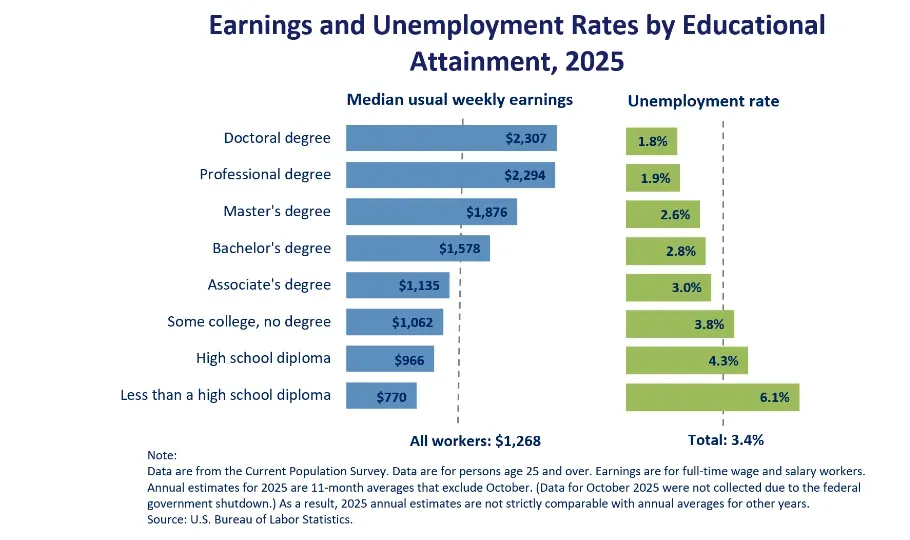 Figure 4: Median weekly earnings climb with each level of schooling and unemployment falls, but the chart counts only highest degree, not apprenticeships or on-the-job training. Source: Bureau of Labor Statistics, Education Pays, Aug 2026. Chart published by the source, cropped from a screenshot of the page, captured 20 Oct 2026.
What do workers earn at each level of education?
- Workers with a bachelor’s degree earned a median $1,578 a week in 2025, with 2.8% unemployment (Bureau of Labor Statistics, Aug 2026).
- Associate degree holders earned $1,135 a week, with 3.0% unemployment (Bureau of Labor Statistics, Aug 2026).
- Workers with some college and no degree earned $1,062, with 3.8% unemployment (Bureau of Labor Statistics, Aug 2026).
- High school graduates earned $966, with 4.3% unemployment (Bureau of Labor Statistics, Aug 2026).
- All workers earned $1,268 a week, with 3.4% unemployment (Bureau of Labor Statistics, Aug 2026).
- Jobs that typically start with a postsecondary nondegree award had a 2025 median wage of $49,910, against $48,050 for jobs that start with a high school diploma (BLS Employment Projections, Sep 2026).
- Jobs that start with an associate degree had a median wage of $64,990 across 3.55 million jobs (BLS Employment Projections, Sep 2026).
- Jobs that start with a bachelor’s degree had a median wage of $96,480 (BLS Employment Projections, Sep 2026).
- Jobs that start with some college and no degree are projected to shrink 3.2% by 2035 (BLS Employment Projections, Sep 2026).
What do certificate and associate completers earn?
The federal College Scorecard tracks people who finished a program and took federal aid. The figures are national medians for working graduates who were not enrolled in school, measured in 2022 and 2023.
- Electrical and power transmission installer certificate completers earned a median $55,923 five years after finishing (U.S. Department of Education, College Scorecard, Oct 2026).
- Associate degree completers in the same field earned $55,611 after one year and $71,513 after five (U.S. Department of Education, College Scorecard, Oct 2026).
- Precision metal working certificate completers, a group that includes welders, earned $42,421 after one year across 25,811 working graduates (U.S. Department of Education, College Scorecard, Oct 2026).
- Their five-year median was $51,060 (U.S. Department of Education, College Scorecard, Oct 2026).
- Cosmetology certificate completers earned $23,574 after one year across 129,761 working graduates (U.S. Department of Education, College Scorecard, Oct 2026).
- Associate degree nurses earned $75,149 after one year (U.S. Department of Education, College Scorecard, Oct 2026).
- Bachelor’s graduates in biology earned $36,562 after one year and $64,695 after five (U.S. Department of Education, College Scorecard, Oct 2026).
- Psychology bachelor’s graduates earned $54,104 after five years (U.S. Department of Education, College Scorecard, Oct 2026).
- English bachelor’s graduates earned $36,147 after one year (U.S. Department of Education, College Scorecard, Oct 2026).
- Communication and media bachelor’s graduates earned $42,882 after one year (U.S. Department of Education, College Scorecard, Oct 2026).
- Criminal justice bachelor’s graduates earned $43,365 after one year (U.S. Department of Education, College Scorecard, Oct 2026).
- Business administration bachelor’s graduates earned $55,206 after one year (U.S. Department of Education, College Scorecard, Oct 2026).
- Computer and information sciences bachelor’s graduates earned $70,762 after one year (U.S. Department of Education, College Scorecard, Oct 2026).
How are recent college graduates doing?
- The unemployment rate for recent college graduates stayed near 5.6% in the second quarter of 2026 (Federal Reserve Bank of New York, Aug 2026).
- 75% of college graduates say their degree was critical or important to reaching their career goals, but the share is 80% for bachelor’s holders and 56% for associate holders (Gallup, Feb 2026).
- 71% of recent bachelor’s graduates say they landed a good job within six months (Gallup, Feb 2026).
What Do Skilled Trade Jobs Pay?
Pay in the building and repair trades is solid for a path that asks for a high school diploma and training on the job. Several of the best-paid jobs also have flat or falling headcount, so entry is not the same as growth.
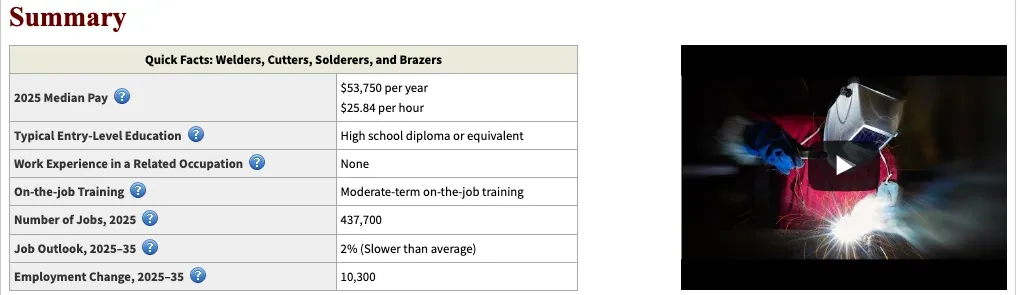 Figure 5: The Occupational Outlook Handbook lists pay, entry education, training, headcount and outlook for each job on one table, shown here for welders. Source: Bureau of Labor Statistics, Occupational Outlook Handbook: Welders, Cutters, Solderers, and Brazers, Aug 2026. Screenshot of the source page with the summary table cropped, captured 20 Oct 2026.
What do jobs learned through apprenticeship pay?
- Boilermakers had a 2025 median wage of $76,410, and the job is entered through an apprenticeship (BLS Occupational Outlook Handbook, Aug 2026).
- Ironworkers earned $61,910 (BLS Occupational Outlook Handbook, Aug 2026).
- Sheet metal workers earned $61,800 across 131,100 jobs (BLS Occupational Outlook Handbook, Aug 2026).
- Masonry workers earned $58,270 across 277,700 jobs (BLS Occupational Outlook Handbook, Aug 2026).
What do jobs that start with a certificate or short training pay?
- Welders earned $53,750 across 437,700 jobs (BLS Occupational Outlook Handbook, Aug 2026).
- Machinists and tool and die makers earned $59,620 across 344,900 jobs (BLS Occupational Outlook Handbook, Aug 2026).
- Automotive service technicians earned $50,620 across 825,800 jobs, and a postsecondary nondegree award is the typical way in (BLS Occupational Outlook Handbook, Sep 2026).
- Solar photovoltaic installers earned $53,140 across 31,100 jobs (BLS Occupational Outlook Handbook, Aug 2026).
- Small engine mechanics earned $49,710 (BLS Occupational Outlook Handbook, Aug 2026).
- Barbers, hairstylists and cosmetologists earned $35,880 across 670,800 jobs (BLS Occupational Outlook Handbook, Aug 2026).
- Construction and building inspectors earned $74,690, and the job asks for five years or more of related experience (BLS Occupational Outlook Handbook, Aug 2026).
Where is the work growing?
- Solar photovoltaic installer jobs are projected to grow 37% from 2025 to 2035, or 11,300 jobs (BLS Occupational Outlook Handbook, Aug 2026).
- Aircraft and avionics mechanics are projected to add 9,400 jobs, 6% growth (BLS Occupational Outlook Handbook, Aug 2026).
- Automotive service technician jobs are projected to grow 5%, or 40,900 jobs (BLS Occupational Outlook Handbook, Sep 2026).
- Welding has about 40,300 openings a year, mostly from workers who leave or retire (BLS Occupational Outlook Handbook, Aug 2026).
- Boilermaker jobs are projected to fall 2% (BLS Occupational Outlook Handbook, Aug 2026).
- Machinist and tool and die maker jobs are projected to fall 1% (BLS Occupational Outlook Handbook, Aug 2026).
When a trade pays this much, the price list has to cover wages, truck time and parts. A shop that quotes by feel will give away margin on every job.
How Much Student Debt Do Americans Carry?
Cost is the reason many families look at trade training first. Debt is also where the college path carries the most risk, and the bill is coming due for millions of borrowers.
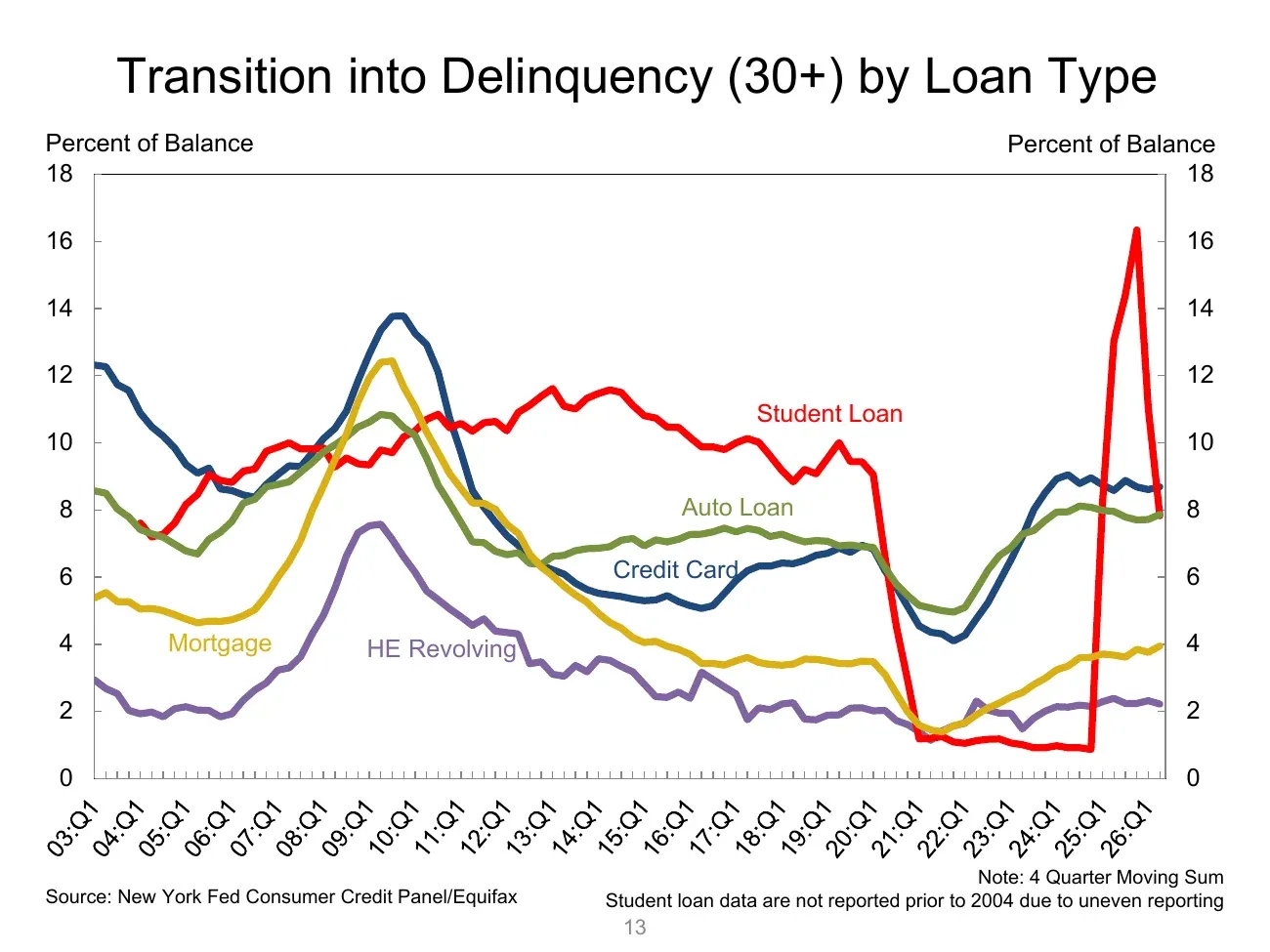 Figure 6: Student loan late-payment transitions fell to near zero during the repayment pause, then spiked to about 16% in 2025 once reporting resumed and had eased to about 8% by 2026. Source: Federal Reserve Bank of New York, Household Debt and Credit Report Q2 2026, Aug 2026. Chart published by the source, rendered from the report PDF, captured 20 Oct 2026.
How big is the total?
- Student loan balances fell $7 billion in the quarter and rose $13 billion over the year (Federal Reserve Bank of New York, Aug 2026).
- The share of student loan balances newly turning 90 days late fell from 12.88% to 7.83% over the year (Federal Reserve Bank of New York, Aug 2026).
- Federal student loans had 42.3 million recipients as of June 30, 2026 (Federal Student Aid, Jun 2026).
Who has the debt?
- 16% of all US adults had student loans in 2025 (Federal Reserve Board, May 2026).
- Among adults who attended at least some college, 21% had loans (Federal Reserve Board, May 2026).
- Only 5% of adults with a high school degree or less had student loans (Federal Reserve Board, May 2026).
- 81% of adults with student loans borrowed for their own education (Federal Reserve Board, May 2026).
- 45% of borrowers were not required to make a payment at the time of the survey (Federal Reserve Board, May 2026).
- 23% of borrowers had recent payment difficulty (Federal Reserve Board, May 2026).
What does school cost?
- Public two-year colleges charged an average $4,150 in tuition and fees for 2025-26, up $110 (College Board, Nov 2025).
- Public four-year colleges charged $11,950 for in-state students (College Board, Nov 2025).
- Private nonprofit four-year colleges charged $45,000 (College Board, Nov 2025).
- Two-year tuition ranged from $1,440 in California to $8,900 in Vermont (College Board, Nov 2025).
- First-time full-time students at public two-year colleges have received enough grant aid to cover tuition and fees since 2009-10 (College Board, Nov 2025).
How does debt change life choices?
- 52% of college graduates who still have student loans say the loans delayed a major life decision (Gallup and Lumina Foundation, May 2026).
- 49% of associate degree borrowers and 53% of bachelor’s borrowers report a delay (Gallup and Lumina Foundation, May 2026).
- About a third (32%) of graduates who borrowed under $10,000 still delayed a milestone (Gallup and Lumina Foundation, May 2026).
- More than eight in ten borrowers worry about making payments, including 78% of those who owe under $10,000 (Gallup and Lumina Foundation, May 2026).
- Only 11% of bachelor’s graduates say four-year colleges charge fair prices (Gallup and Lumina Foundation, May 2026).
How Do Americans See Trade Training and College?
Most parents still prefer college, but cost drives much of the doubt. Trade training is a real choice for a sizable minority.
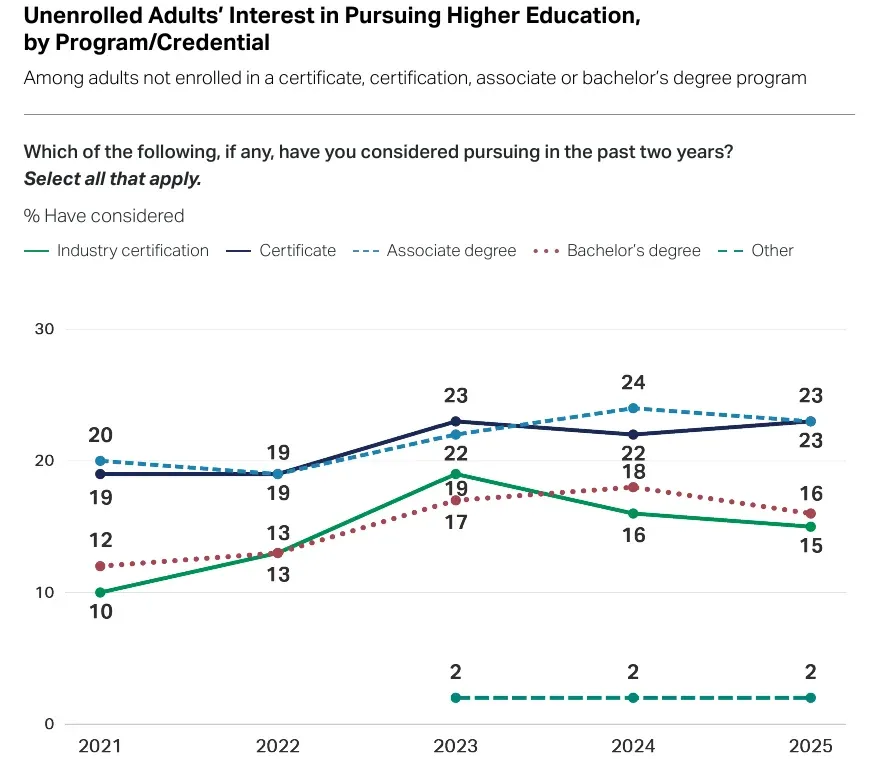 Figure 7: Unenrolled adults consider certificates and associate degrees more often than bachelor’s degrees, and industry certifications are close behind. Source: Lumina Foundation and Gallup, The State of Higher Education 2026, May 2026. Chart published by the source, cropped from the report PDF, captured 20 Oct 2026.
What do parents want for their children?
- 38% of parents most prefer a four-year college, 19% a two-year college, 14% time off, 7% going straight to work and 5% the military (Gallup, Jul 2026).
- Republican parents were more than twice as likely as Democratic parents to prefer a job training or certification program, 24% against 10% (Gallup, Jul 2026).
- Among parents who do not want a four-year college for their child, 33% said it costs too much (Gallup, Jul 2026).
- 17% of those parents cited doubts about return on investment (Gallup, Jul 2026).
- 11% said they would rather see their child take a skilled trade job (Gallup, Jul 2026).
- 11% named debt or loans (Gallup, Jul 2026).
- In 2025, 23% of adults without children under 18 preferred job training or certification for a young person they know, against 16% of parents (Gallup, Aug 2025).
- 59% of parents in 2025 wanted their child to go to college right after high school (Gallup, Aug 2025).
How do all Americans rate two-year and four-year colleges?
- 63% of adults say four-year colleges do a poor job on affordability (Gallup, Jul 2026).
- 54% rate two-year colleges excellent or good on affordability (Gallup, Jul 2026).
- 52% rate two-year colleges excellent or good on workforce preparation (Gallup, Jul 2026).
- 68% rate two-year colleges well on access for people from all backgrounds (Gallup, Jul 2026).
- Only 22% say a four-year degree is worth the cost even if someone has to take out loans, and 29% say it is not worth the cost (Pew Research Center, May 2024).
- 49% say a four-year degree matters less for a well-paying job than it did 20 years ago (Pew Research Center, May 2024).
- 54% of workers aged 25 to 34 did not have a four-year degree in 2023 (Pew Research Center, May 2024).
- In metro areas, 37.8% of adults 25 and over held a bachelor’s degree in 2020-2024, up from 34.2% in 2015-2019 (U.S. Census Bureau, Jan 2026).
What do adults without a degree and employers say?
- 58% of adults without a degree considered a credential or degree in the past two years (Gallup and Lumina Foundation, May 2026).
- Interest was 69% among those who stopped out and 43% among those who never enrolled (Gallup and Lumina Foundation, May 2026).
- 66% of adults aged 18 to 25 without a degree had considered one, against 52% of those aged 36 to 59 (Gallup and Lumina Foundation, May 2026).
- 23% were considering a certificate or associate degree, 16% a bachelor’s degree and 15% an industry certification (Gallup and Lumina Foundation, May 2026).
- Only 25% say all or most people can get a quality, affordable education after high school, down 10 points since 2023 (Gallup and Lumina Foundation, May 2026).
- People who enrolled in certificate programs gave a quicker path to a job as their top reason, at 22% (Gallup and Lumina Foundation, May 2026).
- 20% cited eligibility for local jobs (Gallup and Lumina Foundation, May 2026).
- 55% of employers often hire people who finished short-term training (Gallup and Lumina Foundation, May 2026).
- 74% of employers say it is valuable for new hires to have done short-term training (Gallup and Lumina Foundation, May 2026).
- Even for roles that do not require a degree, 76% of employers prefer a bachelor’s degree and 78% prefer an associate degree (Gallup and Lumina Foundation, May 2026).
What Does Workforce Pell Change?
Federal money now reaches short programs, but only the ones that pass hard outcome tests. That is a big change for any school that teaches a trade in a few months.
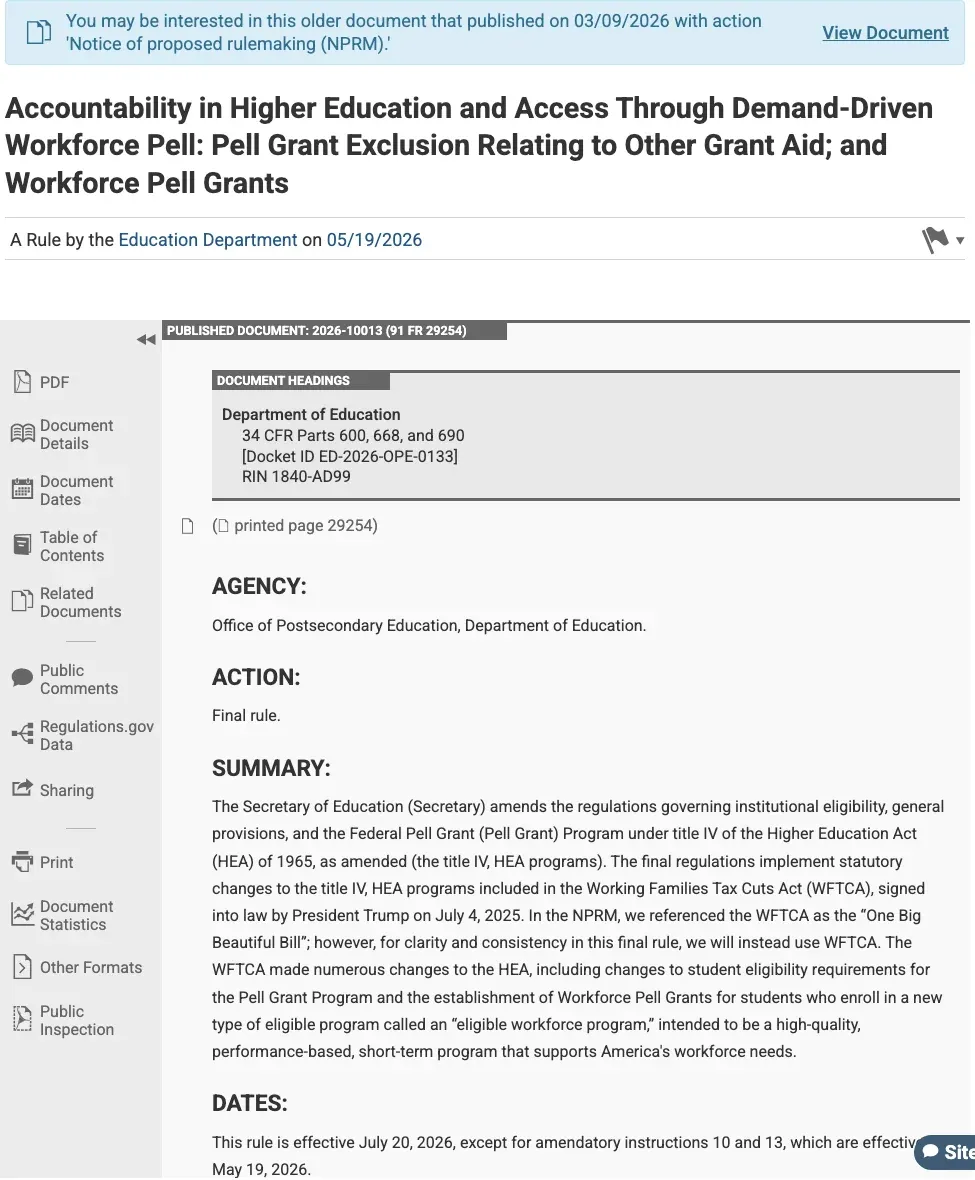 Figure 8: The Department of Education’s final rule sets up Workforce Pell Grants for short programs under a law signed July 4, 2025. Source: Federal Register, Accountability in Higher Education and Access Through Demand-Driven Workforce Pell, May 2026. Screenshot of the source page, captured 20 Oct 2026.
Which programs qualify?
- A qualifying program must last at least 8 weeks but less than 15 weeks of instruction (Federal Register, May 2026).
- A Governor and the Secretary of Education must both approve each program (Federal Register, May 2026).
- A program’s tuition and fees may not exceed the value-added earnings of the program (Federal Register, May 2026).
What outcomes must programs hit?
- For the first three award years, a program must show a completion rate of at least 70% within 150% of normal time (Federal Register, May 2026).
- It must also show a job placement rate of at least 70% (Federal Register, May 2026).
When does it start, and what does it cost?
- The rule took effect on July 20, 2026, with early use allowed from July 1, 2026 (Federal Register, May 2026).
- The Department of Education estimates a net budget impact of $3.2 billion from fiscal year 2027 to 2036 (Federal Register, May 2026).
Does High School Career Training Help?
High school career and technical education is common, but it is not a lane that skips college. The federal data show it shifts students toward associate degrees.
 Figure 9: Students who took a focused set of career and technical courses were more likely to end with an associate degree and less likely to end with a bachelor’s degree or higher. Source: National Center for Education Statistics, Career and Technical Education in the United States, May 2024. Screenshot of the source page, captured 20 Oct 2026.
What happens to students who focus on career courses?
- Among 2013 public high school graduates who enrolled in college by June 2021, 14% of career and technical education concentrators had an associate degree as their highest degree, against 9% of other students (National Center for Education Statistics, May 2024).
- 48% of concentrators ended with a bachelor’s degree or higher, against 54% of other students (National Center for Education Statistics, May 2024).
Who teaches it?
- In 2020-21, 31% of public schools hiring for a career and technical education position had trouble filling it (National Center for Education Statistics, May 2024).
- 24% of public schools with an opening hired in the career and technical field, up from 20% in 2011-12 (National Center for Education Statistics, May 2024).
- 11% of public school teachers in grades 9 to 12 taught career and technical education as their main assignment (National Center for Education Statistics, May 2024).
- 13% of those teachers had less than a bachelor’s degree, against 2% of all teachers (National Center for Education Statistics, May 2024).
Methodology and Sources
We chose each figure from the agency, regulator or research group that produced it. We opened every link, checked that the number sits on that page or file, and wrote down the date of the data. Where a number comes from a data file, such as the federal completions file or the College Scorecard file, we say so and add the figures ourselves; those are marked “by our count” or described as sums. Survey results come from the organizations that ran the surveys. We did not use roundups. Pay and employment figures for the trades come from the Bureau of Labor Statistics, and we left out the HVAC, plumbing and electrician trades because they have their own pages. This page is updated monthly.
Glossary
- Apprenticeship: paid on-the-job training with classroom study, usually tied to a wage scale.
- Registered Apprenticeship: an apprenticeship program approved by the US Department of Labor or a state agency.
- Associate degree: a two-year college degree.
- Certificate: a short college award, from a few weeks to two years.
- CTE: career and technical education, the school term for job-focused courses.
- CIP: the federal Classification of Instructional Programs, used to sort fields of study.
- IPEDS: the Integrated Postsecondary Education Data System, the federal college data survey.
- Middle-skills job: a job that needs more than high school but less than a bachelor’s degree.
- NSC: the National Student Clearinghouse.
- Underemployment: working in a job that does not usually need a college degree.
- WFTCA: the Working Families Tax Cuts Act, the 2025 law that created Workforce Pell.
Sources
- National Student Clearinghouse Research Center, Final Spring Enrollment Trends, Jun 2026
- National Student Clearinghouse Research Center, Spring 2026 CIP appendix, Jun 2026
- National Student Clearinghouse Research Center, Final Fall Enrollment Trends, Jan 2026
- National Student Clearinghouse Research Center, Persistence and Retention, Jun 2026
- National Center for Education Statistics, IPEDS Completions 2023-24, Sep 2025
- National Center for Education Statistics, Career and Technical Education in the United States, May 2024
- Georgetown University Center on Education and the Workforce, Bridging the Middle-Skills Gap, Jun 2025
- U.S. Department of Education, College Scorecard Field of Study data, Oct 2026
- Apprenticeship.gov, Apprentice Completion Rate Analysis, Oct 2026
- Apprenticeship.gov, home page, Dec 2025
- Apprenticeship.gov, industry pages, Oct 2026
- U.S. Department of Labor, ApprenticeshipUSA Factsheet, Aug 2026
- The White House, Executive Order 14278, Apr 2025
- Bureau of Labor Statistics, Education Pays, Aug 2026
- Bureau of Labor Statistics, Employment Projections table 5.2, Sep 2026
- Bureau of Labor Statistics, Occupational Outlook Handbook, Aug 2026
- Federal Reserve Bank of New York, Household Debt and Credit Report, Aug 2026
- Federal Reserve Bank of New York, The Labor Market for Recent College Graduates, Aug 2026
- Federal Reserve Board, Economic Well-Being of U.S. Households in 2025, May 2026
- Federal Student Aid, Portfolio Summary, Jun 2026
- College Board, Trends in College Pricing and Student Aid 2025, Nov 2025
- Gallup and Lumina Foundation, The State of Higher Education 2026, May 2026
- Gallup and Lumina Foundation, Alumni Report, May 2026
- Gallup, Just 12% of Americans Say Four-Year Colleges Are Affordable, Jul 2026
- Gallup, College Students, Grads See Strong Career Value in Degree, Feb 2026
- Gallup, Most Parents Prefer College Pathway for Their Child, Aug 2025
- Pew Research Center, Is College Worth It?, May 2024
- U.S. Census Bureau, Metro and Micro Areas Have Large Gains in Educational Attainment, Jan 2026
- Federal Register, Workforce Pell final rule, May 2026